
In the wave of Brazilian series that blend humor with social critique, Jogo Cruzado (Cross Play), a Disney+ original, hits the mark by using football as a backdrop — but not its central theme. In this story, the real field is television, the game is vanity, and the protagonists are two clashing egos: Matheus Reis, a former player turned media personality, and Elisa Montes, a brilliant yet underestimated sports journalist. Thrown together — or rather, set face to face — on a live show that thrives on conflict, they must perform for ratings.
If Brazilian football has long since evolved into a spectacle beyond the pitch, sports shows have also outgrown mere tactics and stats. The series takes direct inspiration from the debate panels where former athletes express opinions and journalists must dodge daily machismo with a mix of cynicism and patience. All of this is in Jogo Cruzado. And behind this calculated clash lies a quiet figure pulling the strings: Suzana Hartman.
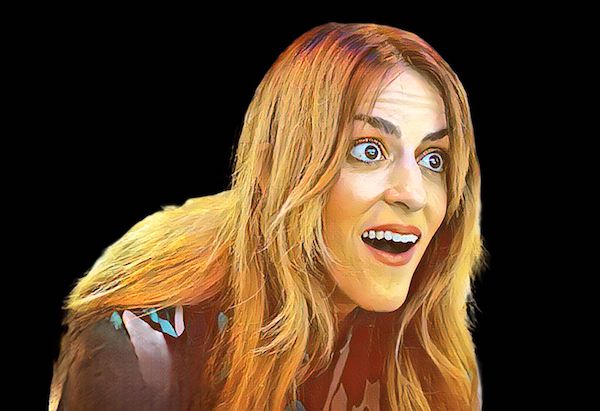
Played with razor-sharp precision by Luciana Paes, Suzana is the heiress and producer of Antena Sport, the TV network. She doesn’t show up often, doesn’t argue — but she has the power to decide who shines, who falls, and what goes on air. Suzana is a portrait of a generation of women who learned to lead from behind the curtain, who prefer to move the chessboard rather than fight for a piece. She sees in Matheus and Elisa the perfect chemistry: a shouting match between a fallen pretty boy and a sharp woman tired of being invisible. To her, it’s gold. To them, punishment. To the audience, pure tension.
It’s striking how Luciana Paes, known for her fluidity between drama and the absurd (Invisible City, Boca a Boca), opts here for cold restraint. Suzana is elegant and tough. Warm only when it suits her. She doesn’t need to raise her voice — her authority lies in her meticulously calculated silences. Her screen time is brief, but in those moments, it becomes clear who truly runs the show: the producers, the network owners, those who know scandal drives ratings, and that every crisis, if well-edited, becomes a promo.
Behind the scenes, the character of Suzana came from the writers’ desire to portray the real power players behind Brazilian sports TV — often men, but increasingly women who wield politics like a spreadsheet full of ratings. Suzana doesn’t want to change the world — she wants results. And perhaps that’s what makes her so fascinating: she represents a new kind of female power, one that doesn’t apologize for ambition.
In an exclusive interview with CLAUDIA, Luciana Paes shared how she built this woman who’s neither a villain nor a sweetheart. We talked about her career, the process, and the thrill of playing someone who sees the whole game — even while pretending to watch from the sidelines. Because Suzana Hartman may not be on the billboard, but she’s the one deciding who gets on it. And Luciana, with cool brilliance, delivers one of the season’s most compelling characters.
CLAUDIA: Suzana Hartman is an ambitious, strategic character. What was it like for you to build this woman who manipulates things behind the scenes of a sports network? Did she challenge you in any way?
LUCIANA: So, Suzana Hartman might come off as manipulative, right? But one of the things I really tried to avoid was playing her as overtly manipulative. To me, she’s a mystery, and I think she ends up manipulating people because you never quite know how she’ll react. Will she be in a good mood? Will she find something funny? Will she fire someone? She’s unpredictable, and I think that unpredictability keeps everyone walking on eggshells around her.
Of course, some people are consciously manipulative. But others just end up controlling a room with their emotional instability. I wanted us to wonder if Suzana is just a madwoman who got lucky, who stumbles into success — or if she’s truly a master strategist. I still have my doubts.
CLAUDIA: Your character bets on conflict as a strategy for ratings. In your view, how much does Suzana actually believe in what she’s doing — and where does her personal ambition come in?
LUCIANA: She’s got this small-town background and didn’t go to the same fancy international schools as her brother. She built her confidence on content. Like, “Yeah, I’m from the countryside, I took a different path — you call me tacky? Fine, I’ll own that.” She embraces her story. I don’t think there’s anything shameful about it, but it could be compared to her brother’s, right? Since she’s the illegitimate daughter, she turns that into her bargaining chip.
She’s definitely ambitious, I’d say she craves power, but she also has fun with it. And that “not taking things too seriously” is part of her success. A lot of what she wants to achieve is about rubbing it in her brother’s face. Her own way, her own path — and yet she managed to outshine him, to be more accepted by their father’s company than he ever was.
There’s a family vengeance vibe to it. Not just toward her brother, but the whole side of the family that thought, “Oh, she’s just a tacky country girl with no taste.”
CLAUDIA: The show touches on topics like sexism in sports journalism and celebrity culture. As an actress, what drew you most to this world of egos, media, and football?
LUCIANA: I got lucky, honestly, because my character, Suzana Hartman, doesn’t know much about football. I come from a family where football wasn’t a religion. My dad was an atheist engineer. I believed in God but didn’t believe in football [laughs]. I love playing ping-pong, but I don’t root for any team — just during the World Cup [laughs]. But I do think sports are beautiful! I love playing football, but I just don’t really understand it.
And like everything that involves power, ego, media — I find that super, super interesting. You get to see how people are in front of the cameras versus behind them. It gives you this rich chance to portray characters in very different emotional states, and that’s fascinating to me.

CLAUDIA: Was there any special preparation for playing someone in the executive world of sports TV? Did you draw inspiration from any real media figure?
LUCIANA: I didn’t base her on any real media figure, but one really cool thing was that we got to visit ESPN and observe how content is produced there. I spent a couple of afternoons shadowing their newsroom, watching how the journalists and producers work in the football world.
CLAUDIA: How is Jogo Cruzado different in terms of tone and approach?
LUCIANA: I actually worked in radio at the beginning of my career, so it wasn’t a completely unfamiliar world to me. But it was really great to explore this universe. I’m also fascinated by women in football, because it’s still such a male-dominated space. And since I didn’t grow up around it, I’m always curious — like, what drives Carol Castro’s character in the show? It’s super interesting.
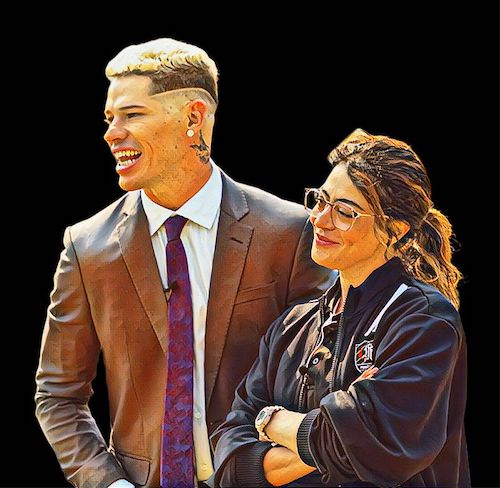
CLAUDIA: What was it like behind the scenes with Carol Castro and José Loreto, who are at the center of the story’s conflict? Was there a scene that particularly stuck with you?
LUCIANA: Well, just look at them! Each of them has borogodó (that untranslatable spark), and together they have double borogodó! It’s an explosion of charm! [laughs] We filmed this show like it was the World Cup finals — right when we started shooting, Loreto injured his foot and, if I remember correctly, needed surgery. Then Carol also got injured. They’re both actors who take their work seriously, you know? They got hurt like real football players.
So the filming was a bit chaotic because of that — both “team captains” were out of commission. But aside from that, it was an amazing shoot! I’m proud to be part of this team, led by Pedro Amorim and Maria Farkas. Truly, it’s a team of all-stars!
Descubra mais sobre
Assine para receber nossas notícias mais recentes por e-mail.
 miscelana.com