
When Madonna announced she would make her own biopic, it surprised no one that she would also write and direct the project herself. She has never been one to give up control — and telling her own story would be no different. At first, she worked with Oscar-winning screenwriter Diablo Cody on a draft script provisionally titled Live to Tell, named after one of her most confessional songs.
Diablo Cody is an American screenwriter who won an Academy Award for Juno (2007), a film that won over both audiences and critics with its sharp, comedic, and sensitive style. Since then, Cody has stood out as an auteur voice in Hollywood, also penning the scripts for Young Adult and Tully (both directed by Jason Reitman and starring Charlize Theron), and the series United States of Tara (produced by Steven Spielberg).
When Madonna invited Diablo Cody to collaborate on the screenplay of her biopic, the announcement generated excitement. The expectation was that Cody, with her provocative and distinctly female writing style, could help shape an honest and creative portrait of the Queen of Pop.
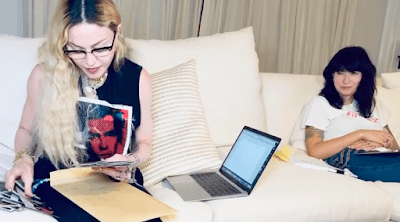
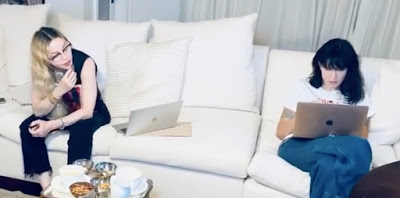
However, the partnership didn’t last long. According to American media outlets (such as The Hollywood Reporter and The Wrap), the collaboration between Madonna and Cody was difficult from the beginning. The main issue was Madonna’s level of control: she didn’t just want to participate — she wanted to decide everything — structure, dialogue, tone, and narrative focus. Cody, used to a degree of creative autonomy, reportedly became frustrated with the constant impasses and shifting direction.
After Cody’s departure, the project entered a kind of creative limbo. In 2021 and 2022, Madonna worked with Erin Cressida Wilson, screenwriter of The Girl on the Train and author of plays and scripts that explore complex female characters. Wilson took over the task of continuing the script’s development, this time with Madonna retaining primary credit as co-writer and director. The film was then renamed Who’s That Girl.
Even so, the script continued undergoing rewrites, and the project was ultimately postponed indefinitely in 2023, when Madonna decided to focus entirely on her Celebration Tour. But before that, even casting was underway, and the search for the actress who would play Madonna became a rigorous, almost mythical process in Hollywood.
Studios knew that even though Madonna was no longer at her artistic or commercial peak, her legacy and global appeal could still yield a lucrative biopic. The “battlefield” was intense: names like Florence Pugh, Odessa Young, Alexa Demie, and Bebe Rexha were reportedly tested. But it was Julia Garner, known for her award-winning role in Ozark and praised for Inventing Anna, who landed the part.

Garner had to work hard to get it. In a recent interview on the SmartLess podcast, she revealed that she went through an exhausting audition process, with singing, dancing, and acting tests — all in front of Madonna herself. Since she’s not a trained dancer, she had to convince the pop icon (and herself) that she could handle it. She said she walked into the room thinking: “What would Madonna do?” The answer? “She would walk in like she already owned the place.” That’s the energy Julia projected — and it worked.
Despite the initial enthusiasm, when the project was paused in 2023, many assumed it had been shelved. Since then, rumors have surfaced that the project — originally planned as a feature film — is being reworked into a Netflix miniseries, produced by Shawn Levy (Stranger Things, The Adam Project), with Julia Garner still attached to the role.
But the question that lingers now is: does it still make sense to revisit Madonna as a cultural phenomenon in the present?
Madonna, the artist, holds undeniable historical relevance. Her impact in the ’80s and ’90s redefined the boundaries of pop culture, fashion, sexuality, and performance. But Madonna, the current public figure, has become a victim of her own obsession with control and youth. Plastic surgeries, incoherent social media appearances, and erratic performances have overshadowed her ability to connect with a new generation. The cultural impact of her work has been diluted by the noise of her persona.

Moreover, authorized biopics often face a difficult obstacle: the need to please the subject. In Madonna’s case, that pressure is multiplied. There are precedents. Elton John‘s Rocketman is a rare exception in terms of artistic freedom and honesty. By contrast, films like Bohemian Rhapsody (about Queen) were criticized for eliminating uncomfortable facts, altering timelines, and smoothing over conflicts. With Madonna directing her own project, the risk of an overly editorialized, self-centered, revisionist narrative is almost a given.
Julia Garner is an actress with the potential to deliver a remarkable performance. And a well-produced miniseries could truly dive into the complex layers of Madonna: the artist, the woman, the icon, the product. But only if it’s honest. The big question is: Is Madonna willing to look at herself without a filter? Because if she isn’t, this project may only serve to confirm what many already fear — that today’s Madonna has lost touch with the Madonna who once transformed the world.
Descubra mais sobre
Assine para receber nossas notícias mais recentes por e-mail.
 miscelana.com