
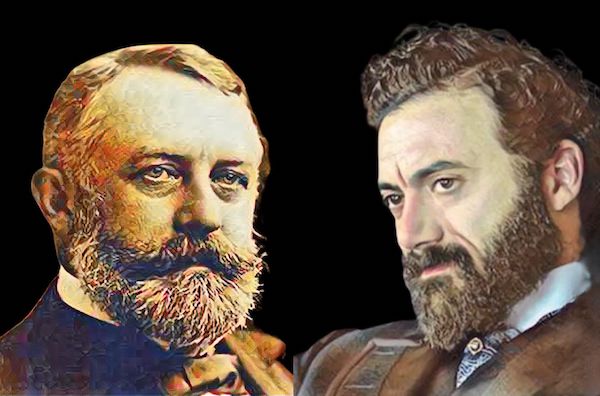
From the very beginning of The Gilded Age, George Russell has stood out as the most fascinating portrait of America’s new industrial elite — not only because of his commanding presence or immense fortune, but because the series builds, with patience and care, a character who embodies all the contradictions of the Gilded Age. Now, with his business on the verge of collapse, amid internal betrayals and calculated risks spiraling out of control, it becomes even clearer that George is not just a dramatic figure: he is a direct mirror of real-life robber barons — men like Henry Clay Frick, who, by the way, survived an assassination attempt, led a war against striking workers, built a palace on Fifth Avenue, and ended his days as a patron of classical art. The resemblance is so striking that it seems almost prophetic that HBO had the cast of The Gilded Age pose inside The Frick Collection — the New York museum that now occupies Frick’s former mansion. It was all there, announced from the beginning.

Frick was born in 1849 in rural Pennsylvania and made his fortune in the coke industry, essential for steel production. He became Andrew Carnegie’s most feared partner, responsible for ruthless cost-cutting measures and labor repression. His name became forever linked to the Homestead Strike of 1892, when he hired armed Pinkerton agents to crush striking workers who had taken over a Carnegie Steel mill. The clash turned into a massacre. Days later, Alexander Berkman, a young Russian anarchist, entered Frick’s office in Pittsburgh and shot him twice at point-blank range — and stabbed him three more times. Frick not only survived, he refused to be taken to the hospital immediately. He continued giving orders, his suit soaked in blood, as if nothing had happened. Far from destroying him, the assassination attempt cemented his reputation as an unbreakable man. Ironically, it was also the turning point that solidified his public image as a villain — and forced him to seek redemption, or at least a nobler legacy.
Decades later, he built his definitive mansion in New York, on the corner of Fifth Avenue and 70th Street, facing Central Park. He had limestone brought in from Indiana, hired renowned architect Thomas Hastings, and filled the grand halls with paintings by Rembrandt, Vermeer, Goya, and Velázquez. Nothing was accidental: Frick wanted to be remembered not only as an industrial titan, but as a patron of Western civilization. When he died in 1919, his home became what is now The Frick Collection, one of New York’s most prestigious museums. A monument to power transformed into culture.

George Russell, of course, is not Henry Clay Frick — but the show feeds off his myth. Like Frick, George is a self-made man who sees the financial system as a game to be won with cold logic and calculated risk. He is feared by his competitors, ruthless with his allies, and driven not just by a desire to get rich, but to be accepted, respected, and elevated. His wife, Bertha, is his partner in that mission — and a force of her own. Together, they build not just a mansion, but a narrative of ascension. In the most recent episodes, as George faces a financial storm threatening to wipe out his empire, the tension doesn’t come just from the money — but from identity. What happens when a man who built everything with his own hands realizes he might lose it all because of someone else’s ambition? And what will he do to stop it?
This is where the parallel with Frick stops being decorative and becomes structural. Just as Frick faced his moment of crisis with a mix of rigidity, coldness, and brutality — and survived — George’s arc seems to be heading in the same direction. The writers know this. Which is why the season’s promotional campaign used the interior of The Frick Collection as its backdrop. It’s not just beautiful or luxurious. It’s symbolic. It’s the palace of the baron who survived bullets, insults, strikes, and scandals — and turned his dirty fortune into eternal art.
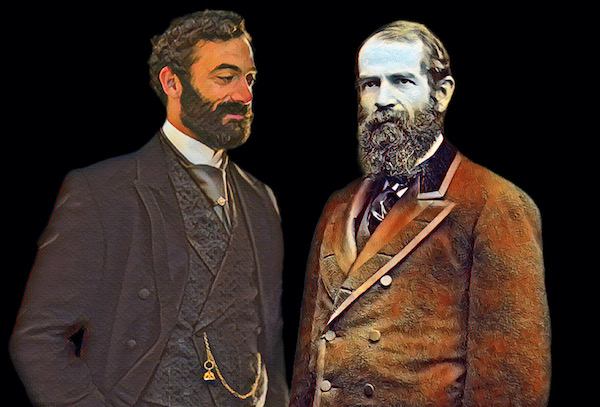
Yes, indeed, George was initially designed as a composite of the great American capitalist titans — with clear echoes of Jay Gould, William H. Vanderbilt, and even the Rockefellers. Jay Gould was the brilliant, ruthless, and widely hated speculator — the kind who manipulated railroads and stocks with mathematical coldness. William Vanderbilt inherited and expanded his family’s railroad empire with a “business is business” mindset that resonates in George, though without the same urgency and social aspiration the show captures so well. These men do serve as a backdrop, yes. But the emotional core of George’s construction — the desire for acceptance, the direct confrontation with labor, the transformation of raw power into lasting legacy — all of that belongs, much more clearly, to Frick’s trajectory.
Frick combines the provincial roots and voracious instinct of Gould with Vanderbilt’s aristocratic ambition. But he offers something more: a tragic and grand narrative arc — with an assassination attempt, blood, survival, downfall, and reinvention. That’s exactly the arc George seems destined to follow. He’s being shaped, episode by episode, not just as a symbol of new money — but as someone who, even when rejected, even when threatened, refuses to disappear. A man who wants to be remembered, who wants to leave something more enduring than numbers.

If Henry Clay Frick managed to emerge from his era with his name etched in marble and gilded frames, George Russell is fighting, day by day, to ensure his own isn’t erased by mud. Even if, to do so, he has to become exactly what his enemies always said he was. And perhaps, in the end, that’s precisely what will make him unforgettable.
Descubra mais sobre
Assine para receber nossas notícias mais recentes por e-mail.
 miscelana.com