
As published on Bravo Magazine
If 2025 has already brought us some major productions, few have impacted me as much as Alien: Earth. I’d place the series on the same level as Andor, which I still consider the best production of the year so far. And this, I must confess, comes from someone who is not particularly a fan of sci-fi—much less sci-fi horror. The Alien creature has always disgusted and disturbed me. It’s given me nightmares since childhood, when I was too young to see Ridley Scott’s original film in theaters, but vividly remember my brother returning home, euphoric, and describing every scene in detail. To this day, the 1979 film remains impactful—and Alien: Earth is not just a grand homage to that legacy. It carries a particular weight, managing to be a visual and narrative spectacle grounded in a universe we already know, yet presented in a radically new way.
I’ve seen six of the eight episodes of the first season—and honestly, each one feels like a feature-length film. A high-budget, cinematic experience with sharp direction, immersive pacing, and an emotional and aesthetic density that’s rarely this consistent in science fiction series. The feeling is one of witnessing something monumental—a production that respects the audience’s intelligence while honoring one of the most iconic legacies in sci-fi cinema: the Alien universe.
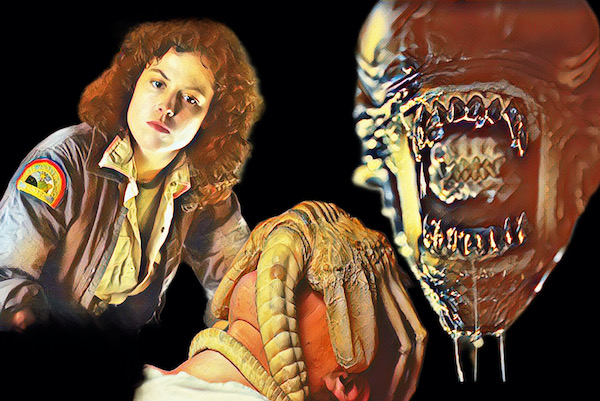
With more than four decades of history, Scott’s film became a franchise and cemented itself as a pillar of sci-fi and horror, marked by its dark aesthetics, futuristic social critiques, and, above all, by its intense and unforgettable female characters. The series, created by Noah Hawley and executive produced by Ridley Scott, keeps that tradition alive, but the xenomorph mythos is given new dimensions and dangers.
An Origin Story… on Earth
The show’s premise is bold and, in a way, surprising: to bring the Alien mythology to planet Earth. But this is no simple spin-off or ordinary prequel. Alien: Earth functions as a kind of expanded origin story, set decades before the events of the original film, in a near future where humanity is already under the growing control of massive corporations—of course, with Weyland-Yutani playing its usual sinister role.
The story follows the initial discovery of alien biotechnology that gradually reveals its catastrophic risks and implications. Within this context, we witness the first experiments involving xenomorph genetic material—still unnamed, still unformed, but already carrying that visceral, existential terror that has defined the franchise from the beginning.
The horror here is more psychological, less explicit—but when it strikes… it hits hard.
The Creative Challenge: Between Legacy and Reinvention
“The hardest part? I think it was finding the balance between honoring the Alien legacy and doing something new, with its own identity. It’s easy to fall into the trap of fan service or, on the flip side, ignore everything that came before. But my goal was always: how do we create something that could only exist now, with the narrative and visual tools we have today?” explained director Noah Hawley in an interview for the series’ launch, where Revista Bravo! was among the invited press.
Known for his cerebral, stylized, and subversive approach (Fargo, Legion), Hawley is not the kind of creator who simply replicates formulas. In a fitting metaphor for what we see on screen, he reprograms the DNA of the Alien franchise to build a dystopian narrative that, while embracing body horror, leans into political, technological, and existential fear. The result is a show with a soul—without being derivative. It’s reverent, but not reverential.


Between Peter Pan and Black Sabbath, Metallica and Rock Mayhem
The premise itself is already fascinating: Alien: Earth is set in 2120, a few years before the Nostromo mission that kicks off the original saga. Earth is already divided among mega-corporations, with Weyland-Yutani dominating the game—now challenged by a daring rival, Prodigy, which has made dangerous advancements in the field of “transhumanism.”
What did they do? They created synthetic bodies into which human minds can be transferred. But the process only works with young brains. The result: terminally ill children are being “reborn” into superpowered bodies—emotionally unstable and disturbingly altered.
Yes, it’s as disturbing as it sounds. And as brilliant as it is bold.
“It was challenging to play an artificial intelligence with latent emotions—or the illusion of them. Everything had to be measured, calculated. And yet there had to be humanity there, even if it wasn’t real,” explained actor Timothy Olyphant, who plays Kirsh—a biomechanical AI, connected with the alien Engineers and later appropriated by humankind.
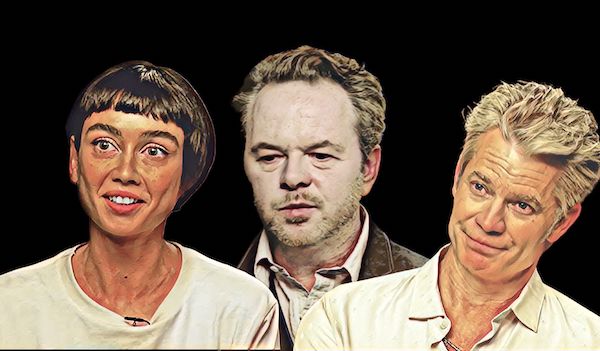
“We talked a lot about Kirsh’s programming, and the idea that he’s not just forbidden from hurting his superior—he also can’t disagree or show anger. So if you don’t agree with your boss… maybe just smile and say ‘f*ck you’ with your eyes,” adds Noah.
The showrunner describes the series as a blend of “Peter Pan’s dream with a heavy metal apocalypse”—and it’s no exaggeration. The soundtrack includes rock classics from Black Sabbath, Metallica, Tool, Jane’s Addiction, and Smashing Pumpkins. Songs like Mob Rules (in the pilot) elevate the deeper, more existential horror—the kind that stems from corporate dehumanization, the infantilization of violence, and the inevitability of destruction.
A Terrifying Atmosphere—With Lightness on Set
“Tim [Olyphant] and I had a lot of scenes together where he’d flash that smile—and I’d know what was behind it. From the moment we met, I sensed there’d be lightness and creative chemistry. That’s essential. Sometimes, you don’t want an actor to unload all their preparation in front of you. You want someone willing to discover it with you,” said actor Samuel Blenkin, who plays the insufferable antagonist Boy Kavalier—a controlling, eccentric trillionaire who believes he’s leading humanity into an evolutionary leap, even if it involves extremely questionable decisions.
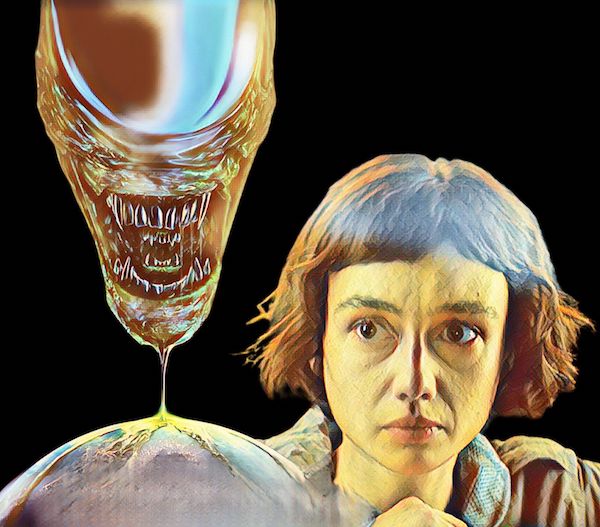
“The hardest part was not letting the intensity of the atmosphere consume you. The set was dark, the tension constant—sometimes you were running for your life with a two-meter-tall xenomorph chasing you… But it was thrilling. Like living inside a nightmare—and loving every second,” added Alien: Earth’s female lead, actress Sydney Chandler. She plays Wendy, a human-synthetic hybrid created by Prodigy, with a child’s consciousness transferred into a robotic adult body. She leads a soldier team on a mission to investigate the crash of an alien spacecraft on Earth, facing extraterrestrial creatures and exposing dangerous corporate secrets.
Known for her roles in Pistol, Sugar, and Don’t Worry Darling, and daughter of actor Kyle Chandler, she’s been hailed as one of the year’s breakout stars. “I used to have nightmares about the xenomorph—so being on set, chased by one in real life—or close enough—felt like closing a chapter,” she joked.
The Weight of Continuing a Saga
It’s not the first time someone has tried to expand the Alien universe. We’ve had brilliant sequels (Aliens, by James Cameron), philosophical prequels (Prometheus), questionable crossovers (Alien vs. Predator), and even a new film in 2024—Alien: Romulus, which was well-received for returning to basic survival horror.
But Alien: Earth does something else. Instead of returning to the origins, it widens the scope—literally. Unlike the films, which have two hours and disposable casts, the series needs to sustain characters, parallel storylines, and purposeful monsters. And Hawley understands this better than most.
According to him, a series demands that creatures be part of a coherent world—with politics, economy, emotions—they can’t just be predators. That’s why the xenomorphs here aren’t the only monsters. There are new species—and there are humans, or quasi-humans, whose decisions are equally terrifying.
Ridley Scott Endorses, but Hawley Transforms
Ridley Scott is involved as executive producer, but Alien: Earth clearly bears Noah Hawley’s signature. He takes the codes of the 1979 universe—the claustrophobic terror, the critique of extreme capitalism, the industrial aesthetic—and rebuilds it all in a world that’s much more open, but just as threatening.


It’s not a series for nostalgic fans of jump scares. It’s for those willing to get lost in a dystopian world dangerously close to ours—where bodies are commodities, childhood is a tool, and survival has become a spectacle. “If you can’t answer ‘why are we doing this?’ with something beyond ‘money,’ maybe you should stop,” explains the showrunner.
The Question Isn’t If You Should Watch—But How Many Times
If the season finale maintains the level of the first six episodes, Alien: Earth will likely go down as one of the best sci-fi series of the decade. It’s visually stunning, philosophically rich, and emotionally devastating. And like all great science fiction, it forces us to look toward the future with fear—but also with awe.
Premieres August 12 on Disney Plus.
Descubra mais sobre
Assine para receber nossas notícias mais recentes por e-mail.
 miscelana.com