
Outlander is not just a TV series or an adaptation of a best-selling novel. It is a cultural phenomenon that transcends borders, generations, and formats. When we think of Outlander, we are not only talking about Claire Randall’s time travel or her epic romance with Jamie Fraser; we are talking about a universe that stirs the deepest emotions, identity, history, and the complexity of human relationships. It is a work that blends adventure, drama, history, and fantasy so powerfully that it creates a legion of loyal fans—not just because of its plot, but because of the intensity and authenticity with which it tells stories of love and struggle.
The series’ success can be explained on several levels: first, by the fidelity to Diana Gabaldon’s literary roots, which spares no detail in either character development or the richness of the historical setting. Second, by the visceral way the show portrays the clash of worlds—the post–World War II England, the 18th-century Scottish Highlands, colonial America, and then back to the 20th century. This oscillation between times and places ensures the story is always surprising and never predictable.

But more than that, Outlander stands out for diving deep into human emotions—fear, passion, pain, desire, courage. It is not a silly romance or an escapist fantasy; it is a drama that reveals the strength of love amid chaos, the fight for survival, the pursuit of freedom, and even the difficult choice between duty and happiness.
It is in this context that Outlander: Blood of My Blood emerges, a spin-off that expands the boundaries of the narrative and promises to be more than a simple appendage to the parent series. Here, the proposal is to explore the origins of two legendary protagonists who have always been secondary or absent figures: Jamie Fraser’s parents—Ellen MacKenzie and Brian Fraser—in the early 18th-century Scottish Highlands, and Claire’s parents—Julia Moriston and Henry Beauchamp—in the devastated landscape of World War I. In other words, we are not just revisiting a distant past; we are discovering the very essence of Claire and Jamie, and how their roots shaped who they would become.
The connection to Outlander is not only chronological or genealogical. It is thematic. Blood of My Blood maintains the same backbone: love stories that defy conventions, confront the weight of history, and survive almost impossible circumstances. The difference is that, unlike the original series, here time travel is not the central element. What drives the plot is the inevitability of encounters and the strength of family bonds—a “blood of my blood” that, as the title warns, is a drama of heritage as much as it is of romance.
And yes, Outlander and Blood of My Blood will coexist. Just as Yellowstone did with 1883 and 1923, this spin-off is not meant to replace the main series, but to run alongside it, feeding the universe’s mythology and offering fans an extra dose while the main story continues. There is something very clever in this strategy: the audience does not have to choose between following the series they already love or venturing into the new one, because both speak to each other, but can also be watched independently. For the most devoted fans, this means an even deeper emotional dive; for newcomers, it means a chance to start at the very beginning without feeling lost.
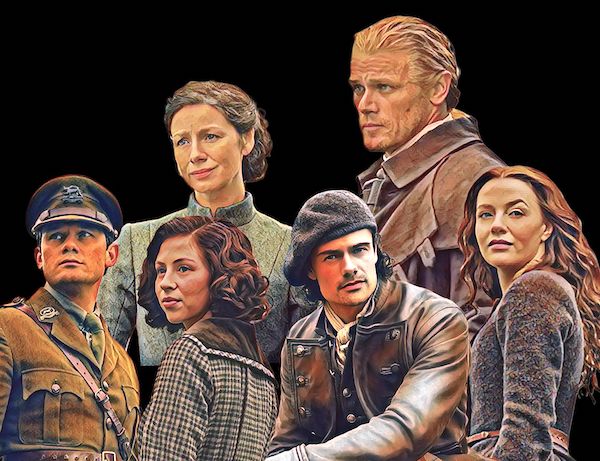
The spin-off also carries a rare creative freedom. Unlike Outlander, which was born from Diana Gabaldon’s literary work, Blood of My Blood is an original creation from STARZ, though developed with the blessing and supervision of veteran producers Matthew B. Roberts, Ronald D. Moore, and Maril Davis. This gives the series room to explore new nuances without being tied to readers’ expectations, while still preserving the narrative DNA that made the franchise work.
If Outlander is the story of two individuals defying destiny, Blood of My Blood is the story of how that destiny was forged long before they were born. The promise is clear: two distinct storylines, in two historically turbulent periods, connected by universal themes such as love, loyalty, sacrifice, and family. In the end, we may realize that Outlander’s great trick was never just time travel, but the certainty that, regardless of the era, some stories are timeless.
And so, the phenomenon continues. Now, not only do we follow Claire and Jamie across the world and centuries, but we also return to their origins to better understand who they are—and perhaps who we are when we look at the past with the same fascination and reverence. The series is already available with its first two episodes, exclusively on Disney+ in Latin America, with new chapters released weekly thereafter.
Descubra mais sobre
Assine para receber nossas notícias mais recentes por e-mail.
 miscelana.com