
The Corsair is one of the most fascinating and challenging works in the classical ballet repertoire, a performance that crosses centuries and continents, remaining vibrant and relevant thanks to its unique combination of dramatic narrative, virtuosic technique, and captivating music. Inspired by the poem by Lord Byron, the ballet tells the adventure of the corsair Conrad, a passionate and fearless pirate, and his quest to rescue the young Medora, kidnapped by a tyrant amidst dangers and intrigues set in an exotic Mediterranean landscape.

Origins and historic premiere
The Corsair premiered in 1868 at the Imperial Bolshoi Kamenny Theatre in Saint Petersburg, choreographed by Joseph Mazilier with original music composed by Adolphe Adam — the same composer behind the unforgettable score of Giselle. From its first staging, the ballet attracted attention for its adventurous, sensual, and exotic atmosphere, as well as for the technical challenges it posed to dancers, especially the male lead role of corsair Conrad and the heroine Medora.
Over the decades, the work underwent numerous choreographic revisions, with one of the most influential being the adaptation by Marius Petipa, the legendary master of Russian classical ballet. Petipa not only reorganized the dramaturgy but also added iconic moments such as the famous Pas de Trois in the third act — a scene that, over time, was adapted into a Pas de Deux focused on individual virtuosity, becoming one of the most anticipated technical highlights for dancers and audiences alike.
Evolution of the musical score
As choreography evolved, so did the ballet’s music. Composers like Cesare Pugni, Léo Delibes, and Riccardo Drigo contributed to expanding and enriching Adolphe Adam’s original score, adding layers of emotion, intensity, and lightness that capture the different moods of the narrative — from passionate romance to moments of action and tension.
This musical diversity makes The Corsair a rich auditory experience, where melodies accompany every movement of the dancers, emphasizing the drama and beauty of the story.
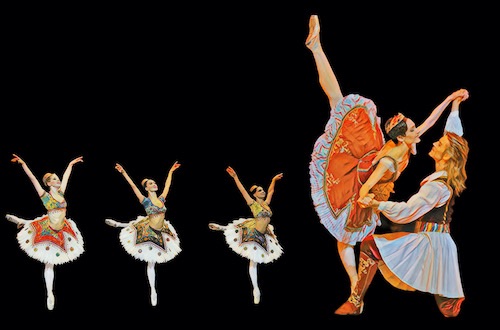
Technical challenge and dramatic intensity
Technically, The Corsair ranks among the most demanding ballets in the classical repertoire. For the dancer portraying Conrad, the demands go beyond technique: they must embody personality, strength, and charisma, translating in movement the corsair’s complexity — a warrior, but also passionate and vulnerable. For the ballerinas playing Medora, lightness and precision are essential, especially in the legendary Pas de Deux, where every pirouette, jump, and pose tells a story of love and despair.
Furthermore, group scenes such as naval battles, festivities, and gatherings of pirates and thieves require immense collective work — not only in coordination but also in body expression — to build the exotic and dramatic atmosphere that characterizes the ballet.
A storyline that captivates generations
The narrative of The Corsair is a true romantic and adventurous epic. The pirate Conrad fights against the tyranny of Turkish prince Birbanto, who kidnaps his beloved Medora. Between battles, chases, and passionate encounters, the story delves into themes of freedom, love, and struggle against oppression, with moments of humor brought by the thieves’ scenes, offering a light and playful counterpoint.
This nuanced plot allows the dance to be not just technical but also full of meaning, creating a deep connection with the audience.

The Corsair at the Theatro Municipal of Rio de Janeiro: tradition and renewal
In Brazil, especially at the Theatro Municipal of Rio de Janeiro, The Corsair holds a special place. Since the mid-20th century, when the local company aimed to establish itself on the international stage, full productions of the work marked milestones by bringing high-quality classical ballet to the Rio audience.
Over the years, many Brazilian dancers and artists have stood out in their interpretations, contributing to the dissemination and recognition of this work among Brazilian dance enthusiasts.
The current production at the Theatro Municipal is emblematic — the result of a partnership between the Ministry of Culture, the Government of the State of Rio de Janeiro, the Secretariat of State for Culture and Creative Economy, the Theatro Municipal itself, the Association of Friends of the Theatro Municipal, and official sponsorship by Petrobras. This institutional and private collaboration highlights the importance of investing in culture to keep great classics alive, democratize access, and encourage new audiences.

The contemporary spectacle: between tradition and innovation
The new production offers a contemporary yet respectful interpretation, balancing classical technique with artistic direction sensitive to today’s times. The cast features dedicated dancers who face the challenge of embodying complex characters while mastering the demanding choreography that requires strength, flexibility, stamina, and dramatic expression.
The artistic direction invests in sets and costumes that evoke the exoticism and atmosphere of the Mediterranean, while exploring ballet’s visual language to enchant and transport the spectator. The live music enriches the immersive experience, celebrating both the original compositions and the revisions by masters of classical music.

An invitation to rediscover classical dance
With this revival, the Theatro Municipal of Rio de Janeiro offers not just a show but an invitation to rediscover classical ballet in its most grand and challenging form. The Corsair, with its intense storyline and technical richness, invites audiences to experience an adventure crossing centuries and borders, keeping alive the flame of dance as a dialogue between past and present.
This is a unique moment for Cariocas and dance lovers across Brazil — the chance to witness a production that combines history, technique, music, and emotion, all united to celebrate art in its most sublime form.
Cast
- MEDORA – Márcia Jacqueline (Aug 14, 17, 19, 21), Juliana Valadão (Aug 15, 20, 23), Marcella Borges (Aug 13, 16, 22, 24)
- GULNARA – Manuela Roçado (Aug 13, 14, 17, 19, 21), Tabata Salles (Aug 15, 20, 23), Ana Luíza Azer (Aug 16, 22, 24)
- CONRAD – Cícero Gomes (Aug 14, 15, 17, 19, 20, 21, 23), Alyson Trindade (Aug 13, 16, 22, 24)
- ALI – Luiz Paulo (Aug 14, 15, 17, 19, 20, 21, 23), Mateus Imperial (Aug 13, 16, 22, 24)
- LANKENDEM – Mateus Imperial (Aug 15, 20, 23), Rodrigo Hermesmeyer (Aug 13, 14, 17, 19, 21), Michael William (Aug 16, 22, 24)
Descubra mais sobre
Assine para receber nossas notícias mais recentes por e-mail.
 miscelana.com