
As published in CLAUDIA
Carrie Coon has never been more prominent than in 2025. Although she has been, for over a decade, one of the most respected actresses in American television, this year marks a turning point: she not only stars in two of the most popular and talked-about series of the season — The White Lotus and The Gilded Age, both from HBO Max — but has also become the absolute favorite for the Emmy thanks to her devastating performance in the final episode of Mike White’s satire. At the same time, she reaffirms in The Gilded Age her gift for sustaining a character who polarizes audiences like few others: Bertha Russell, the social climber who challenges and redefines the boundaries of New York’s high society. Many already bet that her work in the third season of Julian Fellowes’ period drama (Downton Abbey) will make her a frontrunner for the 2026 Emmy as well (and there’s a reason it’s so far ahead).
The Monologue That Will Win the Emmy
With so much great content this year, some might have forgotten, but in the third season of The White Lotus, filmed in Thailand, Carrie Coon delivers a monologue in the final episode that has already entered recent TV history. It’s a moment when her character, until then shrouded in secrets, resentments, and family tensions, strips away all pretense and erupts in an emotional catharsis rarely seen in a satirical drama. The tone is at once intimate and explosive, moving and unsettling — and it’s precisely that mix of contradictions that makes the scene so overwhelming. Critics point out that few actresses could sustain such intensity without falling into artifice, but Carrie Coon does: every line carries truth, pain, and clarity.
It’s this scene that positions her as the favorite for the 2025 Emmy — symbolizing long-awaited recognition for an actress who has always been admired by critics but until now rarely stood at the center of pop culture.

The Lady of Fifth Avenue
Meanwhile, in The Gilded Age, Carrie wears a completely different skin — one just as powerful as it is controversial. As Bertha Russell, the woman determined to carve her place in New York’s aristocracy by any means necessary, the actress brings to life a figure that divides fans. For some, she is the perfect antagonist, an arriviste willing to scheme her way past the old elite. For others, she’s the true heroine of the series, the only character unwilling to bow to the hypocritical conservatism of her time.
Carrie Coon, for her part, has no doubt: she defends Bertha to the end, even in the face of manipulative or ruthless choices. “She’s pragmatic, visionary, relentless because she has to be,” she often says in interviews. The fact is that Bertha Russell has become one of the most fascinating characters on contemporary TV precisely because of this ambiguity — and because she is played by an actress capable of adding depth and charisma to every calculated gesture. And, just like The White Lotus, the final scene of The Gilded Age rests entirely on her shoulders, as she moves through indignation, despair, disappointment, joy, and frustration with barely a handful of words, ending the season in a close-up, crying. Yes, it became a meme, but it is nothing short of spectacular.
Between Two Worlds: From Thailand to the 19th Century
Few know this, but Carrie Coon’s schedule in 2024/2025 was a true marathon. She wrapped filming The White Lotus in Thailand and literally the next day was back in New York, once again embodying Bertha Russell in the lavish sets of the 19th century. The actress jokes that she had to “escape the sun” of the tropics only to dive headfirst into the sobriety of The Gilded Age’s golden ballrooms. The transition between these two universes — one a fractured contemporary paradise, the other a dazzling portrait of America’s aristocracy — shows not only her versatility but also her almost physical commitment to the craft.

From Cult to Mainstream
Carrie Coon did not emerge overnight. Trained in theater, she first distinguished herself on the Chicago stage before gaining international recognition in series like The Leftovers (HBO), where her performance as Nora Durst earned her cult status. Then came Fargo, where she drew critical praise, and standout film appearances such as David Fincher’s Gone Girl. (Yes, that was her as Ben Affleck’s sister in the movie.) Always in complex roles, she has embodied women who are multifaceted, intelligent, wounded, and strong.
But if Carrie had until now been celebrated in more niche circles, 2025 is the year her talent fully breaks into the mainstream. Leading two of HBO’s most talked-about series and standing as the frontrunner for television’s highest honor means something more: it’s the consecration of an actress who never needed to prove herself, but who now receives the widespread recognition she has long deserved.
Two Women, Two Faces of Strength
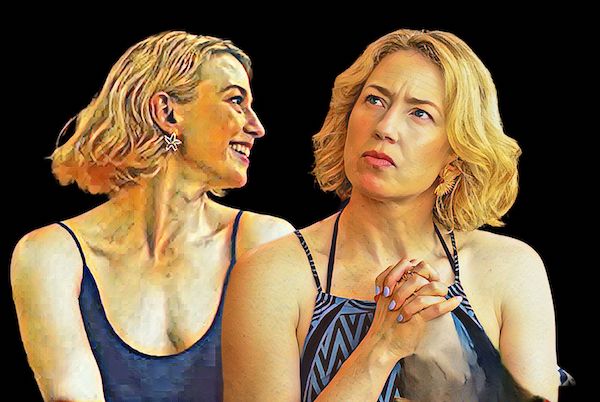
Comparing her two current performances is a revealing exercise. In The White Lotus, Carrie Coon offers a near-painful fragility, a raw burst of humanity that tears away her character’s social mask. In The Gilded Age, she wears the mask with conviction, showing how power can be both an armor and a prison. One performance is visceral, the other calculated — both are brilliant.
And it’s in this very dichotomy that the essence of Carrie Coon shines: her ability to inhabit extremes, to move seamlessly between vulnerability and absolute power, always with a commitment that refuses half-measures.
Recognition Long Overdue, but Well-Deserved
The award looming in 2025 is not just a golden statue. It is the celebration of a career that has delivered unforgettable roles for years, yet has remained underestimated by the broader public. In honoring Carrie Coon, the industry also acknowledges a lineage of actresses who transform every performance into art, who refuse to fit stereotypes, and who challenge writers and directors to create roles worthy of their talent.
Carrie Coon was already monumental. 2025 merely confirmed what critics had been saying since The Leftovers: we are witnessing one of the greatest actresses of our time. And yes, I’ll be rooting for her at the Emmys in September. (The White Lotus is her only contender this year because of Emmy calendar rules: only shows airing by June qualify, which means The Gilded Age, airing from June through August 2025, is already set for 2026 consideration.)
Whether through the devastating outpouring of The White Lotus or the calculated steel of Bertha Russell in The Gilded Age, Carrie Coon has proven she can master every register. The Emmy may just be a trophy, but in 2025, she has already won — with the critics, the audience, and in the history of television. The Emmy will only be the coronation.
Descubra mais sobre
Assine para receber nossas notícias mais recentes por e-mail.
 miscelana.com