
Some stories transcend the boundaries of a political thriller to become genuine human tragedies. A Spy Among Friends is one of them. Released in 2022 as a miniseries and inspired by Ben Macintyre’s 2014 book, the production, now available on Max, not only revisits one of the most famous episodes in British espionage but also dives into what makes this case unforgettable: a mix of blind trust, class loyalty, and a betrayal that devastated both nations and friendships.
The series
In the television adaptation, Guy Pearce plays Kim Philby, the most notorious double agent of the 20th century. At the same time, Damian Lewis embodies Nicholas Elliott, his MI6 colleague and intimate friend, who thought he knew him better than anyone. The clash between these two men — camaraderie and lies — sets the tone of the miniseries.
With an elegant, almost theatrical rhythm, the narrative prioritizes dialogue, silences, and the psychological weight of wounded friendship over action or gunfire. Alexander Cary’s creation and Nick Murphy’s direction emphasize the suffocating atmosphere of the Cold War, where nothing was as it seemed and suspicion was mandatory — except for Elliott, who trusted too much.

The book
The original material, written by Ben Macintyre, was already a bestseller before the adaptation. Published in 2014, A Spy Among Friends: Kim Philby and the Great Betrayal stood out for humanizing espionage. It is not a cold inventory of betrayals and operations, but an intimate portrait of the friendship between Philby and Elliott. It reads like a novel, but each page reminds us that the story is far too real to be invented.
Macintyre reveals not only the secrets exchanged between MI6 and the KGB but also the emotional abyss that opens when one discovers that the trusted friend — the one with whom wine, jokes, and confidences were shared — was, in truth, the greatest traitor of his generation.
The real story
Kim Philby was real. He was part of the Cambridge circle, recruited to communism in the 1930s, and spent decades feeding valuable information to Moscow while rising through the ranks of MI6. The scale of his betrayal is almost incalculable: ruined operations, dead agents, and trust between allies corroded.
But it was in the final episode, in Beirut, that the story gained the contours of a classic tragedy. Elliott was sent to interrogate him, believing he could extract a confession — perhaps even redeem his friend. Days later, Philby vanished aboard a Soviet ship bound for Moscow. To this day, the doubt remains: did Elliott let him escape, out of friendship or obedience to higher orders? Or was he simply manipulated until the very last moment?
Philby lived the rest of his life in Moscow, honored as a Soviet hero, and died in 1988 without ever showing remorse. Elliott, in turn, was left with the shadow of guilt and the weight of having trusted too much.
The appeal of the story
What makes A Spy Among Friends irresistible is not only the historical weight of the Cold War but also the universal drama of intimate betrayal. Philby did not only deceive his country — he deceived his friends, his wife, his colleagues, the very social circle that shielded him.
The book, the series, and reality converge at this point: we are not only faced with a brilliant spy or a ruthless traitor, but with a man who showed how friendship and trust can be used as weapons. It is Shakespeare set in the Cold War.
And perhaps that is what keeps Kim Philby’s legend alive: it is not enough to talk about ideology or politics. His story touches on what frightens us the most — the idea that the person beside us may, in fact, be the enemy.

The real Philby, the one in the book, and the one on screen
There are many ways to tell a story, and Kim Philby ended up gaining different versions, each revealing in its own way.
The real Philby: historical, concrete, almost bureaucratic in his coldness. A man who lived between two loyalties and chose the Soviet Union to the end, even in the face of Stalin’s purges, Moscow’s crimes, and its decay. He died in 1988, decorated as a Soviet hero, never showing regret. He was the perfect traitor — and at the same time, the friend who laughed, drank, and charmed everyone around him.
Philby in Ben Macintyre’s book: here, he gains literary depth. Macintyre presents him as an ambiguous, almost novelistic figure, with irresistible charm and silent cruelty. He was the man who turned friendship into a tool, who used personal bonds as camouflage for his betrayal. The book neither sanctifies nor demonizes him — it exposes the paradox: how could someone so sociable, so beloved, carry within him loyalty to an invisible enemy?
Philby, in the series embodied by Guy Pearce, is the most human and, at the same time, the most theatrical. The adaptation dramatizes silence, the look, the gesture of broken trust. It is less about documents and more about psychology: the tension between Elliott’s affection and Philby’s enigma. The series makes us feel the weight of betrayal not in numbers or reports but in conversations between friends, in shared glasses of whisky, in unanswered questions.

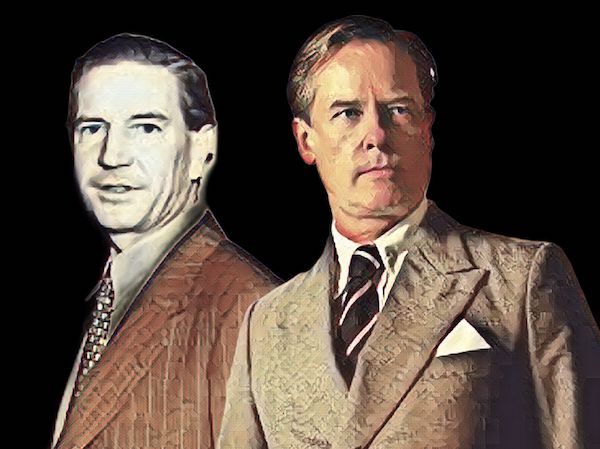
In each layer — real, literary, and dramatized — Philby reveals a little more. There is no single truth, but the sum of them explains his fascination. He was the most damaging spy of the Cold War, but also the friend who ripped out the heart of those who trusted him
In the end, A Spy Among Friends is not just about espionage. It is about the fragility of human bonds. It is about how trust, when placed in the wrong hands, can become the deadliest weapon.
Philby continues to fascinate because he is not only a character of the Cold War — he is a disturbing reminder that the worst betrayal does not come from the declared enemy, but from the friend who sits right beside us.
Descubra mais sobre
Assine para receber nossas notícias mais recentes por e-mail.
 miscelana.com