
Few plays have endured through time with as much force as Amadeus, by Peter Shaffer. Written in 1979, it was born out of a persistent rumor, one of those that travel across centuries: did Antonio Salieri poison Mozart? The story, of course, already existed in earlier versions – Pushkin wrote his short tragedy Mozart and Salieri in 1830, Rimsky-Korsakov set it to music, and the myth of rivalry hovered in the collective imagination. But Shaffer went a step further: he turned gossip into metaphor. In his version, Salieri is a man consumed by recognizing the divine presence in another. Devout, disciplined, an admirer of music, yet incapable of reaching the genius that Mozart exuded effortlessly. The result is one of the most painful and fascinating reflections of modern theater: what do we do in the face of the injustice of talent, when the world distributes gifts arbitrarily?
The play is structured as a confession. Salieri, now an old man, speaks directly to the audience and relives his relationship with Mozart, that insolent prodigy who behaved like a vulgar boy but wrote music as if it were dictated by God. The contrast between Mozart’s almost grotesque behavior and the perfection of his scores generates the tension that sustains the entire narrative. At the same time, Shaffer does not treat Salieri simply as a villain, but as a profoundly human figure – bitter, ironic, desperate in the shadow of another’s gift.


The premiere took place in London, at the National Theatre, in 1979, directed by Peter Hall, with Paul Scofield as Salieri and Simon Callow as Mozart. It quickly became clear that there was something special there. In 1980, the play arrived on Broadway with Ian McKellen and Tim Curry in the leading roles and won the Tony Award for Best Play. And what a duo! Curry, fresh from Rocky Horror Show, and McKellen, trained in the most classical traditions of the stage? I wish I had a time machine to watch a performance by those two legends together.
Since then, Amadeus has become one of theater’s great rituals: a work that demands from its interpreters the same rigor as Hamlet or King Lear. The role of Salieri, in particular, became a challenge for major actors – from McKellen to David Suchet (whom I saw on Broadway in 1998, with the brilliant Michael Sheen as Mozart), from F. Murray Abraham to Lucian Msamati, the latter responsible for a brilliant production at the National Theatre in 2016, which even brought an orchestra and choir on stage and was broadcast worldwide through the NT Live project.

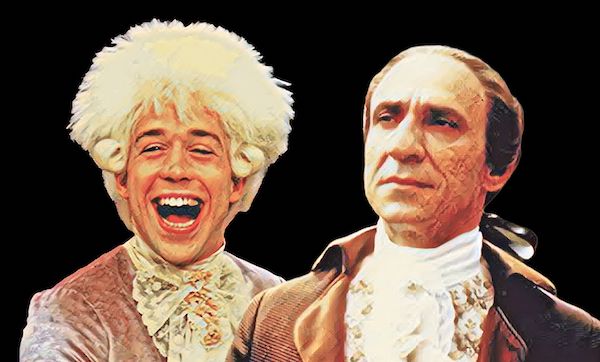
If the text was already immense on stage, it was in the cinema that it achieved immortality. In 1984, Milos Forman directed the adaptation written by Shaffer himself, with Tom Hulce as Mozart and F. Murray Abraham as Salieri. The film replaced the rigidity of theatrical staging with flashbacks narrated by Salieri in an asylum, giving the story a darker, more intimate tone. And, above all, it placed Mozart’s music at the center, stitching scenes with arias and symphonies that elevated the emotion to almost unbearable heights. The result was historic: eleven Oscar nominations, eight wins, including Best Picture, Best Director, Best Actor for Abraham, and Best Adapted Screenplay. To this day, it is considered one of the finest works ever made about music and about human fragility in the face of genius.
Since then, the play has never stopped returning. Each revival, in London or on Broadway, reshapes its perspective on power, envy, faith, and privilege. And now, more than forty years later, Amadeus is preparing for a new life, this time on television. Produced by Sky and Universal, the miniseries will have five episodes and premiere in 2025. Will Sharpe, known for The White Lotus and Flowers, will play Mozart, while Paul Bettany will portray Salieri, and Gabrielle Creevy will take on the role of Constanze, the composer’s loyal wife.

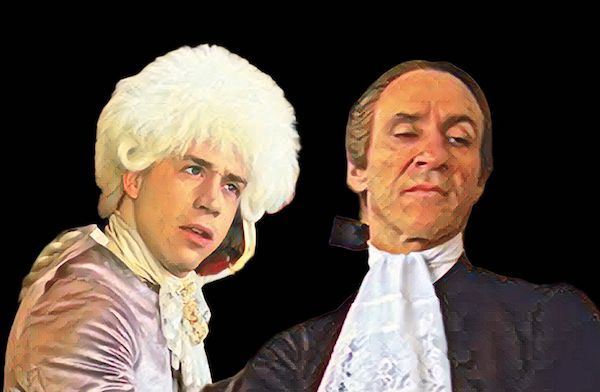
The story begins with Mozart at twenty-five, newly arrived in eighteenth-century Vienna, in search of creative freedom. He marries Constanze, secures a place in the city’s effervescent musical life, but also faces mistrust, scandal, and his own inner demons. Meanwhile, Salieri, already established as a court composer, observes this boundless talent and begins to feel the raw wound of envy. What begins as admiration and competition turns into a thirty-year obsession, culminating in a delirium of murder and in Salieri’s desperate attempt to intertwine his own identity with Mozart’s forever.
The cast also features Rory Kinnear as Emperor Joseph II, Lucy Cohu as Cecilia Weber, Jonathan Aris as Leopold Mozart, Ényì Okoronkwo as librettist Lorenzo da Ponte, Jessica Alexander as Katerina, Hugh Sachs as Von Strack, Paul Bazely as Von Swieten, and Rupert Vansittart as Rosenberg, alongside Anastasia Martin, Nancy Farino, Olivia-Mai Barrett, Viola Prettejohn, and Jyuddah Jaymes. The series is directed by Julian Farino (Giri/Haji) and Alice Seabright (Sex Education), with a script by Joe Barton (The Lazarus Project). Filming took place in Budapest throughout 2024, with the premiere scheduled for late 2025.
In the end, that is why Amadeus endures. Because it is not just about classical music, nor about biography. It is about all of us – about the anguish of realizing that life can be unfair, that there are gifts we will never attain. And, at the same time, about the beauty of a work that, born of envy and pain, transforms itself into unforgettable art.
Descubra mais sobre
Assine para receber nossas notícias mais recentes por e-mail.
 miscelana.com
1 comentário Adicione o seu