
As published in CLAUDIA
Few superhero films have a history as contradictory as Elektra (2005). At the time, it was considered a critical and box-office disaster, one of the worst titles ever adapted from Marvel comics. Twenty years later, it has resurfaced as a cultural phenomenon: among the 10 most-watched films globally on Netflix, holding the #4 spot in Brazil. But the legacy of Elektra is more than just that of a flop revived by streaming — it also exposes how Hollywood treated women actresses, and how the same failure could mean very different things for men and for women.
Garner and Affleck: from comic books to marriage
Jennifer Garner and Ben Affleck met behind the scenes of Daredevil (2003). He played Matt Murdock, she played Elektra Natchios. The film was not a critical success, but their reunion marked the beginning of a romance that soon turned into marriage. Two years later, in June 2005, after the release of Elektra, they tied the knot. And in December of that year, Violet was born, the first of the couple’s three daughters. What is curious is that Elektra, beyond being a professional turning point for Garner, also became forever linked to the beginning of an intense personal life, constantly followed by the media.

Jennifer Garner’s big chance — and her downfall
In the early 2000s, Jennifer Garner was one of Hollywood’s brightest prospects. She had just come off the massive success of Alias on TV and had scored a box-office hit with 13 Going on 30 (2004). Elektra was supposed to be her trial by fire: the chance to establish herself as the lead of an action blockbuster. But the project was rushed, weighed down by a problematic script and uninspired direction. The result was a $43 million film that grossed only $56 million worldwide and was trashed by critics.
And here lies a crucial point: as Forbes analyzed years later, this flop was a turning point in Garner’s career. Unlike Ben Affleck — who also sank with Daredevil, Gigli, and other bombs, but managed to rebuild his career, reinvent himself as a director, and even go on to be cast as Batman — Jennifer never had the same chance. Elektra virtually killed her trajectory as a major studio star. A typical case of Hollywood misogyny.
The weight of gender in Hollywood
It is impossible to talk about Elektra without talking about gender differences in the industry. Affleck, as noted, even after a string of box-office disappointments, still had the space to reinvent himself artistically: he shone in Hollywoodland (2006), was reborn as a director with Gone Baby Gone (2007), and reached his peak in 2013, winning the Oscar for Best Picture with Argo.
Garner, on the other hand, was confined to roles as mothers, wives, or girlfriends in middling films — Valentine’s Day, The Odd Life of Timothy Green, Draft Day, Men, Women & Children. Always competent, she rarely had another shot at leading roles. And worse, some argue that Elektra didn’t just flop: it helped freeze the idea of female-led superhero films for a decade, until Wonder Woman (2017) finally arrived.
In short, they both fell together, but only one had the industry’s structure to get back up. A story all too typical of Hollywood.
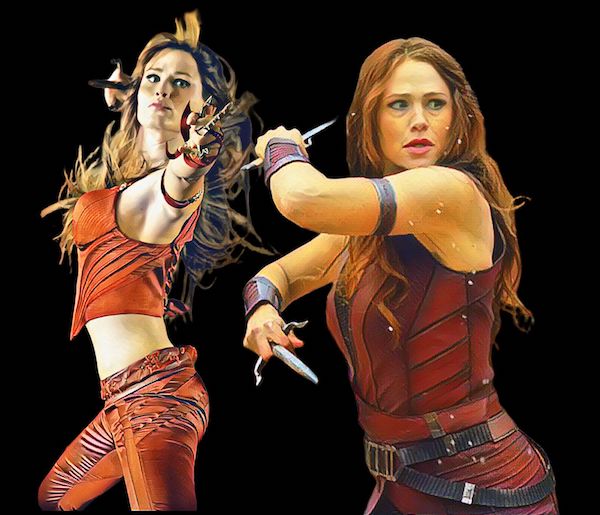
The character’s return and late redemption
In the comics, Elektra has always been iconic: the assassin created by Frank Miller in 1981, loved precisely for her ambiguity between heroine and villainess. On screen, she was reimagined with Élodie Yung in Netflix’s Daredevil (2015–2018). But it wasn’t until 2024 that Jennifer Garner returned to the role — in a special cameo in Deadpool & Wolverine. The moment was received as a kind of reckoning with the past, a gesture of affection from both fans and the actress herself toward her own legacy.
That return partly explains today’s phenomenon: when Netflix added Elektra to its catalog in August 2025, curiosity exploded. A once-forgotten film became a global attraction, with millions of hours watched in just a few days.
20 years later: from flop to pop culture artifact
What the resurrection of Elektra proves is that failures are not permanent. Time, nostalgia, and the power of streaming can rewrite narratives. Today, the film is seen through different eyes: not as a great example of superhero cinema, but as a portrait of an era when Hollywood still didn’t know how to handle female characters in the genre — and of how Garner’s career was unfairly cut short because of it.

Two decades later, Elektra may be living its strangest moment yet: simultaneously a symbol of gender inequity in Hollywood and, paradoxically, a streaming hit in 2025. Jennifer Garner, now respected and freer in her choices, finally watches this belated reversal from the front row. And we, as viewers, can revisit the story with less cruelty — and more awareness of what really happened.
Descubra mais sobre
Assine para receber nossas notícias mais recentes por e-mail.
 miscelana.com