
As published in Bravo Magazine
It’s always fascinating when a filmmaker known for comedy — the man behind Austin Powers and Meet the Parents — turns to darker territory. That’s exactly what Jay Roach has done with The Roses, a new adaptation of Warren Adler’s novel, immortalized in the 1980s with The War of the Roses. Here, instead of merely watching a couple at war, we witness a dangerous dance between love, identity, and ambition. Roach spoke with us about shaping this story into something closer to a Shakespearean tragedy, about the incendiary partnership between Benedict Cumberbatch and Olivia Colman, and why he believes this film might make couples everywhere rethink the way they speak honestly with each other.
For me, it was curious to revisit this realistic and unsettling tale of the end of a marriage now that I am an adult. The first version, from 1989 — more than 35 years ago — seemed almost frightening. Yes, it was strange to see Kathleen Turner and Michael Douglas again, at the time best known as the romantic duo from Romancing the Stone, but now literally trying to kill each other over dividing assets in a divorce. Think Mr. and Mrs. Smith without the reconciliation? Exactly. And without irony, Brad Pitt and Angelina Jolie — now fighting their own “war of the rosés” — come to mind. Adler’s 1981 novel was a bestseller precisely because it broke the taboo of addressing how dark divorces can become when it comes to dividing assets, and how a couple once in love can turn dangerously belligerent and hostile once love is gone.
The 1989 version keeps that violent discomfort that provokes uneasy laughter. In the new version, instead of simply watching a couple at war, we witness a dangerous dance between love, identity, and the desire for power. Roach spoke about how he transformed this story into something closer to a Shakespearean tragedy, about the incendiary partnership between Benedict Cumberbatch and Olivia Colman, and about why he believes this film might lead couples to reflect on honesty within their own relationships.
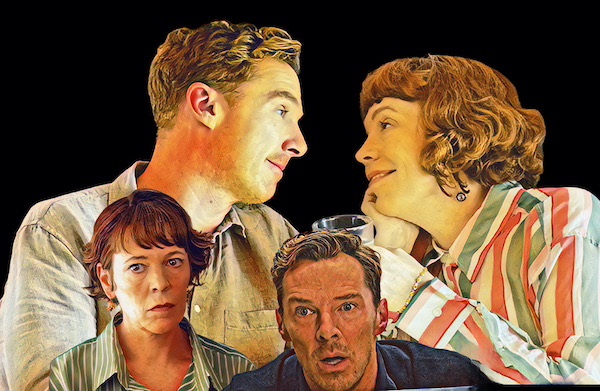
BRAVO!: How would you describe what audiences can expect from The Roses?
JAY ROACH: The Roses begins the way most romantic comedies have taught us relationships should look. Theo [Benedict Cumberbatch] and Ivy [Olivia Colman] have, at first, an enviable bond. They’re wonderfully communicative, articulate, and witty as hell. Until their paths suddenly set them on a catastrophic new course. And it’s an absolute joy to watch Benedict and Olivia go through it. This is a film with plenty of funny moments, for sure. But at its core, it’s a tragedy — almost Shakespearean. In a sense, this couple is star-crossed lovers, even after ten years of marriage. You feel from the start that it won’t end well, because both their identities are at stake.
BRAVO!: Why are both their identities at stake?
ROACH: Because their identities switch. Theo, after a series of events, goes from being arrogant, confident, witty, and at the top of his game, to losing his mojo and facing a deep identity crisis. Ivy, meanwhile, who has had a somewhat subconsciously repressed experience raising their kids and sacrificing some of her career ambition to become a restaurateur, suddenly gets a shot at success, power, and her own agency. She discovers a strength she maybe didn’t even known she had. And right at that destabilizing moment, they realize that relying on their old ways of talking to each other may not work anymore.
BRAVO!: What makes Benedict and Olivia so perfect as Theo and Ivy?
ROACH: I love British wit, and these two are at the very peak of it. Olivia is freaking hilarious, and Benedict’s Theo feels like a Peter Sellers character. They make it look so easy — and being funny is hard. But for them, it comes naturally, like a sixth sense. I’ve been a fan of Benedict for so long. I thought he was hilarious in Sherlock. I saw Patrick Melrose as a kind of dark comedy, and he’s also a fantastic physical comedian. And Olivia Colman has been hilarious since I first saw her on Fleabag. They are both incredible comedic engines, with razor-sharp wit. It’s astonishing how good they are together here. The Roses is a drama, but it clearly aims for a shared comedic amusement between characters and audience — and that’s not easy. I haven’t done comedies in many years. I find comedy way harder than drama because it’s alchemy: mixing strange ingredients into something undefinable, unscientific. These two have superpowers in that sense.
BRAVO!: How did you come onto the project?
ROACH: I met Tony McNamara [screenwriter] in the spring of 2023 to talk about other projects, and we hit it off. I’m such a fan of The Great, The Favourite, and Poor Things. Knowing Benedict and Olivia were already attached was obviously a huge draw. And then there was the idea that this film had a very different scope than the original. That while it would echo some of the earlier film’s patterns and structure, the characters, the setting, and the journey would be entirely different.
BRAVO!: In what ways does it differ from The War of the Roses (1989)?
ROACH: Danny’s [DeVito, who directed it] film is brilliant. But one key difference is that in his version, the couple [Michael Douglas and Kathleen Turner] turn on each other very early. Much of the fun in that film comes from watching how they will destroy each other and how long it will take. Our film isn’t about how they’ll destroy each other, but if they will. Theo and Ivy spend the entire movie trying to rediscover whatever glue might hold them together and how they can maintain it. Of course, since it’s a divorce comedy, there’s the fun of seeing how viciously and deliciously they turn on each other — but they always go back to trying again, and you keep wondering through all the self-destruction: maybe they’ll still make it?

BRAVO!: How would you describe the tone of your take on Warren Adler’s novel?
ROACH: With the films I make, I often relate them to my anxiety dreams. I don’t have any other kind of dreams, and my coping mechanism is basically to laugh through them. As an anxious person, I often use humor to get through moments. And I think couples who know how to do that — to tease and joke their way through tension — are usually in healthy relationships. But the film is about how that love language can sometimes cross a line, from playful teasing into an attack. And sometimes you can’t tell the difference. Films have to be personal to me. Otherwise, I don’t know how to engage with them on the level a director needs to. If I’m trying to work something out in myself while making a film, it feels like it will also be a healthy conversation for the audience. Selfishly, for me, making a movie is about working my own stuff out.
BRAVO!: What does the film say about modern relationships and marriage?
ROACH: A lot. On one level, it’s about how you can be charming, witty, and intelligent enough that your spouse still wants to be around you. I envy couples like that, who have a love language that isn’t overly earnest, but filled with irony, satire, and subversion. Honest communication is key — and we see that in what happens to Theo and Ivy. The truth is, we don’t fully know who we are, much less who our partner is. You never know everything that’s going on in someone else’s mind.
BRAVO!: In The Roses, Theo and Ivy end up fighting over a dream house. What does it represent in the story, and what did you want production designer Mark Ricker to achieve with it?
ROACH: The house had to be perfect. It had to be a character of its own, because it’s a manifestation of Theo’s attempt to regain his mojo. We even gave the house a voice — like Siri or Alexa — almost like HAL in 2001: A Space Odyssey. Over the course of the story, it becomes clear that Theo and Ivy’s egos are so entangled with their individual ambitions that they’re missing each other in the night. The house dooms them because they believe this grand project will save the marriage. Ironically, it becomes part of what destroys it, because they put too much into it.
BRAVO!: Inside that house, we get one of the film’s signature scenes — the dinner party Theo and Ivy host. How much fun was that to shoot?
ROACH: I love dinner scenes. Some of my favorite career moments are dinner scenes: the one in Meet the Parents [with the legendary line, “I have nipples, Greg. Could you milk me?”] and Dr. Evil around the table in Austin Powers. A dinner table gives you built-in conflict. You can pre-design the tensions, set up all the forces, and then trap people together. It’s a great comedic crucible, a pressure cooker. And there’s something unique about the way British couples talk that Americans will just never get. So when you throw the Americans into the mix [like Kate McKinnon and Andy Samberg as Amy and Barry, and Zoë Chao and Jamie Demetriou as Sally and Rory], it becomes a huge comedic misunderstanding. Theo and Ivy are trying to hide their conflict, but the audience knows it will spill out.
BRAVO!: The dinner party also features some brilliant improvisation from the supporting cast. What does that bring to you as a director?
ROACH: We shot many versions of multiple scenes. What I love about that process isn’t just the new lines and ideas, but the sense of danger it creates. There’s less stability, more chaos, just barely under control. I’ve always said I love the takes right after actors crack each other up and break character. When they’re forced back into character, something alive happens that the audience can feel. And when you’ve got such talented improv comedians, it stirs everything up. I love that about making comedies. This one was tough because the tone is ultimately a love story, with some very dramatic, dark moments. But of course, Tony’s script was brilliant to begin with. Most of what’s in the film is his. Still, when great actors bring wildcards, it keeps things fresh.
BRAVO!: What do you hope audiences take away from The Roses?
ROACH: Benedict and I talked about this after the table read. It turned out to be surprisingly emotional, even though it was on Zoom — just boxes of heads on a screen. At first, everyone was laughing, but by the end, the tragedy of it all became crystal clear. When we finished, Benedict said: “I hope this film makes every viewer turn to their partner and say, ‘We need to talk. Honestly. We need to get past the surface and say what’s really going on, because if we don’t, we might misunderstand each other. We might stop giving each other the benefit of the doubt.’” I think that’s the real magic of any relationship. Once you lose that, you’re on a slippery slope. Benedict said exactly what I was feeling. And that’s a pretty great goal to aim for when you’re making a film.
Descubra mais sobre
Assine para receber nossas notícias mais recentes por e-mail.
 miscelana.com