
If you’re not into alpha-male content filled with war, betrayal, and conservative ideology, the prequel to The Terminal List — which aired on Prime Video in 2022 and premiered its prequel on the platform this week — is not for you.
With The Terminal List: Dark Wolf, Prime Video expands Jack Carr’s universe by diving into the past of Ben Edwards, the character who, at the end of the first series, revealed himself as the traitor to his brothers-in-arms. The prequel, released in August 2025, arrives steeped in contradictions: while it presents itself as a spy thriller packed with action, it also becomes an ideological portrait of America in the waning days of its global supremacy.

Critics have already noticed the discrepancy. For many, Dark Wolf insists on repeating the rhetoric that “bureaucrats” — the implied “deep state” — prevent men like Edwards from “saving the free world.” This combat-ready language saturates the dialogue, preferring to frame the story as a simplistic battle of good Americans against “monsters at the door,” rather than probing the complexities of geopolitical conflict. Like The Terminal List, the new series favors explosions, shootouts in European cities, and one-liners over subtlety.
And yet, there is something magnetic in watching Taylor Kitsch take center stage. Reviewers agree he is better suited to the archetype of the tormented warrior than Chris Pratt, who here appears only in the opening and closing episodes. Kitsch lends weight to a shattered Edwards, a man who, five years before the events of The Terminal List, had already lost faith in authority and embraced a path of violence with no rules of engagement.
In a recent interview, Kitsch reflected on this duality. For him, the greatest challenge was to understand how someone could reach the point of betraying his SEAL brothers. His approach has always been rooted in discipline and repetition: for over a decade, he has trained with Navy SEAL Ray Mendoza, who has guided him since Lone Survivor. In Dark Wolf, he prepared not only for desert combat but also for fight choreography in markets, subway stations, and underground tunnels. This preparation gives the show a technical realism, even when the narrative veers toward propaganda.
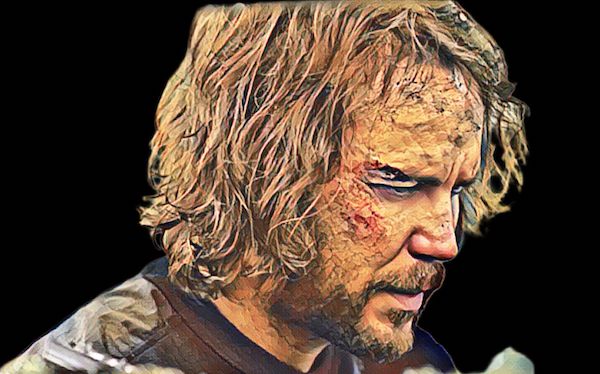
The actor admits that Edwards is driven by devastating emotions. Something deeply personal breaks him in Mosul, Iraq, in 2015, leading him to lose faith in superiors who decide to protect a sadistic CIA asset. From that moment, his trajectory changes: he seeks redemption, but drags his friend Raife Hastings (Tom Hopper) into a spiral with no way out. As Kitsch puts it: “War is not black and white, you live in the grey. Ben is tested at that limit.”
The result is uneven. At times Dark Wolf delivers intensity — like a memorable hand-to-hand fight between a slight hacker and her much larger adversary — but it often falls back on easy solutions: bullets, explosions, and quips like “I’d rather grab a beer, but fuck it, let’s blow it all up.” Testosterone overshadows nuance, and even moral dilemmas become little more than background noise to justify aggression, collateral damage, and even abusive conduct by secondary characters.

Still, Kitsch’s presence, his dedication, and even his life outside the screen add layers that the series itself could not provide. Parallel to his work with Prime Video, he founded a retreat in Montana for veterans, trauma survivors, and those struggling with addiction — Howlers Ridge. On 22 acres near Yellowstone, the actor seeks to create a space for healing, something Edwards himself never finds.
And perhaps that is the greatest irony: while the series seems most interested in sustaining the mythology of the American who makes the world better through violence, the man who plays Edwards uses his fame to build spaces of refuge, not of war. Between the hard ideology of fiction and the quiet practice of real life, Dark Wolf becomes most compelling precisely offscreen — in the contrast between the character and the actor who embodies him.
Descubra mais sobre
Assine para receber nossas notícias mais recentes por e-mail.
 miscelana.com