
It feels almost surreal to write this: Dwayne “The Rock” Johnson, the face of global blockbusters, light comedies, and pop entertainment, may finally be on the verge of an Oscar nomination for Best Actor. Such a possibility is not only surprising — it is transformative for an artist long regarded as a charismatic star but rarely as a performer of depth. And the irony is that this potential breakthrough comes by reconnecting with his origins: a role that leads him back to the world of fighting, but in a radically different key.
The real weight of Mark Kerr
Benny Safdie’s The Smashing Machine casts Johnson as Mark Kerr, one of the most fascinating and tragic figures in MMA history. Kerr was a legendary fighter in the 1990s, an undefeated champion in Vale Tudo and UFC, nicknamed “The Smashing Machine” for the brutal way he dismantled his opponents. At his peak, he looked unstoppable: sculpted muscles, immense strength, a man destined for the pantheon of the sport. But behind the glory, there was an abyss.
Away from the cage, Kerr’s life was consumed by opioid addiction, episodes of depression, and a turbulent relationship with Dawn Staples, which swung between passion and devastation. His struggles were laid bare in a 2002 HBO documentary that revealed the reality of his dependence and his internal battles. It was clear even then that his story was larger than sport: it was about the crushing weight of public triumph and the silent defeat of private despair.


Johnson’s transformation
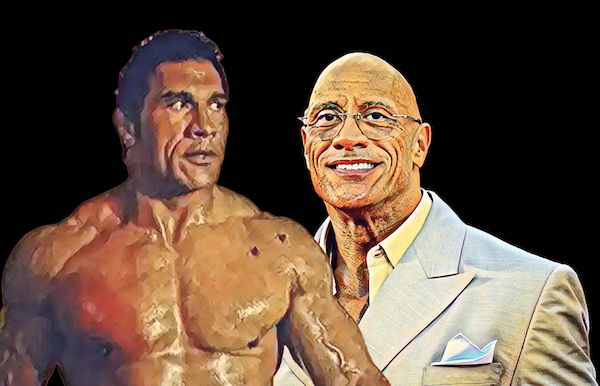
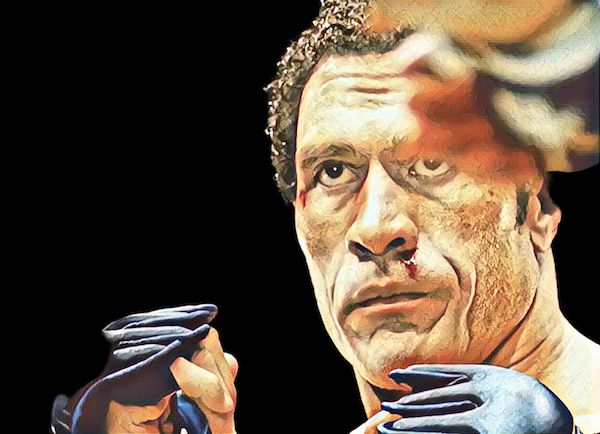
To embody Kerr, Johnson had to do something he had never done before: erase the myth of The Rock and give life to a broken man. The transformation was both physical and emotional. He worked with Oscar-winning prosthetics master Kazu Hiro, who reshaped not only Johnson’s features but also his very presence on screen. Every detail mattered — the hardened look of addiction, the fragility behind the muscles, the despair etched into his face.
Yet the deepest transformation was internal. Johnson, long known for his ironclad control of his public image — eternally charismatic, strong, and “larger than life” — allowed himself to crumble on screen. He let the camera capture his tears, his confusion, his vulnerability. He surrendered to the rawness of portraying a man undone by his own demons. At the Venice Film Festival, critics described his performance as a “revelation,” drawing comparisons to Mickey Rourke in The Wrestler and Brendan Fraser in The Whale — actors who, against expectations, found artistic rebirth in roles of aching fragility.
A full circle moment
There is a powerful symbolism in Johnson’s choice. He was never an MMA fighter, but his identity has always been forged in the ring. The grandson of Peter Maivia and son of Rocky Johnson, he grew up immersed in professional wrestling and became world-famous as The Rock. It was that persona — the gladiator of charisma and spectacle — that carried him into Hollywood, launching two decades of action hits, family comedies, and billion-dollar franchises.
Now, by playing a real fighter marked not by triumph but by collapse, Johnson makes a move of personal catharsis. He steps away from the scripted theater of wrestling to inhabit the raw truth of a man destroyed by his addictions. It is, in every sense, a full circle: the invincible hero of the ring embodying the fragile reality of one who could not survive it.
Critical reception
The impact was immediate. In Venice, the film was met with a 15-minute standing ovation, with Johnson visibly in tears. Variety called him “the year’s most unlikely revelation,” while GQ described The Smashing Machine as “the first truly great Dwayne Johnson film.” People highlighted his “raw intensity and rare vulnerability,” and the Washington Post went further, saying that Johnson not only disappears into Mark Kerr but also rediscovers himself as an actor.
There is near-consensus: Johnson is no longer an action star trying out drama. He is a legitimate contender for the awards season — including, perhaps, the Oscar itself.
What lies ahead
For Johnson, such recognition would be more than an accolade. It would mark the breaking of a decades-old perception. He has always been respected as a global star, rarely as a performer of complexity. The Smashing Machine could finally bridge that divide, aligning him with actors who reinvented themselves in roles of profound emotional weight.
And for Hollywood, the moment carries its own resonance. In an industry wrestling with box office decline and shifting genres, watching the world’s most bankable action star embrace fragility and nuance might inspire new career paths for others.
The man behind the myth
The Smashing Machine is not just a sports drama. It is a portrait of human fragility — and a trial by fire for Dwayne Johnson. The man who was born in the wrestling ring, who conquered action cinema and family comedies, now dares to show himself broken, vulnerable, and painfully real.
If the Oscars reward the courage to shed the persona and reveal the truth, then for the first time in his career, Johnson has entered the race with legitimacy. And perhaps that is the deepest irony: the man who once embodied invincibility now moves us by portraying the fighter who lost the battle within.
Descubra mais sobre
Assine para receber nossas notícias mais recentes por e-mail.
 miscelana.com