
As published in Bravo Magazine!
Telling stories in cinema and television does not depend solely on images or words. There is an element that flows through everything and becomes almost invisible, yet essential: the soundtrack. It can announce surprises, give body to the most intimate emotions, and above all, remain etched in collective memory. How could anyone forget the unforgettable Lara’s Theme in Doctor Zhivago? Or summon Hogwarts without immediately hearing in our minds the magical notes written by John Williams?
Music in audiovisual storytelling works as a bridge between literature and sensory experience. When a novel is transported to the screen, the score has the delicate task of recreating atmospheres that once lived only in the imagination of readers. Patrick Doyle did this like few others, translating Shakespeare, Agatha Christie, and Jane Austen into melodies that balance intimacy and grandeur. Maurice Jarre, in turn, transformed Pasternak and Forster into musical epics.
Alexandre Desplat brought to the 21st century the delicacy of Louisa May Alcott and the dark fantasy of Guillermo del Toro, showing that music continues to be the invisible thread between book and screen. Ennio Morricone, who signed more than 400 soundtracks in his career, not only shaped cinema but also gave literary audiovisual works a dimension of their own, with The Name of the Rose (1986), inspired by Umberto Eco’s novel, as one notable example.
In more recent times, names like Ramin Djawadi and Bear McCreary have proven that music is also the language of entire worlds on television. Djawadi, with Game of Thrones and House of the Dragon, not only accompanied the grandeur of George R.R. Martin but created anthems that became part of our collective imagination. McCreary, on the other hand, brought to Outlander and The Rings of Power a fusion of tradition and modernity, showing that soundtracks can give identity to universes that span centuries.
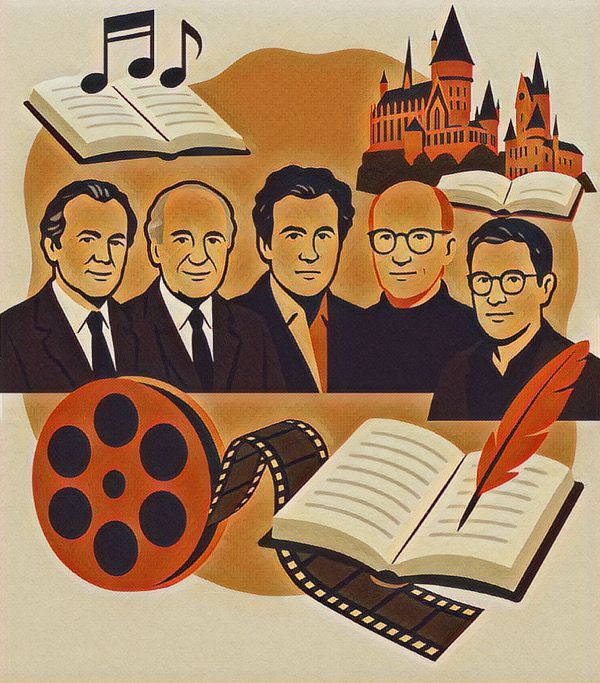
You know what’s hard? Talking about only five composers, but I accepted the challenge. I chose among my favorites, those most impactful when it comes to setting books to music on screen. The list may surprise you, but I’m certain you’ll agree with me! Each of these finalists reminds us that literature doesn’t reach cinema only through words, but also through the melodies that give shape to stories.
Patrick Doyle
Few composers are so intimately tied to literary adaptations as Patrick Doyle. A Scotsman and artistic partner of Kenneth Branagh, he created a true sonic identity for Shakespeare on film. They began together with the brilliant Henry V (1989), where Doyle’s symphony stands as an independent piece. It is an absolute must-have in any collection (though somewhat harder to find).
Perhaps his most popular with Branagh is the joyful and romantic Much Ado About Nothing (1993), where he set Sigh No More, Ladies to music—a song suggested in the play, but with Doyle’s melody, it became definitive. His work in Hamlet (1996), more symphonic, is also grandiose. Doyle managed to turn the cadence of Shakespearean poetry into accessible music without losing delicacy. Another iconic and important score is his contribution to Mary Shelley’s Frankenstein (1994), a film that wasn’t successful, though its music is undeniably moving.
It’s hard to control myself with Doyle, as I’m a huge fan. His works with Alfonso Cuarón also sail through literature: A Little Princess (1995) and Great Expectations (1998) are soul-elevating. And if that weren’t enough, in his work with Emma Thompson, his sensitivity also shone in Sense and Sensibility (1995), where he translated Jane Austen into melodies of timeless elegance.
In a more pop universe, his contribution to Cuarón’s Harry Potter and the Prisoner of Azkaban includes the love theme for our favorite wizard. I could go on endlessly, but then I’d only be talking about one composer. Because yes, even in Agatha Christie adaptations, he delivered unforgettable melodies. Patrick Doyle is unsurpassable.
Maurice Jarre
No other composer knew how to translate the literary epic like Maurice Jarre. His work in Doctor Zhivago (1965) turned Boris Pasternak’s novel into an unforgettable romantic experience, forever marked by the famous Lara’s Theme.
Years later, in A Passage to India (1984), he brought E.M. Forster’s prose into music, balancing exoticism and lyricism. Jarre specialized in amplifying the weight of literature, creating themes that became larger symbols than the films themselves.
John Barry
Elegance is the word that defines John Barry. His style, both romantic and majestic, made him one of the great names in turning pages into music. In Out of Africa (1985), based on the memoirs of Karen Blixen, Barry created a score of expansive beauty, which won the Oscar and became inseparable from the landscapes of Kenya.
Years later, in Dances with Wolves (1990), inspired by Michael Blake’s novel, he composed one of the most celebrated works of his career, again awarded the Oscar. In The Scarlet Letter (1995), an adaptation of Nathaniel Hawthorne’s classic, Barry delivered a score of intense lyricism that has outlasted the film itself.
But his name is also eternally linked to one of the most popular literary sagas of the 20th century: James Bond. Although the original theme was created by Monty Norman, it was Barry who orchestrated, expanded, and consolidated 007’s sound, scoring the music for 11 films in the franchise. In doing so, he not only gave Ian Fleming’s spy a musical identity but also established a sonic model that became synonymous with the spy genre in cinema.
James Horner
James Horner was the composer who knew how to unite the popular heart with literary adaptations. In Braveheart (1995), inspired by the historical chronicles of William Wallace, Horner built a hymn of freedom that still echoes. In A Beautiful Mind (2001), based on Sylvia Nasar’s biography, he used piano and ethereal voices to translate both the brilliance and the fragility of a mathematical genius’s mental health.
He also worked on The Perfect Storm (2000), adapted from Sebastian Junger’s book, and Legends of the Fall (1994), based on Jim Harrison’s novella. His music had the rare ability to be both grand and deeply intimate, creating emotional bridges between literature and audiences.
Alexandre Desplat
French and owner of an unmistakable sophistication, like Patrick Doyle, Alexandre Desplat has become a great literary translator of contemporary film music. His work balances lightness and density, as if each note were written to accompany words. In The Painted Veil (2006), inspired by Somerset Maugham, he composed a score of delicate refinement, which won the Golden Globe. In Little Women (2019), he found a modern lyricism to bring Louisa May Alcott’s prose to life.
He also contributed to Harry Potter, in the franchise’s final films; Twilight; as well as scores for The Imitation Game (2014), The King’s Speech (2010), The Danish Girl (2015), and many other Oscar films. But it is alongside Guillermo del Toro that he has found new prominence: already present in The Shape of Water (2017) and Pinocchio (2022), both treated as musical fables.
Now, in 2025, he resumes his partnership with del Toro in Frankenstein, an adaptation of Mary Shelley’s classic. His score has been described as emotional, grand, and poetic—not a musical horror, but a lyrical hymn to both creature and creator. Desplat thus confirms his place among the composers who have most brilliantly transformed literature into music in recent cinema, creating atmospheres that are both intimate and universal.
All of those mentioned here form a portrait of the diversity of voices that have turned books into music. From Shakespeare’s symphony to African lyricism, from medieval melancholy to epic heroism, their scores are memories that endure, reminding us that literature and cinema always find their soul in music.
Descubra mais sobre
Assine para receber nossas notícias mais recentes por e-mail.
 miscelana.com