
Season 5 of Only Murders in the Building leans into the clichés and classics of Italian Mafia lore in Manhattan as the trio of amateur sleuths and podcasters investigates the murder of doorman Lester Coluca. His body is discovered in the Arconia’s courtyard fountain, shocking Oliver, Charles, and Mabel, who had known him for decades but never suspected his hidden ties to crime. And where does this unlikely investigation lead them? Naturally, to the legendary Corleone mansion from The Godfather trilogy. Yes, the house is real — and its history is as fascinating as the fiction it helped create.
Few houses in film history carry as much symbolic weight as the Corleone residence in The Godfather. Located at 110 Longfellow Avenue in Emerson Hill, high up on Staten Island, New York, the mansion became one of the most recognizable images from the 1972 classic and has since entered the popular imagination as a symbol of family, power, and the Mafia’s American story. But before it was transformed into Don Vito Corleone’s fictional home, the property already had its own history — and it was precisely this blend of prestige, tradition, and architectural grandeur that caught Paramount’s attention.

Built in 1930 in the Tudor Revival style, with a stately brick-and-stone façade, leaded glass windows, and steeply pitched roofs, the house spans 6,248 square feet with five bedrooms and four bathrooms, set on half an acre. For many years, it was the residence of Joseph A. Palma, an Italian-American who served as Borough President of Staten Island from 1934 to 1945. His choice of Emerson Hill/Todt Hill, an enclave known for privacy and prestige, already reflected the aura of power that would later define the house on screen.
But according to Forbes, what truly brought the house into The Godfather’s orbit was a member of the cast itself. Actor Gianni Russo, who played Carlo Rizzi, reportedly led producers to the mansion. Having grown up in Staten Island, Russo knew the neighborhood well and pointed them toward the property just a stone’s throw from where he lived. That connection between actor and location sealed the mansion’s fate as the Corleone estate — a perfect blend of personal history and cinematic mythmaking.
The arrangement with the owners was straightforward: Paramount offered compensation to use the exterior of the house, with the guarantee that no interior filming would take place. The family agreed, and all interior scenes were instead shot at Filmways Studios in Harlem. To enhance the visual impact, Coppola’s crew built temporary set pieces — a stone wall, wrought-iron gates, even a guard booth with armed sentries. These additions, though fictional, have become inseparable from the image of the Corleone compound.
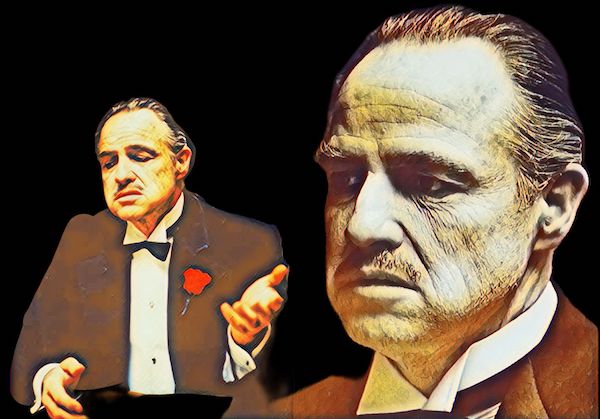
It was in this setting that two of the saga’s most iconic moments were staged: the wedding of Connie Corleone, which opens the first film, and later the death of Don Vito in the backyard (now occupied by a swimming pool), as he suffers a heart attack while playing with his grandson. In The Godfather Part II, the house reappears as Peter Clemenza’s New York base of operations, and after his death, it is inherited by Frankie Pentangeli.
The mansion’s real estate journey has been almost as dramatic as its on-screen life. It sold in 2012 for $1.687 million and underwent extensive renovations, including a modernized kitchen with two refrigerators and an island. Just three months later, it was relisted at $2.25 million, but was quickly taken off the market. In 2014, it resurfaced again at $2.895 million, only to be withdrawn after four months. Finally, in 2016, the house sold for $2.4 million. Around that time, Forbes estimated its market value at roughly $1.5 million.
The most unusual chapter came in 2022, when the mansion was listed on Airbnb for 30 nights at the symbolic price of $50 per night to mark the film’s 50th anniversary. Though the interiors had nothing to do with Coppola’s sets, the chance to stay in the Corleone house itself was enough to turn the listing into a worldwide cultural event.
Today, the property is celebrated both for its architectural beauty and for its place in film history. More than just a home, it has become a cultural landmark, embodying the fusion of reality and fiction: once the residence of a borough president, later the stronghold of cinema’s most famous Mafia family, and now a touchstone for generations of movie fans.

And now, with Only Murders in the Building turning its lens toward the Corleone mansion, the myth extends even further. A house that once belonged to a borough president, then became the fortress of Don Vito and Michael Corleone, now resurfaces as a clue in a modern-day mystery comedy. Reality and fiction, past and present, intertwine once more — proving that this Staten Island home will forever remain larger than life, both on screen and off.
Descubra mais sobre
Assine para receber nossas notícias mais recentes por e-mail.
 miscelana.com