
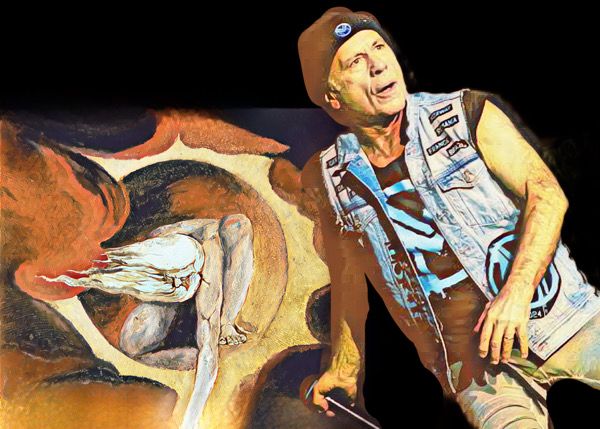
At a massive show during The Town festival, Bruce Dickinson — vocalist of Iron Maiden, writer, pilot, and one of the most iconic figures in heavy metal — dominated the audience with the same power that has marked his career for over four decades. The crowd roared as if witnessing a ritual: Dickinson, now in his sixties, still commands the stage with a presence that borders on mythical. Thrilled to be back in Brazil exactly forty years after his legendary debut at Rock in Rio in 1985, he not only delivered Iron Maiden classics like “The Trooper” and “Run to the Hills,” but also made a point of invoking the name of the man he calls his greatest idol: poet and painter William Blake.
For some, the connection might sound unlikely. What could an eccentric eighteenth-century English poet, mystic, and engraver possibly have in common with the raw power of heavy metal? For Dickinson, the answer is simple: Blake was a visionary, an artist who refused boundaries and fused spirituality, social critique, and his own mythology into a body of work that remains timeless. That same spirit of transgression, of never accepting the world as it is handed down, echoes not only through the history of Iron Maiden, but especially through Dickinson’s solo career.

Who Was William Blake
Born in 1757 and dead by 1827, Blake was an outsider in his own time. A poet, painter, and engraver, he claimed to converse with angels and biblical prophets. His contemporaries often dismissed him as mad, yet today he is celebrated as one of the pillars of Romanticism. Among his best-known works are Songs of Innocence and of Experience (1789/1794), contrasting childhood purity with social corruption; The Marriage of Heaven and Hell (1790), which gave us the immortal line “The road of excess leads to the palace of wisdom”; and Jerusalem (1804–1820), which would later become a near-national hymn for Britain, opening with the haunting questions:
“And did those feet in ancient time / Walk upon England’s mountains green?
And was the holy Lamb of God / On England’s pleasant pastures seen?”
For Blake, imagination was the true essence of existence. He built an entire mythology populated by figures such as Urizen — the oppressive embodiment of reason — and used visionary poetry to fuse politics, spirituality, and prophecy. In his art, he developed illuminated printing, uniting text and image in works that were both poems and paintings.
Blake’s Impact and Legacy
Blake’s influence stretches far beyond his lifetime. He inspired the Romantic poets Wordsworth and Coleridge, shaped modernists like W. B. Yeats and T. S. Eliot, and even haunted Beat poet Allen Ginsberg, who claimed to have literally “heard” Blake’s voice in visions. The Pre-Raphaelites revered him, while Surrealists and the psychedelic counterculture of the 1960s saw him as a precursor.
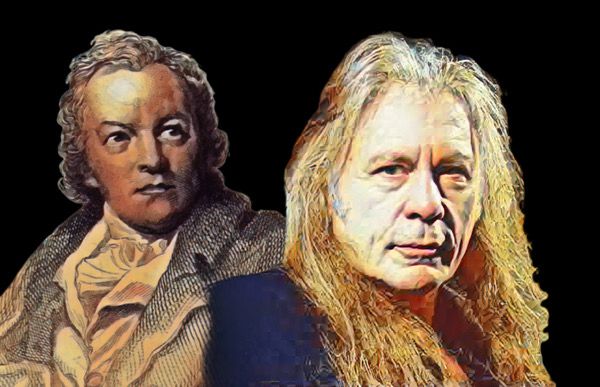
In music, his mark is everywhere. Bob Dylan wove echoes of Blake into his lyrics; Patti Smith has openly declared her admiration for his mystical poetry; U2 carried fragments of his imagery into their concerts; Jim Morrison and The Doors shared his obsession with merging spirituality, rebellion, and sensuality. Comic book writer Alan Moore drew heavily on Blakean visions in From Hell and V for Vendetta. Blake, who sold barely any books in his lifetime, became an enduring cultural icon.
William Blake in Bruce Dickinson: Verses Turned to Riffs
Dickinson doesn’t just read Blake — he channels him. His most celebrated solo album, The Chemical Wedding (1998), is practically a Blakean hymn set to metal. Its cover features Blake’s painting The Ghost of a Flea, and its lyrics are saturated with the poet’s mythos. What makes the album striking is how Dickinson takes Blake’s poetry and transforms it into music — sometimes quoting directly, sometimes reimagining it in thunderous sound.
1. “Jerusalem”
- Blake: “Bring me my bow of burning gold, / Bring me my arrows of desire.”
- Dickinson: sings the lines almost verbatim, but wrapped in massive guitar riffs, turning a spiritual summons into a heavy-metal anthem.
2. “Book of Thel”
- Blake: a mystical poem about innocence, fear of mortality, and the fleetingness of life.
- Dickinson: reshapes the text into a song drenched in melancholy and epic tones, carrying the same questions about innocence and death.

3. “Gates of Urizen”
- Blake portrays Urizen as the tyrant of reason, binding humanity with laws.
- Dickinson: “And he gave his light to the darkness / And he gave his life to the void” — a metallic echo of Blake’s indictment of rational oppression.
4. “The Trumpets of Jericho”
- Blake: invokes biblical resonance in visionary form.
- Dickinson: reworks the idea into crashing riffs, the trumpets becoming a symbol for breaking down the walls of conformity.
5. “The Alchemist”
- A meditation on transformation and hidden knowledge, mirroring Blake’s fascination with alchemy and spiritual rebirth.
Even Blake’s most famous poem, The Tyger, resonates with Dickinson’s world. Its verses — “Tyger Tyger, burning bright, / In the forests of the night” — feel almost designed for heavy metal, embodying ferocity, beauty, and the sublime all at once.
The Unlikely Meeting of Poetry and Metal
Dickinson’s devotion to Blake may sound unlikely at first, but on closer inspection, it makes perfect sense. Blake rejected boundaries, building art that was total — word, image, vision, and spirit. Dickinson does the same in music: he transforms metal into narrative, theater, and epic. It is no wonder that, in Brazil, before an ecstatic audience, the name of William Blake rang out as naturally as the roar of an electric guitar.
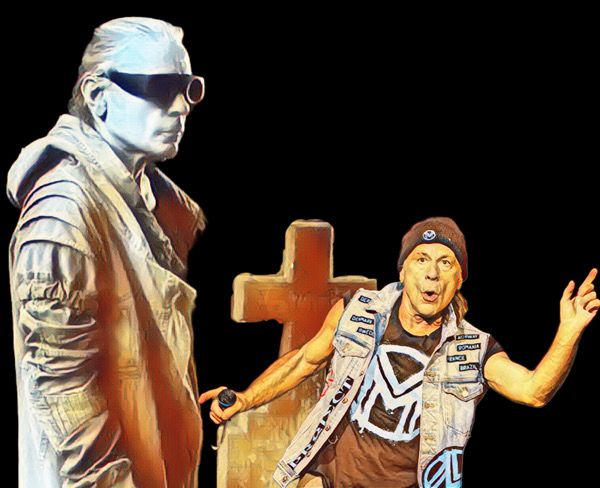
Forty years after his debut at Rock in Rio, Dickinson returned not only to celebrate his own career and the legacy of Iron Maiden, but also to honor a poet who died poor and largely ignored, yet whose light still burns. For Blake, imagination was the substance of life itself. In Dickinson, he has found a modern apostle, one who turns poetry into thunder, prophecy into riffs.
And the Brazilian audience understood. On that night, William Blake re-emerged in the form of heavy metal — a blazing vision, burning bright like the eternal tiger in the forests of the night.
Descubra mais sobre
Assine para receber nossas notícias mais recentes por e-mail.
 miscelana.com