
Since the dawn of cinema, the tension between mother-in-law and daughter-in-law has been one of the most enduring dramatic engines — and one of the most fascinating. It’s a relationship that transcends cultures, eras, and social classes, loaded with expectations, power struggles, and generational clashes. The mother-in-law is the guardian of the family’s status quo, while the girlfriend or wife represents the force of renewal, potentially disrupting domestic harmony. From Monster-in-Law (2005), with Jane Fonda and Jennifer Lopez, to Marie Barone in Everybody Loves Raymond, to the refined sparring matches of Downton Abbey and the high-stakes melodramas of Asian dramas, this battle has fueled comedy, tragedy, and even gothic tension — and has rarely failed to captivate audiences.

The Girlfriend, Prime Video’s miniseries based on Michelle Frances’ novel, takes this trope and reinvents it as a stylish, wickedly entertaining thriller, the kind of guilty pleasure that revels in its own messiness. From the opening scene, set to a haunting cover of “Everybody Wants to Rule the World” by Lorde, we hear doors slamming, raised voices, and someone shouting: “Laura, put the knife down!” — a signal that we are about to witness the ultimate showdown between two women who love the same man in completely different ways.
Directed by and starring Robin Wright, the series introduces us to Laura Sanderson, a successful London gallerist whose relationship with her son Daniel (Laurie Davidson) is so close it borders on suffocating. He is sweet, devoted, and the center of her existence — enough to be unnerving even before Cherry Laine (Olivia Cooke) comes into the picture. Cherry, a real estate agent from a working-class background, is determined to rise in the world and disrupts the carefully maintained order of the Sanderson household — and, in Laura’s eyes, threatens everything.

The series’s greatest strength lies in its narrative structure, which presents key events twice: first from Laura’s perspective, then from Cherry’s — sometimes in reverse order. This device not only builds tension but forces the audience to distrust both sides. Laura often seems excessively protective, teetering on the edge of pathology, while Cherry can be seductive and manipulative, yet also genuinely in love. It is a game of two truths — a puzzle in which each woman withholds key pieces, with Cherry’s ultimate secret only revealed near the end. The series invites us not just to ask who is lying, but why, and to realize that the core of the conflict is not simply Cherry but the unresolved, almost symbiotic bond between Daniel and Laura. As Howard (Waleed Zuaiter), Laura’s endlessly patient husband, says in a crucial moment, Laura’s deepest fear is being replaced by Cherry. That fear fuels every act of protection, every invasion of privacy, every burst of paranoia.
But Cherry is not merely “intense” — there are hints of psychopathy or sociopathy in her behavior that make her genuinely dangerous when pushed to the limit. Her obsession with her ex, her impulsive and vengeful acts, and her ability to mask her intentions when convenient reveal someone capable of going far beyond social audacity or romantic drama. And yet, she seems truly in love with Daniel, which keeps the audience from reducing her to a mere gold digger. The fact that she enjoys the perks of Daniel’s world — the clothes, the trips, the access to wealth — is never shown as her sole motivation; it is something that coexists with her feelings for him. This duality is what makes Cherry fascinating and threatening: she doesn’t just want Daniel or just the lifestyle — she wants both, and she will do anything to keep them.
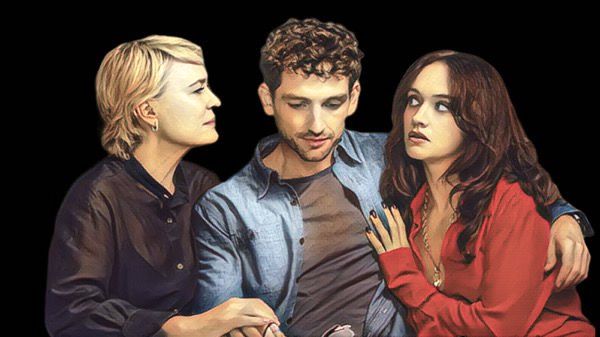
Unlike many thrillers of the genre, The Girlfriend refuses to let viewers take sides too soon — it wants them to waver, to feel unsettled, and to keep watching to discover who, if anyone, is “right.” It is in this gray area that Robin Wright and Olivia Cooke truly soar: Wright makes Laura believable even in her most paranoid spirals. At the same time, Cooke gives Cherry a magnetic charisma that keeps us suspended between empathy and fear.
Critics have praised Wright for grounding Laura with her trademark gravitas, making even her most irrational choices feel like the instinct of a fiercely protective mother — and Cooke for delivering a Cherry who is layered, ambitious, and never merely “the crazy girlfriend.” There is also a sharp social commentary at play, exploring class division: the money that allows Daniel and Laura to live effortlessly is the very thing that fuels Cherry’s hunger and anxiety. The writing plays clever games with our sympathies — it’s easy to root for Cherry when we watch Laura mock her “slightly vulgar” dress or accent, but the series quickly reminds us that Cherry lies, manipulates, and crosses boundaries.

The Girlfriend does not pretend to be a profound psychological study or a refined social drama like Big Little Lies (where the war between Meryl Streep’s mother-in-law and Nicole Kidman’s daughter-in-law adds a chilling layer of fear). Instead, it embraces its identity as a story of intrigue and excess, closer in spirit to The Hunting Wives than to any “serious” prestige drama. There are bold scenes of Cherry transgressing, dialogue that flirts with the trashy, and a deliciously nasty tone that keeps the series from becoming too heavy. Rather than aiming for absolute realism, it invites the viewer to revel in the absurdity — in dinner parties that end in tears, passive-aggressive confrontations, and knife-wielding showdowns.
At its core, The Girlfriend inherits an entire storytelling tradition but injects it with the freshness of a modern thriller. Where the mother-in-law was once a caricature of control and the girlfriend merely a victim, here both women are portrayed as complex, contradictory individuals, driven by fear, desire, and the need to belong. It is a psychological duel that does not ask the audience to find heroes or villains, but to immerse themselves in the battle and sit with the discomfort.
And perhaps that is why it works so well: because it transforms an archetypal conflict — mother and girlfriend, tradition and disruption, love and possession — into spectacle, with blood, irony, and a darkly glamorous edge. If you have not read the book but pay attention to the tightly woven details of the series, there are no major surprises: we know where it is all heading from the very first scene. But The Girlfriend doesn’t care — the pleasure lies in watching every step of this intimate war and discovering just how far these two women are willing to go to avoid losing the man who binds them — a man who, ultimately, is only a supporting player in his own story.
Descubra mais sobre
Assine para receber nossas notícias mais recentes por e-mail.
 miscelana.com