
The release of The Long Walk in 2025 put Stephen King back at the center of a discussion he himself started more than forty years ago. King not only wrote the original novel in 1979, but also closely followed the film adaptation — and for many younger viewers, watching it was almost a revelation. After all, for those who grew up on The Hunger Games and binged Squid Game, it’s hard to imagine that this concept — a deadly game of physical endurance, used both as entertainment and as a tool of control — was invented decades earlier in a lean, existential horror novel King published under the pseudonym Richard Bachman. The Long Walk is, in many ways, the spiritual father of all these modern narratives, and the film has resurrected that fact for a generation that thought it was seeing something “new” when Katniss first raised her bow or when masked men herded debtors into a giant warehouse in South Korea.
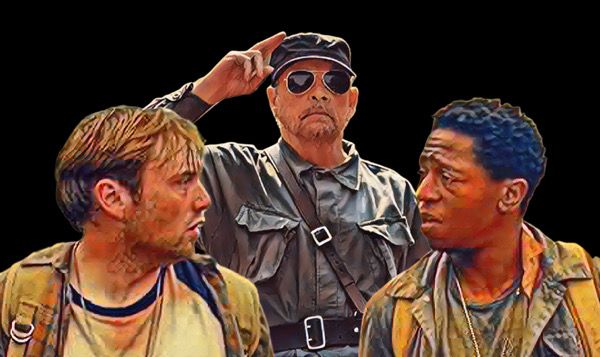
What makes The Long Walk so striking — in book or film — is the brutal simplicity of its premise: one hundred boys walk until only one remains. There are no weapons, no technological arenas, no chances to hide. Just the body and the road. The Major, lived on the screen by Mark Hammill, a figure of almost mythical authority, represents the system that watches, punishes, and executes without hesitation. Every bullet fired at those who fail to keep the minimum pace is a reminder of the price of falling behind — and every step Ray Garraty takes is both an act of submission and defiance.
Stephen King wrote this in 1979, long before Big Brother, long before Survivor, long before reality TV became a cultural obsession. He predicted the spectacle of pain before we had live cameras to capture it. That’s why the story feels so current: because what King imagined as a metaphor has become routine. We watch people confined, tested, broken down, pushed to their limits — and make it the topic of next-day conversation. King simply stripped away the pretense and showed us the most ruthless version of this logic: what if failure meant death?

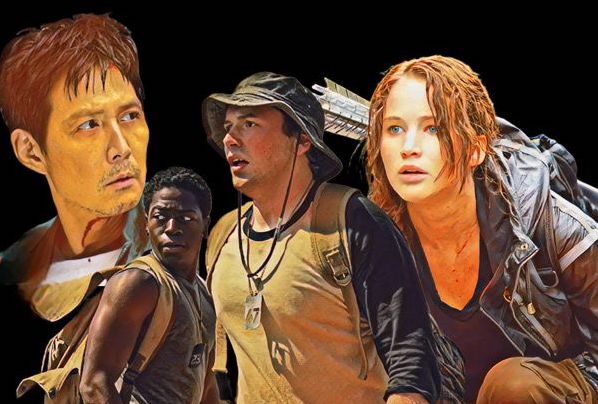
Suzanne Collins, with The Hunger Games, took this concept one step further — she turned the cameras on. In Panem, oppression only works because it is broadcast. The Games are not merely punishment; they are a show. The Capitol demands not just that the districts sacrifice their children, but that they watch closely, that they cheer, that they care. Katniss Everdeen learns early on that every gesture, every tear, every kiss with Peeta will be edited, televised, and used — and she starts playing the game of image manipulation to subvert the system. Resistance in The Hunger Games is also a spectacle, and Collins is brilliant at showing this paradox: to bring down the regime, Katniss must become a star.
And then came Squid Game, which became one of Netflix’s most-watched shows ever. The series is stylish, bloody, addictive — and also far less “new” than many of its fans believed. It masterfully repeats the pattern that King and Collins had already explored: ordinary people forced into deadly games for a prize that promises salvation. But Hwang Dong-hyuk adds an even more brutal twist: here, the system isn’t a government but capital itself. It isn’t the state that watches, but money that buys. And the audience isn’t a nation forced to watch — it’s a handful of masked billionaires who consume human suffering as luxury entertainment. The game becomes a literal product to be consumed — and, ironically, the show itself became one of the most profitable products in streaming history.

But to trace the genealogy of this idea, you can’t ignore Battle Royale. Koushun Takami’s 1999 novel, and its 2000 film adaptation, sent an entire class of students to kill each other on a remote island, under military supervision. It was a fierce critique of Japanese authoritarianism and the fear of a lost generation standing at the turn of the millennium. Battle Royale shocked Western audiences — and likely paved the way for Suzanne Collins to write The Hunger Games for a global YA audience. Together, these works built an entire narrative tradition: youth sacrificed as spectacle, the body turned into a currency of control.
And that body is at the heart of it all. Garraty cannot stop, because stopping means dying. Katniss cannot refuse to fight, because that would mean abandoning her sister and District 12. The students of Battle Royale must kill or be killed, even if that means murdering their best friend or first love. The players of Squid Game see their debts turned into betting chips, and everybody who falls increases the value of the jackpot. The body is simultaneously a prison and the last tool of freedom. It is where the horror is concentrated — and where resistance is carved out.

And in this, Collins, Takami, and Hwang Dong-hyuk are perhaps even more ruthless than George Orwell. 1984 was about the mind, about the control of language and the destruction of thought. But Panem, King’s endless road, Takami’s island, and Hwang’s deadly playground are about something far more physical, far more visceral: the blood running down legs, the skin tearing open, the feet bleeding raw. Dystopia is no longer purely intellectual — it has become sensory. We don’t just understand it, we feel it.
And here lies the final irony: we, too, turn these stories into spectacle. We read The Long Walk with morbid fascination, rooting for Garraty. We cheer and cry with Katniss. We dress up in green tracksuits for Halloween after watching Squid Game. We cosplay characters who were created to criticize our appetite for watching suffering. Perhaps this is the most unsettling thing that King, Collins, Takami, and Hwang leave us with: we are not innocent bystanders. We are part of the cycle. We keep watching — and, in a way, keep asking for more.
Descubra mais sobre
Assine para receber nossas notícias mais recentes por e-mail.
 miscelana.com