
In 2025, we celebrate the 135th anniversary of Agatha Christie‘s birth — and in 2026, it will be 50 years since her death — a milestone that reminds us how alive her work still feels. Christie didn’t exactly invent the whodunit — Wilkie Collins’ The Moonstone (1868) and Conan Doyle’s Sherlock Holmes had already laid the groundwork — but she refined it to perfection and turned it into the gold standard of mystery fiction.
The Christie whodunit became a kind of mathematical formula: a closed circle of suspects, a murder that appears impossible, clues fairly placed for the reader to follow, a brilliant detective — whether Poirot, Miss Marple, or another — and a final revelation that makes every piece click into place. This “fair play” approach is key: Christie invited her readers to play along, to solve the case before the last page, and then delighted them with a twist that felt shocking yet inevitable.

The Big Twists
Christie wrote 66 detective novels and 14 short-story collections, but a few stand out for their audacity and innovation. The Murder of Roger Ackroyd (1926) is a watershed moment: its narrator, Dr. Sheppard, turns out to be the killer — a move that shattered conventions and sparked debates about whether it was “fair.” And Then There Were None (1939) is perhaps her darkest and most influential work: ten strangers lured to a remote island are killed off one by one, with no detective to save them, resulting in one of the most haunting endings in crime fiction. It remains her best-selling book, with over 100 million copies sold worldwide.
- Murder on the Orient Express* (1934) is arguably her most iconic story, with its ingenious ending — everyone is guilty — a radical but perfectly logical resolution. Death on the Nile (1937) and A Murder is Announced (1950) are further proof of Christie’s mastery at hiding clues in plain sight and directing the reader’s attention away from the truth until the perfect moment.
From Page to Screen
Cinema fell for Christie early on. Sidney Lumet’s 1974 adaptation of Murder on the Orient Express is considered a masterpiece, with Albert Finney’s Poirot leading an all-star cast including Lauren Bacall and Ingrid Bergman (who won an Oscar for her role). John Guillermin’s Death on the Nile (1978) brought Peter Ustinov to the role of Poirot — an actor whose interpretation of the Belgian detective became beloved in the late 20th century.

In recent years, Kenneth Branagh has reintroduced Christie to new audiences with Murder on the Orient Express (2017), Death on the Nile (2022), and A Haunting in Venice (2023), a loose adaptation of Hallowe’en Party. Branagh’s Poirot is more emotionally wounded and complex, with a past that haunts him. These films bring lush visuals, a heightened sense of drama, and a touch of gothic atmosphere, especially A Haunting in Venice, which shifts the action to a fog-drenched Venetian palazzo and flirts with the supernatural. It is a Poirot film as much about ghosts — literal and psychological — as about the crime.
The Life of Agatha
Agatha Mary Clarissa Miller was born in Torquay, Devon, in 1890, the daughter of an American father and an English mother. She grew up in a comfortable home, was educated at home, and dreamed of becoming an opera singer. She even studied music in Paris, but was told her voice was lovely, but lacked the power for the stage. Returning to England, encouraged by her mother, she began writing stories.
During World War I, Christie worked as a nurse and later as a dispenser in a hospital pharmacy, where she learned about poisons and chemicals, a knowledge that became a signature element in her plots. Her first novel, The Mysterious Affair at Styles (1920), introduced Hercule Poirot. It was rejected by several publishers before finally being released — and quickly found a devoted readership.
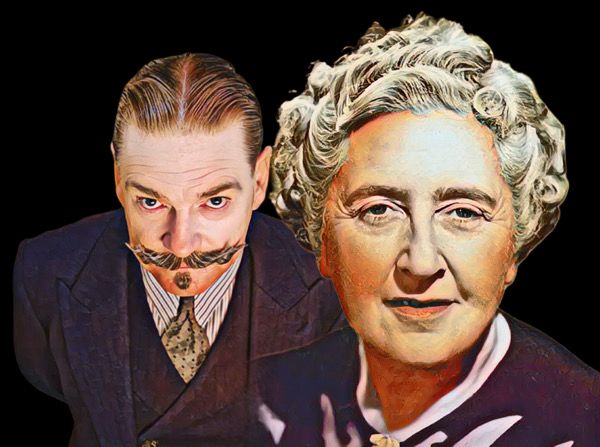
Her first marriage, to aviator Archibald Christie, ended painfully when he asked for a divorce, admitting he had fallen in love with another woman. It was during this time, in 1926, that Agatha disappeared for 11 days — an event that captivated the entire country. Her abandoned car was found, and she was eventually discovered at a spa hotel, registered under the name of her husband’s mistress. Biographers today largely agree that this was the result of a nervous breakdown rather than a publicity stunt.
In 1930, Agatha married archaeologist Max Mallowan, with whom she shared a happy and intellectually rich life until her death. Traveling with Mallowan to archaeological digs in the Middle East inspired some of her most atmospheric novels, including Death on the Nile and Murder in Mesopotamia.
Christie passed away peacefully in 1976, at the age of 85, at her home in Oxfordshire. Her death was mourned worldwide — obituaries hailed her as “the greatest storyteller of the 20th century.”
A Legacy That Won’t Fade
Fifty years after her death, Agatha Christie remains one of the best-selling authors in history, with over two billion books sold. Her stories continue to inspire stage plays, TV series, films, and even video games. Most importantly, the whodunit she perfected is alive and thriving: Rian Johnson’s Knives Out films, Lucy Foley’s bestsellers, and TV hits like Only Murders in the Building are proof that we still crave the intellectual game Christie offered. Just like See How They Run, The White Lotus, or The Afterparty

Why does it still work? Because her stories tap into a universal human need: to make sense of chaos. A crime disrupts the social order, but the solution restores balance. When the detective gathers everyone in the drawing room and lays out the truth, the world feels right again — no matter how many secrets are exposed along the way.
At 135, Agatha Christie remains unmatched. Not because no one has tried to surpass her, but because she crafted something so precise, so elegant, that it still feels definitive. Reading Christie in 2025 is to realize that behind every murder mystery we consume today — in books, on streaming, on the big screen — there is still the echo of a woman who turned logic and suspense into an art form.
Descubra mais sobre
Assine para receber nossas notícias mais recentes por e-mail.
 miscelana.com