
I’ve said before that I have a hard time with gore. Graphic, bloody violence usually repels me, and my stomach turned more than once during Chief of War’s finale — but here, it made perfect sense. There was no way to avoid intensity, pain, blood, and vengeance in the great confrontation — just the first — that the series had been building toward since the opening episode.
Keoua and the Price of Alliance
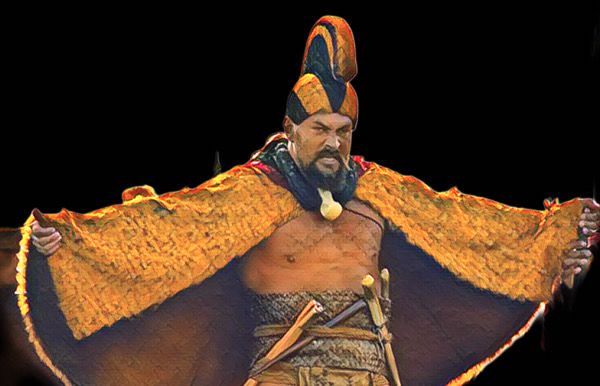
The penultimate episode had already made it clear that there was no turning back. The eruption of the volcanoes was taken as a sign that Pele, the fire goddess, stood with Keoua. Districts that had once hesitated now joined him — including Hilo, whose chief brought men, support, and even the sacred club of his bloodline. But Keoua wanted more: humiliation, not just loyalty. He forced the chief to offer his own teeth as a sacrifice to Pele. It’s a cruel moment that shows Keoua doesn’t just want to win — he wants to hurt. Now, with Hilo and Maui behind him, he marches to war against Kamehameha.
Ka’iana Steps Into His Destiny — and His Conflict
On the other side, Kamehameha chooses Ka’iana as his chief of war — a decision that completes Ka’iana’s journey from fugitive to leader. The ivory tooth necklace he’s given is more than a symbol; it’s the weight of prophecy. At his side is Ka’ahumanu, now formally a member of his council, a bold choice that enrages her father, who already distrusts her proximity to Ka’iana.
And this is where the finale hits its most human and painful note. There is something unspoken between Ka’iana and Ka’ahumanu — something Kamehameha is starting to notice. He may be a king, but he’s also a man, and Ka’iana’s loyalty is both a blessing and a threat. The look Kamehameha gives Ka’iana carries respect but also a flicker of jealousy. Ka’iana, for his part, seems to have made peace with the past: when his brother Namake confesses that he and Kupuohi were together when they believed Ka’iana was dead, Ka’iana does not rage. His forgiveness is quiet, maybe because he already knew, maybe because the pain has transformed into something deeper. But the viewer feels that this wound, even if healed, could break open again — and that this love triangle will be impossible to avoid in the next season.
The Battle and Its Consequences
When the armies meet in the black desert, Pele makes her presence known, and the battle begins. The series doesn’t hold back: the fighting is physical, relentless, and fueled by fury. Heke has her defining moment facing Opunui, avenging the violence he inflicted on her after Nahi’s death. It’s brutal, but it completes her arc — a painful catharsis that gives her strength.
Keoua, meanwhile, is betrayed by the very goddess he thought blessed him. The ground opens, and the fire swallows his army whole. Ka’iana survives but is knocked unconscious until the fighting is done. When he wakes, he is hailed as a hero — but immediately redirects the glory to Kamehameha, leading the chants of victory for the king. It’s a symbolic scene, one that acknowledges the larger role prophecy has given him.

Kahekili and the Next Act
Meanwhile, in Maui, Kahekili reveals just how cruel he can be. He confronts his son Kupule and his lover Lima, torturing the advisor in front of the injured young man — a sadistic display of power. He doesn’t kill Lima but breaks him. For Kahekili, Kamehameha’s victory is not a defeat but a provocation, a sign from the gods that his destiny is to kill Ka’iana. Every step, to him, is part of a larger plan leading to an inevitable final showdown.
An Ending That Opens the Door
With Keoua defeated, Kamehameha is closer than ever to uniting Hawai’i, but nothing is truly resolved. Kahekili remains a looming threat — crueler and more dangerous than ever. And the tension between Ka’iana, Ka’ahumanu, and Kamehameha is a ticking time bomb that the series seems eager to explore. Chief of War makes it clear that this was only Act One. The red-mouthed weapons will have to be raised again.
Descubra mais sobre
Assine para receber nossas notícias mais recentes por e-mail.
 miscelana.com