
It has always struck me as ironic that when we talk about the “creation of social media,” the first name that comes to mind is Mark Zuckerberg and Facebook — forgetting that the first true social network was launched back in 1997 by Andrew Weinreich with SixDegrees. But when it comes to dating apps, it’s impossible to ignore the woman who changed how we meet online forever: Whitney Wolfe Herd.
Whitney named Tinder, led its campus marketing campaign, and helped turn it into a global phenomenon. But by 2014, her relationship with the company soured: she left under allegations of sexual harassment and gender discrimination, sued the founders, and became a symbol of a larger reckoning with Silicon Valley’s toxic culture. The biopic Swiped dramatizes this arc of rise, fall, and reinvention — following her journey from Tinder to founding Bumble, the app that put women in control of the first move.

The film begins lightly, almost as a romantic comedy, before plunging into the suffocating atmosphere of early 2010s tech offices, exposing casual sexism and systemic exclusion. This first half is vibrant, acidic, and unflinchingly honest, evoking genuine indignation as we watch Whitney get sidelined from decisions, harassed at events, and ultimately pushed out of the company she helped build.
It’s here that Lily James truly shines. Her flawless American accent and nuanced performance capture the mix of euphoria and frustration of someone who, so young, found herself at the center of a cultural revolution and a personal storm. The film’s second half, however — which follows the creation of Bumble — is more linear, cleaner, and risks becoming too mythologized. Challenges are overcome too quickly, and Whitney’s triumph feels almost too perfect.
Even so, Swiped serves an important purpose: it exposes tech’s entrenched misogyny and inspires conversations about who gets to shape the digital spaces we inhabit. Dan Stevens, nearly unrecognizable as Russian investor Andrey Andreev, is a scene-stealer, injecting humor and unpredictability into the film. Watching Swiped is also a reminder that Hollywood has discovered a gold mine in corporate and tech dramas — and even when reality is messier than fiction, it’s worth revisiting through a female lens.
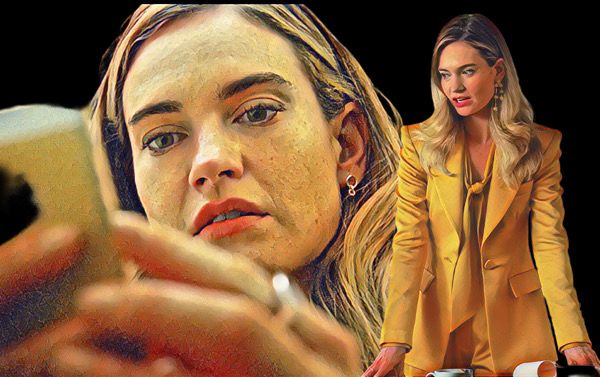
To dig deeper into how this story was brought to life, I spoke with star Lily James and director Rachel Lee Goldenberg.
Q&A with Lily James and Rachel Lee Goldenberg
CLAUDIA: The film starts almost like a romantic comedy and then dramatically shifts its tone. Was that always intentional?
Rachel: Yes, absolutely. The goal was for the audience to feel what Whitney felt: at first, she’s full of energy, the world seems open, and everything feels possible. We wanted that light, poppy, fun tone. But as things begin to unravel, the tone darkens — the lighting changes, the humor drops away, the mood shifts. We wanted the audience to track her emotional journey as closely as possible.
CLAUDIA: Lily, you had to play ten years of Whitney’s life in just two hours. What was the biggest challenge?
Lily: The biggest challenge was embracing both the highs and the lows. With great success comes great adversity, and I wanted to be honest about that. I related to her ambition and her courage to follow her heart. It was so inspiring to show her transformation — from this optimistic young woman fresh out of college to a formidable entrepreneur.

CLAUDIA: You reunited on screen with Dan Stevens, who you worked with on Downton Abbey. How was that experience?
Lily: It was so special! One of my very first scenes on Downton Abbey was with Dan, so it felt like closing a circle. He’s brilliant in the film, completely transformed — and it was just so much fun to work with him again after all these years.
CLAUDIA: Rachel, telling this story must have been complicated, given that Whitney still has NDAs with Tinder. How did you work around that?
Rachel: We researched everything publicly available — interviews, court documents, articles. We weren’t able to speak to her directly, but we wanted to honor her story and avoid flattening her into a one-dimensional heroine.
CLAUDIA: What do you hope audiences will take away from this story?
Rachel: I hope the film sparks conversations. Being a woman in a male-dominated space is still a challenge, and I wanted to explore how you navigate that, where you draw your moral lines. If this film makes people talk about those issues — even in their living rooms — then that’s a win for me.
Lily: And I hope people feel inspired by Whitney’s courage. She turned something very painful into something transformative, and that’s incredibly powerful.
Descubra mais sobre
Assine para receber nossas notícias mais recentes por e-mail.
 miscelana.com