
If Jackson Lamb is the most unforgettable face of Slow Horses, Diana Taverner is its cold, calculating brain – and, in many ways, the real engine that drives Mick Herron’s entire saga. Across the books and the Apple TV+ adaptation, she is a quiet force who rarely allows herself to be caught off guard. Her presence is the constant reminder that MI5 is not just disgraced spies and botched missions; it is a political machine, ruthless and willing to sacrifice pieces to ensure its own survival.
In the Books: Ambition in the Guise of Pragmatism
In Herron’s novels, Diana Taverner is known to veterans of the service as the “Second Desk,” the second-highest position in MI5, just below the ever-absent First Desk. She is shrewd, practical, and – unlike Lamb – refuses to hide behind cynicism. Her game is clear: climb to the top and turn MI5 into what she believes it should be, even if that means engineering crises and using allies as leverage.
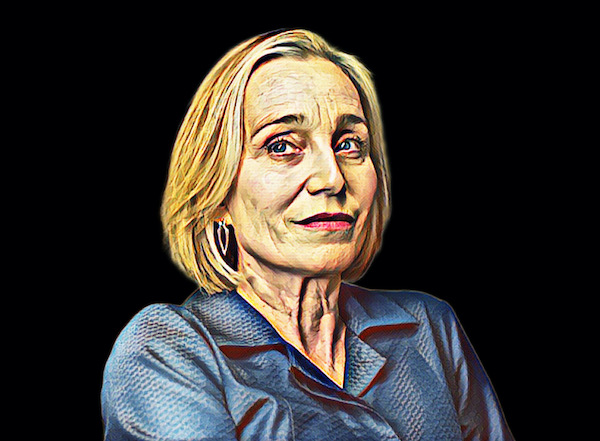
Taverner is the character who most clearly exposes the political machinery of the spy world. If Lamb is the man of action and River Cartwright the idealist-in-training, Diana is the strategist who keeps the gears turning, even when that means morally gray operations. Her relationship with the slow horses is purely utilitarian: they are tools to be used, discarded, or – occasionally – saved, if saving them serves a larger goal.
In London Rules, perhaps the book that gives her the most agency, we see Taverner manipulating a volatile situation of terrorist attacks to consolidate her power. Herron writes her as someone who will gamble with reputations, careers, and even lives if it means emerging from the crisis stronger than before. This is the point in the series where she steps out of the shadows and into the front line, navigating cabinet meetings and life-or-death decisions.
On the Series: Coolness with a Touch of Wit
In the Apple TV+ adaptation, Diana Taverner is given face and body through the razor-sharp performance of Kristin Scott Thomas – and it is almost impossible to imagine anyone else in the role. The actress brings a fascinating balance of elegance, disdain, and composure to the character. Every look, every pause, every perfectly measured line delivery speaks of a woman who has seen it all and will not be intimidated – not by Lamb’s chaos, nor by the political disasters that threaten MI5.

The show softens some of the harder edges of Herron’s Diana, giving her more wit and almost turning her into a co-conspirator with the audience. In her interactions with Lamb, there’s a rivalry chemistry that borders on playful, though the underlying tension never dissipates. Kristin Scott Thomas achieves the near-impossible: she makes us root for someone who moves lives around like chess pieces.
What Kristin Scott Thomas Brings to the Role
Kristin Scott Thomas elevates Diana into something greater than an ambitious bureaucrat. She gives her charm and a dangerous magnetism. Her “Lady Di,” as Lamb mockingly calls her, is simultaneously icy and deeply human. There is a clear satisfaction in watching her win – whether it’s outmaneuvering a political rival or getting Lamb to begrudgingly cooperate.
The actress also layers in subtle vulnerability, especially during moments of crisis. This Diana is not made of stone; she feels the weight of running an organization that feeds on perpetual emergencies. In brief flashes, we see her frustration, her exhaustion, even her fear – emotions that do not paralyze her, but make her more complex.

Evolution Across the Story
Diana begins as a loyal deputy, someone who must balance obedience to the First Desk with the instinct to protect her own position. Slowly, we see that she doesn’t just want to follow orders – she wants to give them. Her arc is one of someone learning to leverage crises not merely to survive them, but to shape them to her advantage.
In London Rules, this transformation reaches its peak. Diana takes risks that could end her career if anything goes wrong – but she emerges more powerful than ever. At this point, she becomes almost Shakespearean: a woman convinced of her own destiny, willing to get her hands dirty to claim it.
Diana and Lamb: Rivals, Allies, Survivors
One of the richest dynamics in Slow Horses is the relationship between Diana and Jackson Lamb. They have known each other for decades, and their history suggests a time when they may have been allies – perhaps even friends. Now, they are adversaries who respect each other and, crucially, need each other to survive. Diana needs the slow horses to do the dirty work without implicating MI5; Lamb needs her to keep his team from being quietly erased from the map.

This love-hate relationship is one of the series’ greatest pleasures, and Kristin Scott Thomas and Gary Oldman make it electrifying. Sometimes a single look exchanged between the two carries more charge than an entire action sequence.
Diana Taverner is, in many ways, the axis around which the entire Slow Horses universe spins. She is proof that the most dangerous battles in espionage are not fought on the streets of London but in the closed rooms of Whitehall. Ambitious, elegant, ruthless, and occasionally vulnerable, she is the character who most embodies the cost of holding power – a cost she seems perpetually willing to pay.
Descubra mais sobre
Assine para receber nossas notícias mais recentes por e-mail.
 miscelana.com