
The Monster franchise, created by Ryan Murphy and Ian Brennan, debuted in 2022 with a season dedicated to Jeffrey Dahmer and quickly became one of Netflix’s biggest audience phenomena, ensuring its continuation as an anthology series based on real crimes. Awarded a Golden Globe for Evan Peters and recognized at the BAFTAs, the series was not without controversy: accused of exploiting victims’ suffering and distorting facts, as in the case of the Menendez brothers, it sparked debates about how far true crime can be recreated as entertainment without losing ethical responsibility. Now, with Monster: The Ed Gein Story, the franchise returns to the birthplace of psychological horror that inspired classics like Psycho, exploring the figure of Augusta and the making of the “Butcher of Plainfield” — perhaps its most disturbing portrait yet.
And it makes sense, because in the criminal history of the United States, few names provoke as much horror as Ed Gein. His macabre crimes — murders, grave robberies, the transformation of human remains into household objects — became fuel for fiction and the direct inspiration for iconic characters like Norman Bates in Psycho. But before all this, Ed Gein was just a boy from rural Wisconsin, devoted to the point of obsession to the most dominant figure in his life: his mother, Augusta.
The new season repositions the central question: who created the monster?

A religious, obsessive, and tyrannical mother
Augusta Wilhelmine Gein was born in 1878 and, from an early age, lived according to strict religious values. Married to George Gein in 1900, she became the true authority in the household. According to contemporary reports, including a 1957 Time article, Augusta was described as a domineering and uncompromising woman who viewed the modern world as corrupt and sinful.
She recited biblical stories to her sons, Henry and Ed, warning that women’s immorality would bring about the end of times. For Augusta, makeup, short skirts, and any sign of modernity were instruments of damnation. While her husband sank into alcoholism, Augusta isolated her children from social interaction and kept them busy with farm chores, cultivating a suffocating dependency.
Experts believe this environment contributed to the development of an Oedipus complex in Ed, who never had romantic encounters and grew emotionally incapable of detaching from his mother.
Losses, isolation, and the mother’s shadow
The death of his father in 1940 and the suspicious death of his brother Henry in 1944 left Ed alone with Augusta. Officially, Henry was said to have died of asphyxiation while helping his brother put out a fire near the farm. However, police found bruises on his head, suggesting he may have been struck. The most intriguing detail was that Ed, when alerting the authorities, was able to lead them directly to the location of the body, despite claiming he had lost sight of his brother in the flames. No investigation was carried out, and the case was closed without charges, but for many scholars this episode may have been the first concrete sign of violence in Ed’s trajectory — a point of no return.
With Henry out of the way, Ed’s relationship with Augusta, already marked by dependence and devotion, became absolute. When she suffered two strokes and died in December 1945, Ed was devastated. Without electricity, without running water, and now without his central figure, he transformed the interior of the house into a mausoleum. Entire rooms were preserved as shrines to his mother’s memory. It was as if Augusta continued to inhabit those walls. For the psychiatrists who later analyzed him, this morbid mourning was the trigger for his psychosis. As he would recall years later: “a force built up in me.”

From devotion to horror
Without Augusta, Ed plunged into a dark delirium. He began frequenting cemeteries, exhuming corpses, and collecting human remains in an attempt to physically recreate his mother. The goal was explicit: “to become her,” sewing a “female suit” out of human skin.
This obsession exploded into homicidal violence. In 1954, Ed killed Mary Hogan, the owner of a local tavern. Three years later, in 1957, he murdered Bernice Worden, owner of a hardware store. It was this last crime that led police to the Gein farm — and to the discovery of an unimaginable scene: heads, viscera, skin masks, and furniture made from human parts.
The most disturbing detail? The entire house was in ruins, except for Augusta’s room, kept immaculate.
The legacy of obsession
Arrested and diagnosed with schizophrenia, Ed was initially considered unfit to stand trial. In 1968, he was eventually convicted, but remained institutionalized until he died in 1984. He was buried in an unmarked grave, ironically between Augusta and Henry, as if he could never escape the family that shaped him.
For many scholars, Augusta’s figure is inseparable from Ed’s monstrosity. Not because she foresaw her son’s fate, but because her religious obsession, authoritarianism, and isolation created fertile ground for madness.
Popular culture captured this dynamic like few other examples: Norman Bates in Psycho or Buffalo Bill in The Silence of the Lambs are spiritual children of this diseased relationship between Ed and Augusta.
As Bates himself says in a line that could have come from Gein: “A boy’s best friend is his mother.”

Psycho: the book, the film, the legend
Of all the terrifying characters Gein inspired in cinema, none stands out more than Norman Bates, who generated a classic, sequels, unsuccessful remakes, and even a prequel series (Bates Motel), entirely detached from the true story. And before all that, there was the book.
The novel Psycho, written by Robert Bloch in 1959, was directly inspired by Gein’s crimes, whose 1957 arrest shocked the United States. Alfred Hitchcock, attentive to the potential of psychological horror, anonymously purchased the rights to the work for just $9,000. Fascinated by its critique of sexual repression and its intense narrative, he brought it to the screen in 1960. Gein was still alive, institutionalized in a psychiatric hospital, and the repercussions were immediate: the association between his crimes and Norman Bates cemented the Butcher of Plainfield as a cultural ghost. The film, starring Anthony Perkins and Janet Leigh, redefined modern horror and remains one of the most influential works in cinema history.


In the new season of Monster, Netflix expands this link between reality and myth by recreating the behind-the-scenes of Psycho. Tom Hollander plays Alfred Hitchcock, Joey Pollari embodies Anthony Perkins as Norman Bates, and Olivia Williams portrays Alma Reville, the director’s wife and creative collaborator. By intertwining criminal investigation and filmmaking, the series reinforces how Gein’s monstrosity transcended the crime pages to become eternalized in cultural imagination through cinema.
Ryan Murphy and the unsettling fascination
By casting Laurie Metcalf as Augusta and Charlie Hunnam as Ed, Monster: The Ed Gein Story recovers not only the crimes but also the psychological roots of horror. The relationship between mother and son is presented as the true heart of the tragedy.
Laurie Metcalf is one of the most respected actresses of her generation, capable of moving seamlessly between sharp comedy and intense drama. She gained worldwide recognition as Jackie in Roseanne — a role that earned her three Emmys — and won critical acclaim as the controlling mother in Lady Bird (2017), which led to Oscar, Golden Globe, and BAFTA nominations. A two-time Tony Award winner, Metcalf combines hardness, fragility, and magnetism on stage, making her perfect to play Augusta. As in Lady Bird, she revisits the visceral mother-child relationship, but now in a context where love and obsession tragically intertwine.
Meanwhile, Charlie Hunnam, best remembered as Jax Teller in Sons of Anarchy, surprises by taking on Ed Gein. Until now associated with charismatic antiheroes (Pacific Rim, King Arthur, The Lost City of Z), he dove into a characterization that emphasizes isolation and strangeness. He worked on the voice and physicality to convey the suffocating dependence on his mother. Alongside Metcalf, he delivers one of the boldest and darkest roles of his career.
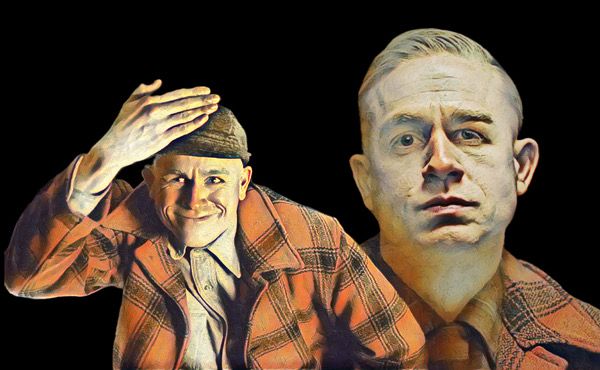
It is uncomfortable, but inevitable, to reflect: Ed Gein was not born a monster. He was shaped in silence, inside an isolated house, under the shadow of a mother who tried to shield him from evil — and ended up becoming its source.
In the end, the story of Ed and Augusta Gein is not just a criminal case, but a distorted portrait of the devastating power of human relationships when marked by fear, repression, and obsession. Augusta believed she was protecting her son from the corruption of the world, but by isolating him and suffocating his identity, she built the emotional prison that transformed him into a killer. The “Butcher of Plainfield” was born not only from Ed’s disturbed mind, but from the inescapable shadow of a mother who confused love with control. It is this thin line between protection and destruction that makes the Gein case one of the most unsettling — and enduring — in the history of crime and popular culture.
Descubra mais sobre
Assine para receber nossas notícias mais recentes por e-mail.
 miscelana.com
1 comentário Adicione o seu