
At first glance, it looks like a simple tagline — a poetic way to frame the tone of the series as a grand Westerosi legend. But anyone who’s read George R. R. Martin’s The Hedge Knight knows there’s far more hidden in that phrase.
“Tall tale” carries a deliberate double meaning. In English, it means an exaggerated or unbelievable story, but it also plays on the literal sense of tall — and Ser Duncan “the Tall” is, of course, famous for his towering height. The poster is a sly wink to the audience, a pun that links Dunk’s physical presence to the larger-than-life myth he eventually becomes.
Yet the wordplay cuts deeper. The tagline quietly points to the first unresolved wound in the story itself: was Duncan truly knighted — or did he lie about it?
That question has lingered since the opening pages of Martin’s novella. Dunk begins as an orphaned squire who claims to have been knighted by his master, Ser Arlan of Pennytree, just before the old man’s death. But there are no witnesses, no proof, only his word. Was it truth — or a convenient “tall tale”?
That’s where the original title, The Hedge Knight, gains meaning. Literally, a hedge knight is a “knight of the hedge” — but in Westeros, the phrase is figurative. It describes a wandering, landless knight, a man without lord or home, sleeping under hedges and living by his sword. He is both noble and marginal: a dreamer trying to live by the code of chivalry in a world that has no place for it.
While great knights serve lords in castles, the hedge knight survives on the road, through tournaments, favors, and chance. He’s the embodiment of idealism in exile — honor stripped of privilege, courage without inheritance.
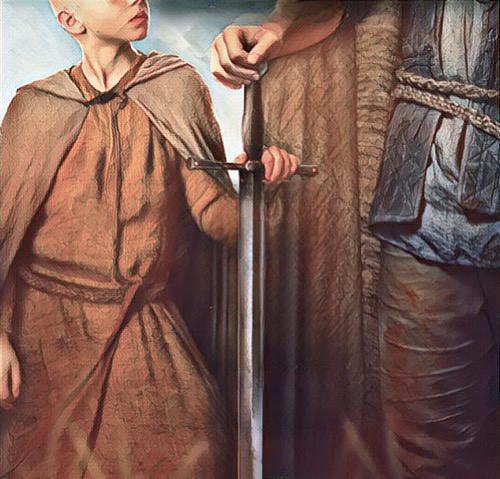
That’s why the tagline resonates so strongly. “A tall tale that became a legend” is both ironic and reverent. Perhaps Dunk’s legend began as a desperate act of faith — a lie told by a boy who wanted to believe in something better — and, over time, that story became truth.
The phrase also sets the emotional tone of the series: more intimate than epic, focused less on destiny and dragons and more on how ideals are born — and tested — in an imperfect world. Before the prophecies, before the wars, A Knight of the Seven Kingdoms promises to take us back to a time when heroes were still human, fragile, and painfully real.
And HBO knows the weight of that promise. After years away from Westeros, expectations are sky-high. Dunk and Egg is set to premiere in January 2026, and all signs point to the first footage dropping soon — likely during New York Comic Con.
Until then, the poster does exactly what it should: it provokes.
A story too tall to be true — or a man too tall to fit within history. Either way, what began as a tall tale has already become legend.
Descubra mais sobre
Assine para receber nossas notícias mais recentes por e-mail.
 miscelana.com