
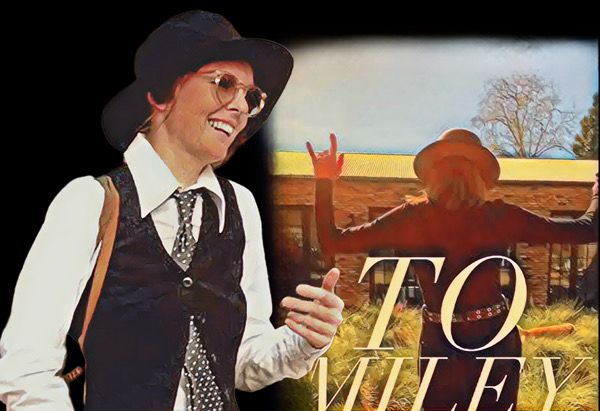
The moment was already legendary back in January 2023, when Diane Keaton posted a video on Instagram of herself dancing to “Flowers” by Miley Cyrus. As happens with the rare flashes of genuine emotion on the internet, the clip spread with tenderness and spontaneity — as if a door had suddenly opened. Not just to the affection the public has always felt for her, but to a new kind of symbolic intimacy: a 77-year-old woman, alone in her backyard, dancing her own way and reminding the world that freedom is still a possible gesture. In the video, Diane moves around her backyard with her dog, swaying in that delightfully awkward way that’s become her signature. Her caption read: “@mileycyrus YOUR INCREDIBLE SONG GAVE ME A REASON TO DANCE IN MY OWN BACKYARD!”

The reaction was immediate. Fans, journalists, and even Miley herself responded with joy. What could have been just a fleeting post became something else entirely — a small, luminous manifesto of freedom. At 77, Diane Keaton turned a spontaneous moment into a portrait of vitality and independence. In a world obsessed with youth and perfection, she chose to dance alone, in her own way.
And the song could not have been more fitting. “I can love me better than you can” is a refrain that could easily soundtrack Diane’s entire life. From the beginning of her career, she has built a public image rooted in authenticity — in the refusal to be molded, and in the courage to exist entirely on her own terms.
Between Style, Cinema, and Independence
Diane Keaton has always been an icon of style, of humor, of integrity. With her oversized suits, hats, and belts, she created a persona that blurred the lines between masculine and feminine. Her wardrobe wasn’t a disguise; it was an extension of her philosophy of life.
For decades, Diane has been asked the same question again and again: Why did you never get married? And her answers, though varied in tone, were always the same at their core. “I think I never got married because I didn’t want to get married.” In another interview, she added: “I don’t think it would have been a good idea for me to have married, and I’m really glad I didn’t.”
She never framed her choices as a lack of opportunity or love — but as self-knowledge. “I’m an oddball,” she once said, laughing. What she calls oddness is really coherence. Diane has always known that her freedom was not negotiable.
In an industry that constantly demands women — especially older women — to justify themselves, Diane never flinched. She said recently, “I don’t date. It’s highly unlikely.” And yet she has never seemed less alone. The woman who won an Oscar for Annie Hall long ago realized that there’s more dignity in belonging to oneself than in being chosen.
“You Don’t Own Me”: The Refrain of a Life
In The First Wives Club, Diane, Bette Midler, and Goldie Hawn sing “You Don’t Own Me,” the feminist anthem that declares with wit and defiance: “Don’t tell me what to do, don’t tell me what to say.” The scene became one of the most iconic of her career — because more than any dialogue, it captures who Diane truly is: a woman who has always claimed her voice, her body, and her destiny.
Years later, alone in her garden, she repeated the gesture — this time without a character, without a costume, without lighting. The camera was her phone; the audience, the entire internet. But the message was the same: no one owns her. “Flowers” and “You Don’t Own Me” speak to each other across time — two verses of the same song. One from the 1990s, one from a new generation. Miley sings about a woman who learns to love herself again after heartbreak. Diane dances that truth, as if to say: I’ve lived it — and I survived by being myself.
A Luminous Epilogue
There’s a tender melancholy in that video. Two years before her unexpected death, it seemed she closed a circle — that of a woman who never let herself be defined by what she lacked: not a husband, not biological children, not eternal youth. Her viral dance wasn’t a performance but a confession. A reminder that freedom isn’t always loud — sometimes it’s as quiet as moving to a song in your backyard while the sun goes down.
Diane never needed an audience to be fascinating. But by choosing a song about self-love and dancing alone, she reminded the world of what has always been true:
Her life has always been a love story — with herself.
Descubra mais sobre
Assine para receber nossas notícias mais recentes por e-mail.
 miscelana.com
1 comentário Adicione o seu