
If The Last Frontier’s premiere introduced chaos and physical danger, “Wind of Change” dives deeper into the psychological — and moral — warfare behind the hunt for Havlock. The first episode gave us the crash; now, what explodes is trust. Frank Remnick (Jason Clarke) and Sidney Scofield (Haley Bennett) discover that the real battle won’t be fought with weapons, but with information.
The episode opens with Frank trying to project control before the press. Still shaken by his wife’s abduction and Havlock’s direct threats, he does his best to reassure the people of Fairbanks. It’s a scene that captures Frank’s essence: a man who only functions when pushed to the edge but hides fear behind rigidity. Jason Clarke nails that duality, mixing authority and desperation through small, restrained gestures and weary eyes.
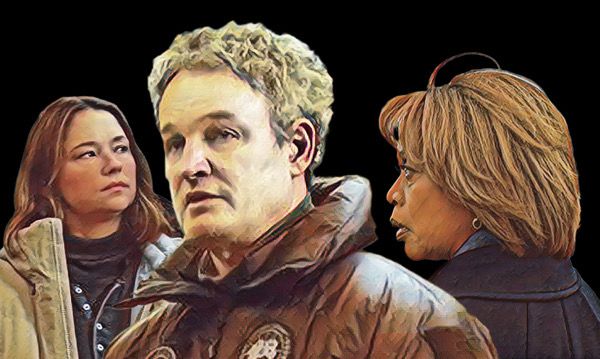
While the marshal struggles to keep the town calm, Sidney receives devastating news at Langley: Havlock has hacked into the CIA’s system and stolen Archive 6, a top-secret dossier listing every lethal operation carried out under the Atwater Protocol. It’s like opening the Agency’s conscience — a document that could blow up decades of covert action. The scene’s tone is cold and bureaucratic, but its subtext is crystal clear: Havlock now controls the truth, and truth itself is the most dangerous weapon of all.
Back in Alaska, a new character emerges: Henry Sickler, one of the escaped inmates who mysteriously turns himself in to the police. Frank is suspicious, and rightly so. Soon after, he receives a disturbing call — a neighbor claims to have seen Sarah and Havlock at their home. When Frank rushes over, he finds a camera and a video message left by the criminal. Havlock, ever the strategist, delivers a direct, almost theatrical ultimatum: Frank must release the prisoner from seat 12A of the flight — Sickler — and deliver him to a remote pump station by 4 p.m. If he does, Sarah will live. If not, he’ll never see her again.

It’s the perfect trap: personal and professional intertwined, forcing Frank to betray everything he believes in. Sidney, ever pragmatic, argues that no one will miss Sickler and that the exchange is the only option. Frank hesitates — the series turns his ethical dilemma into pure suspense, with terse dialogue and framing that emphasizes each character’s isolation.
Between the steps of this plan, the episode intercuts flashbacks of Sidney and Havlock before the crash. We see a younger Levi Hartman — the man who would become Havlock — giving a lecture on trust and truth, already showing his obsessive fascination with control and morality. Sidney approaches him, pretending to be a corporate recruiter, but he unmasks her instantly: he recognizes the CIA posture, the vocabulary, the look. The scene reveals that their cat-and-mouse dynamic began long before the catastrophe — and that there’s something personal between them.
Meanwhile, Frank is unaware that his son Luke and Luke’s girlfriend Kira are about to stumble into danger. The teenagers leave the cabin to explore and find an unconscious man in the snow — unaware that he’s another fugitive. The sequence plays like a ticking time bomb: the audience knows what they don’t, and the editing alternates between youthful romance and looming peril, heightening the tension.

Havlock, meanwhile, doesn’t stop at blackmailing Frank. He calls the CIA and speaks with Director Jacque Bradford, sending her a mysterious link that opens a countdown: if he doesn’t enter a code every 72 hours, the contents of Archive 6 will automatically be released to enemy groups. It’s a dead man’s switch, a kind of insurance policy against his own death. With it, Havlock becomes untouchable — a ghost with the power to destroy a nation with one click.
Sarah tries to fight back. In a brief, silent sequence, she attempts to escape, taking advantage of Havlock’s abdominal wound. But the villain is as cerebral as he is cruel: he overpowers her and presents a bloodstained cool box — a macabre symbol of his control. The direction plays with stark contrasts: the white of the snow against the red of the stains, visually capturing the show’s central theme — the purity of truth versus the contamination of manipulation.
As Frank debates whether to go through with the exchange, he seeks to understand Havlock’s true motive. Sidney explains that he doesn’t want money or power — he wants to prove that the government is a lie, that the system feeds on the very corruption it claims to fight. And Sickler, the prisoner in question, is the key: a broker used to laundering money and mediating dirty deals. Havlock needs him to sell Archive 6 on the black market.
Frank decides to act cleverly. He sets up a staged exchange, hoping to turn the tables. But Havlock is always one step ahead — the trade is merely a diversion. The real target is the flight’s black box. By intercepting it, Havlock secures evidence that the CIA never wanted to see daylight. Frank and Sidney arrive too late. The villain escapes with what he came for, leaving the hero powerless once again.

In the final scenes, the series cuts back to the cabin, where Luke and Kira, still blissfully unaware of the danger, dance in the dim light of the fireplace as the fugitive outside regains consciousness. It’s a moment of innocence on the brink of destruction — and of tragic irony. Simultaneously, Frank receives the same thermal box Havlock showed earlier. Fresh blood. A label: “For Frank.” Its contents remain a mystery.
“Wind of Change” keeps the pilot’s intense pace but adds layers of paranoia and manipulation. The title — borrowed from the Scorpions’ power ballad — is ironic: here, the wind of change is a storm of lies. Jon Bokenkamp returns to his favorite themes — mirrored opposites, state secrets, flexible morality — with the same precision that defined The Blacklist, but now with a grittier, more physical tone.
Dominic Cooper once again shines, crafting an antagonist who mixes intelligence, charm, and madness. He doesn’t shout — he controls. Jason Clarke deepens Frank’s despair as the losses mount, and Haley Bennett adds new layers to Sidney — at once complicit and victim of a system that creates monsters only to pretend to hunt them.
With snow, blood, and silence, The Last Frontier continues to explore the final boundary between duty and conscience — reminding us that the real war isn’t in the skies, but in the mind.
Descubra mais sobre
Assine para receber nossas notícias mais recentes por e-mail.
 miscelana.com