
3:10 to Yuma is one of those films that transcends decades without losing its power. On the surface, it’s a Western about a poor rancher escorting an outlaw to the 3:10 train bound for Yuma prison. Underneath, it’s a story about what remains of decency in a morally collapsing world. Its origin lies in a short story by Elmore Leonard, published in 1953, in which an ordinary, frightened man with nothing left to lose decides to do what’s right. It’s a tale of psychological tension, of heat, of time moving slowly, and of a charismatic criminal trying to corrupt the quiet courage of the man guarding him. Leonard always wrote about characters living on the edges of morality, and Three-Ten to Yuma is exactly that — an ethical duel between two exhausted men.

In 1957, Delmer Daves turned that short story into a powerful film. Van Heflin played Dan Evans, a debt-ridden rancher, and Glenn Ford played Ben Wade, a smooth-talking, dangerous, almost charming outlaw. Unlike the loud, action-packed Westerns of its era, Daves filmed with introspection: more glances than bullets, more waiting than action. It was a moral Western, almost a psychological experiment. Critics compared it to High Noon, but 3:10 to Yuma was darker, quieter, and more unsettling. Over time, it became a classic, celebrated for its delicate portrayal of courage and its slow-burning tension. The film expanded Leonard’s short story by turning the sheriff into a struggling farmer, giving the tale a social dimension — the fight of an ordinary man to prove that he still matters.
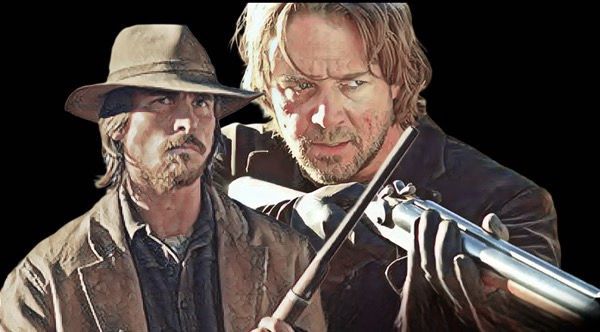
Fifty years later, James Mangold revisited the story and reinvented it for the 21st century. 3:10 to Yuma (2007) is more violent, more tragic, and paradoxically more humane. Russell Crowe and Christian Bale form one of the most compelling duos the genre has ever seen. Crowe’s Ben Wade is brilliant, cruel, introspective — a man bored with life, weary of himself, and tired of his own legend. Bale’s Dan Evans is maimed, exhausted, and clinging to his dignity by sheer will. Wade watches him with curiosity: a poor man, frightened yet incorruptible. That fascination is what changes him. Wade doesn’t pity Dan — he respects him. Dan is what he can no longer be: a man of integrity in a world that has forgotten the word.

There’s a quiet, almost imperceptible moment when Wade’s gaze shifts. From then on, he doesn’t want to escape; he wants to understand. When he speaks with Alice, Dan’s wife, it’s not seduction — it’s a test. He wants to see if that broken, impoverished family still believes in something. And when he realizes they do — that there’s still love and faith despite hardship — he sees what he’s lost: humanity. That’s the beginning of his transformation.
But the film is also about the mirror image of decency. Ben Foster’s Charlie Prince is a living shadow — Wade’s devoted, obsessive reflection. Their relationship carries a clear homoerotic subtext, never verbalized but always visible: Prince worships Wade, follows him with adoration and rage, protects him with violent loyalty. There’s love and destruction in that devotion. If Dan represents dignity, Prince represents fanaticism. Between those two forms of love — the noble and the sick — Wade must choose who he will be. When Prince laughs at Dan’s death, Wade hears himself in that laughter: the cynicism, the emptiness, the disbelief. So he shoots. He kills Prince — and kills his former self with him.


The final scene is one of the most moving in modern cinema. Wade, who could easily escape, chooses to board the train. It’s not surrender — it’s respect. It’s an acknowledgment. Dan gave him a reason to act again. And when Wade whistles for his horse — reminding us he can flee anytime — the gesture is almost spiritual: he’s free, but for the first time, he chooses not to run. In that instant, the outlaw finds peace.
What makes 3:10 to Yuma so extraordinary is that, in every version — Leonard’s short story, Daves’s 1957 classic, or Mangold’s 2007 remake — the essence remains the same: two men trapped in the same space, trying to understand what’s right in a world where no one else seems to care. Leonard’s story is sparse and moral. The 1957 film is restrained and elegant. Mangold’s version is brutal and poetic. But all tell the same truth — about the cost of decency, the quiet courage of ordinary men, and the strange respect that grows between opposites. Russell Crowe once described Wade as “a man bored with life, looking for something worth his time.” And he found it — not in a woman, not in gold, but in another man. Dan Evans, the broken, invisible rancher, became the challenge that gave his life meaning.

3:10 to Yuma is about exhaustion of the soul, the longing for redemption, and the belief that dignity is still possible. It’s about how one act of honor can transform even the most lost of men. And that’s why, when the train pulls away, carrying Wade to Yuma, it also carries the quiet certainty that somewhere between hell and honor, hope still survives.
Descubra mais sobre
Assine para receber nossas notícias mais recentes por e-mail.
 miscelana.com