
I’ve always had my issues with Kate Wyler — and perhaps that’s exactly why she fascinates me. In The Diplomat, Keri Russell plays a woman at war with her own visibility. Kate doesn’t want to be looked at, yet you can’t look away. She rejects glamour, yet embodies it without meaning to. She is the perfect contradiction: a woman desperate to be taken seriously, yet constantly defined by appearances.
From the very first episode, her wardrobe is a manifesto. When stylists and aides try to transform her into a “proper public figure,” she cuts them off impatiently: “I have a black suit and another black suit.” It’s a line that defines the entire character. For Kate, clothes are tools, not decoration. She dresses to move, to think, to negotiate — and, if necessary, to run. She’s a woman living on the edge between chaos and control, and she has no time to soften the edges.
Her dark suits — black, charcoal, deep navy — create an almost monastic silhouette. Clean lines, precise tailoring, quality fabrics. The wardrobe, designed by Roland Sanchez, relies heavily on Theory suits and Vince blouses — polished, unfussy, practical. As showrunner Debora Cahn put it, Kate needs to “look good and be able to run if bombs start falling from the sky.”
She’s a diplomat who must appear solid and invisible at once. And it’s precisely this desire to disappear that makes her unforgettable.

The woman who became an icon by accident
Kate’s anti-fashion aesthetic ended up creating one of television’s most distinctive images. The crossbody bag — practical, ever-present — became almost part of her anatomy, a portable shield. And the woman who never wanted to be remembered turned into a style reference.
Searches for “Kate Wyler’s suit” or “Kate Wyler’s bag” prove the irony at the heart of the show: the harder she tries to blend in, the more she stands out.
The Diplomat knows this and plays with it.
There’s a hilarious moment when a CIA agent, assigned to protect the Second Lady, is disguised as Kate. To sell the illusion, they put the agent in a suit and deliberately mess up her hair. The result is absurd and accurate at once. Kate, visibly annoyed, protests — “I wash my hair, okay?” — and even asks that someone brush the woman’s hair, which, of course, never happens.
It’s an inside joke, a sly wink at the audience — and at Keri Russell’s own history with Felicity and the national obsession with her curls.
Hair and soft power
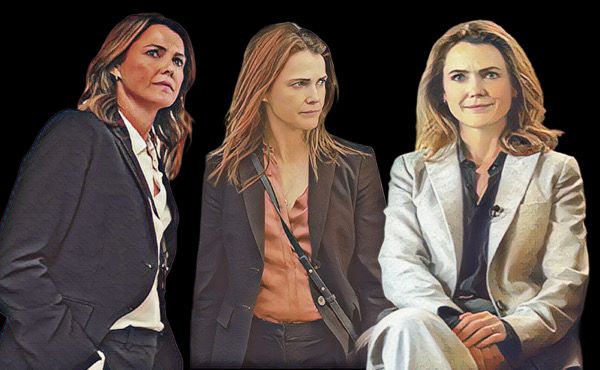
Kate’s hair is as discussed as her suits. Always hastily tied, slightly frizzy, aggressively functional — the opposite of the political blow-out. But the show treats this not as negligence, but as language.
In Season 2, the subject becomes explicit in her conversation with Grace Penn (Allison Janney), the U.S. Vice President. It’s a duel between two versions of female power. Grace, immaculate and media-savvy, represents the politics of image; Kate, pragmatic and prickly, despises the theater of presentation. But Grace delivers one of the show’s sharpest truths: “It’s soft power.”
She reminds Kate that no one will read her policy briefs — but her face will appear “12,000 times a day.” In diplomacy, image isn’t vanity; it’s influence. It’s culture, empathy, and authority distilled into visual shorthand.
Grace isn’t talking about makeup; she’s talking about symbolism. It’s a master class in perception and gender politics. Kate rejects the lesson, but something shifts. Because deep down, Grace is right — and The Diplomat makes sure we see it. Even a messy bun can be foreign policy.
The weight of the dresses
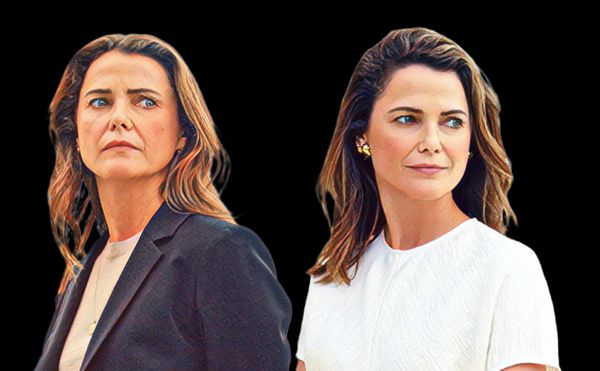
If suits are armor, dresses are cracks in the armor. Throughout the series, each dress marks a psychological or emotional turning point.
The first is the “Cinderella dress”, a white, glamorous gown she’s forced to wear for an official photo shoot. Before putting it on, she snaps: “I’m not Cinderella. I’m here for thirty funerals.” It’s classic Kate — sharp, impatient, allergic to pretense. But it’s also prophetic: the woman who rejects the fairy tale will, by season’s end, descend a staircase looking like she’s in one.
In the finale of Season 1 comes the red dress — arguably the show’s most iconic fashion moment. The scene, shot at the Louvre, is pure cinematic symbolism. After an entire season spent in black, Kate steps out in a crimson gown by Galvan London, reworked by the costume designer to be more dramatic. The shade was intensified to pop against the museum’s wine-colored walls, and the train lengthened so Dennison could escort her down the staircase — heightening the romantic tension.

“When you put on a red dress, you mean it,” said Keri Russell. And indeed, that red means everything: anger, freedom, rebirth. As showrunner Debora Cahn explained, it’s the mirror image of her earlier line — “I have a black suit and another black suit.” After betrayal by Hal and exhaustion from her own restraint, Kate finally chooses visibility. The color is defiant made of fabric. She’s opening, in Cahn’s words, “the door to a different life.”
In Season 3, the visual evolution continues. The black sequined gown, tight and gleaming, turns her trademark darkness into light. It’s the perfect metaphor for a woman who, after years of hiding, begins to shine on her own terms.
And then there’s the cream dress, delicate and feminine, worn when Hal sees her with Callum. For the first time, she looks unguarded. The soft fabric and flowing cut expose the human beneath the diplomat. It’s the closest the series lets her be simply a woman, not an emblem.
Each of these outfits tells a story. Together, they trace a slow reconciliation between identity and image.
Making peace with the mirror
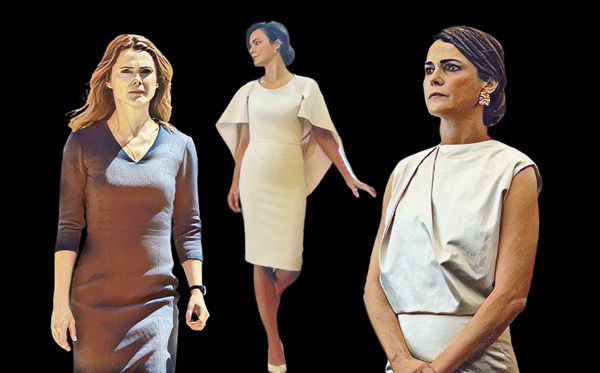
By Season 3, Kate Wyler no longer seems at war with her reflection. She’s still practical — the crossbody bag hasn’t gone anywhere — but there’s a new ease. The clothes remain functional, but now they feel chosen, not imposed. She’s learned that coherence doesn’t have to mean rigidity; that presentation doesn’t erase depth.
Off-screen, Keri Russell embodies the same paradox. The actress, long known for understated elegance, has, ironically, become a fashion muse. Her press looks and red-carpet appearances echo the Wyler aesthetic: quiet strength, polished minimalism, power without spectacle.
The final paradox
In the end, The Diplomat isn’t just about geopolitics — it’s about the politics of self-presentation.
Grace Penn calls it soft power: the ability to influence without force. And Kate, reluctantly, learns to wield it.
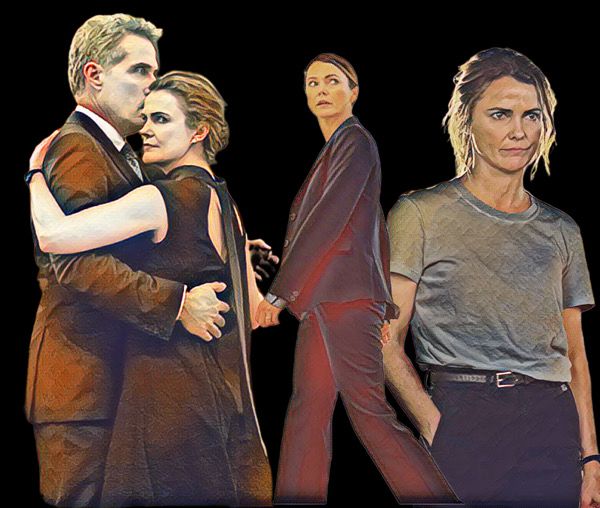
Her wardrobe charts her inner evolution — from dark suits designed to erase her to dresses that allow her to exist. It’s the story of a woman who wanted to go unnoticed and became a symbol instead.
Kate Wyler is the anti-fashion icon who defined modern power dressing. In the end, it’s simple: when you stop trying to prove anything, you end up proving everything. And that’s Kate Wyler’s quiet, unshakable power.
Descubra mais sobre
Assine para receber nossas notícias mais recentes por e-mail.
 miscelana.com