
What happened at the Louvre on the morning of October 19, 2025, felt like something straight out of a film.
In less than seven minutes, four masked figures broke into the Galerie d’Apollon, one of the museum’s most celebrated halls — home to the French Crown Jewels.
The operation was fast, precise, and eerily silent. When it was over, eight historic pieces were gone — some more than two centuries old — carrying with them the weight of empires, queens, and the evolution of French jewelry craftsmanship.
The value? Officially “priceless.” In truth, impossible to measure — because what was lost goes far beyond gemstones.

The Sapphires of Queen Marie-Amélie and Hortense de Beauharnais
The first blow was to one of the Louvre’s most emblematic treasures: the sapphire parure of Queen Marie-Amélie, wife of King Louis-Philippe I, and Queen Hortense de Beauharnais, Napoleon Bonaparte’s stepdaughter.
Created in the early 19th century, the set embodied the neoclassical taste of the Napoleonic era and the unmatched artistry of French jewelers. The deep blue sapphires, framed by gold and diamonds, symbolized serenity, power, and faith — virtues that royalty loved to display.
Among the stolen pieces were:
- The sapphire tiara, a symbol of the Orléans court;
- The matching necklace, seen in official portraits;
- One of the original earrings, with an impeccable oval cut.
These jewels had survived the 1848 Revolution and the great dispersal of royal treasures after the fall of the Second Empire. Inside the Louvre, they were silent witnesses of a France forever torn between monarchy and republic.
Now, all that remains are empty display cases — and the feeling that history has vanished, once again.
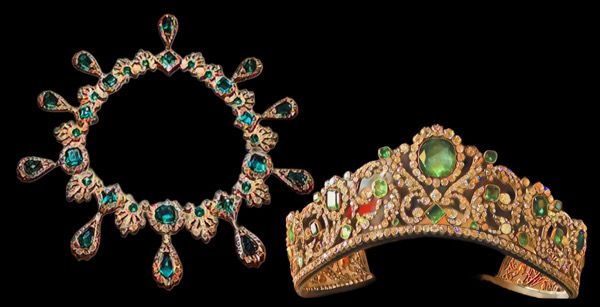
The Emeralds of Empress Marie-Louise — Napoleon’s Wedding Gift
In 1810, Napoleon I married Marie-Louise of Habsburg-Lorraine, Archduchess of Austria, in a political alliance designed to secure his empire.
As both token of affection and propaganda, he commissioned a set of emeralds and diamonds, crafted by the Maison Nitot — the forerunner of Chaumet.
The necklace and earrings, both stolen, were imperial statements of power and continuity. The vivid green of the emeralds represented hope, fertility, and prosperity — virtues meant to define the empire’s future.
These jewels are masterpieces of craftsmanship — and fragments of a time when luxury was a political language.
On the black market, they could fetch tens of millions of euros, but their real value lies elsewhere: in the story of an emperor trying to immortalize himself through beauty.
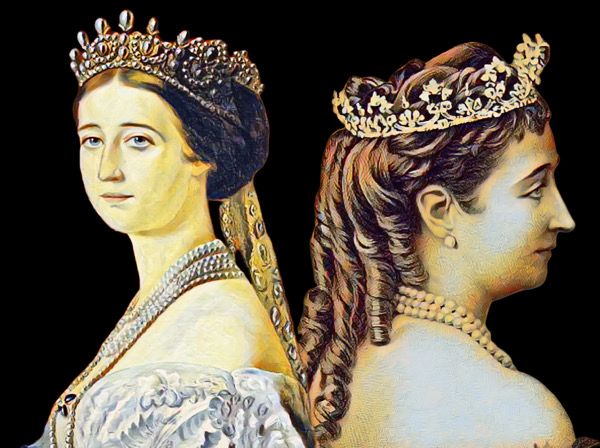
The Tiara and Brooches of Empress Eugénie de Montijo
Few women embodied the splendor of 19th-century France like Eugénie de Montijo, the Spanish-born empress and wife of Napoleon III.
She was the ultimate muse of the Second Empire — the bridge between politics and fashion, and the face of a France eager to dazzle the world.
The thieves took three of her emblematic pieces:
- Her diamond and emerald tiara, created in 1855, worn at state balls and official portraits;
- The grand “bodice knot” brooch, shaped like a bow, symbol of grace and femininity;
- The reliquary brooch, a more intimate jewel that once held miniature portraits and mementos.
Each piece is a three-dimensional portrait of a lost world: the Haussmannian Paris of mirrors and chandeliers, where jewels were political symbols as much as adornments.
Their theft is not just a material loss — it’s an aesthetic wound in France’s collective memory.


The Crown of Empress Eugénie (Recovered, but Damaged)
Amid the devastation, there was one bittersweet relief: Empress Eugénie’s Crown was found.
Crusted with 1,354 diamonds and 56 emeralds, it was discovered damaged on the banks of the Seine, abandoned during the thieves’ escape.
Crafted in 1855, it was never worn in a formal coronation — yet it stood as one of the Louvre’s crown jewels, literally and symbolically.
Its historical value is immeasurable: one of the few surviving imperial crowns, a relic that endured revolutions, exiles, and centuries of change.
The image of the broken crown — its gold twisted, gems scattered — feels almost poetic: even when history survives, it bears its scars.

The Price of the Priceless
French authorities have avoided putting a number to the loss, but experts estimate that together, the stolen pieces could exceed €80 million in auction value — if they could ever be sold, which is unlikely.
Their provenance is too famous, too traceable, too sacred.
The Louvre Heist of 2025 is not merely the crime of the century — it’s a reminder of how fragile history remains.
Each stolen gem carries an echo — of queens, empires, and artisans — and with its disappearance, we lose more than treasure: we lose a piece of who we are.
Descubra mais sobre
Assine para receber nossas notícias mais recentes por e-mail.
 miscelana.com