
It’s well known that George R. R. Martin draws inspiration from real events in Medieval history to build the brutal, politically intricate universe of Game of Thrones.
Stephen King, on the other hand, is the master of finding horror in the ordinary — turning everyday life into stories that shift between the supernatural, the psychological, the dramatic, and sometimes even the comic.
As he once explained, whenever he reads a news story — whether local or distant — a single question sparks his imagination: “What if…?”
That small, simple question is the key to his creative engine.
Love him or not, it’s impossible to deny that Stephen King is one of the most talented, versatile, and influential writers of the past century — someone who sees the extraordinary in the mundane, and the horror hiding in plain sight.

Derry Exists
Derry, the fictional town where evil awakens every twenty-seven years, is a collage of real places. Stephen King built it in Bangor, Maine, the city where he has lived for most of his life. Bangor is lovely — full of Victorian houses, old cemeteries, and quiet streets — but to King, it always had a pulse of unease.
In the 1970s, Bangor faced a wave of real violence, including child disappearances and unsolved crimes that rattled the community. There was also the unspoken racism and the weight of forgotten tragedies. King once said the idea for It came while thinking about “something evil that lives in the sewers,” before realizing that real evil already flowed through the pipes of ordinary life.
Bangor became Derry not just for its geography (both are riverside towns with dams, forests, and flooding), but for its psychology — the kind of small town that thrives on silence.
A Town That Denies: America and Its Buried Crimes
In It, adults ignore the disappearances of children. That’s not just fantasy; it’s history.
King drew inspiration from the social decay of postwar America — the racism, the moral panic, and the selective blindness of its communities.
One of the book’s most striking episodes is the burning of The Black Spot, a nightclub for Black soldiers that’s torched by white supremacists. The story mirrors real events such as the Ocoee Massacre (1920) and the Tulsa Massacre (1921), in which Black communities were annihilated and then erased from collective memory.
King rewrote those horrors into Derry’s mythology. The supernatural creature doesn’t create hate; it feeds on it. The result is a portrait of a country that insists on innocence while quietly rotting from within.
Derry is, in many ways, the stand-in for America itself: forgetful, hypocritical, and comfortable in denial.
The Real Killer Clown
If Derry represents America, then Pennywise is its face. And like all masks, his smile was borrowed from something real.
In the 1970s, the United States was haunted by John Wayne Gacy, a man who dressed up as “Pogo the Clown” for children’s parties while secretly kidnapping, raping, and murdering more than 30 young men and boys around Chicago.
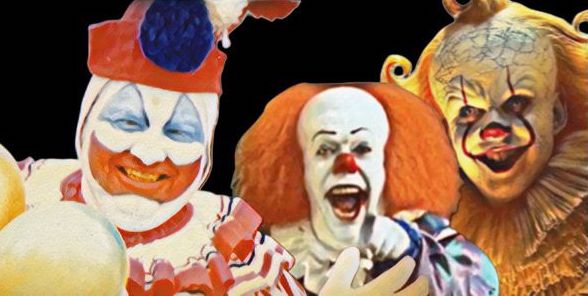
His crimes were uncovered in 1978, just as King was beginning to imagine It. While King has never said that Pennywise was directly based on Gacy, he admitted that after the case, “clowns could never be innocent again.”
That loss of innocence — the collapse of joy into horror — became the heart of It.
Pennywise is the smiling man who kills. The trickster, the liar, the predator that thrives on our trust.
But King gave his clown something Gacy never had: mythology. Pennywise is not just a murderer — he’s a symbol, the embodiment of the corruption we laugh away. The man behind the painted smile is the reflection of society itself.
Fear as a Reflection of Reality
What makes It so unsettling is that it doesn’t invent fear: it organizes it. King wove his story from the anxieties of a real America:
- The wave of missing children that filled headlines through the 1970s and ’80s.
- The domestic abuse hidden inside perfect suburban homes is mirrored in Beverly and her father.
- Addiction and guilt, drawn from King’s own struggles, are seen in Bill’s grief and paralysis.
- Racism and isolation, experienced by Mike Hanlon.
- And above all, the social silence — the refusal to see what happens in plain sight.
Every thread in It is real. King simply gave them a shape and teeth.
The Monster Is Us
King once wrote, “Monsters are real, and ghosts are too; they live inside us, and sometimes they win.” That line could be the thesis of It.
Pennywise is only a disguise. The true horror is the town that enables him. Derry is not a haunted place — it’s a complacent one. A metaphor for the societies that thrive on denial and feed off repetition.
That’s why It remains so powerful nearly forty years later. It’s not about magic — it’s about behavior.
The monster that returns every twenty-seven years is just another way of saying we never learn.

From Headlines to Myth
Stephen King’s genius lies in how he transforms headlines into parables. The Bangor crimes, the killer clown of Chicago, the racial violence of New England, the domestic horrors of everyday life — taken separately, they could have filled police reports. Together, King turned them into something larger: a moral fable about fear itself.
In It, the supernatural doesn’t replace psychology — it reveals it. The clown, the city, the sewers — they’re metaphors for what lives beneath the surface. Evil never comes from outside. It grows where we refuse to look.
Echoes in Welcome to Derry
The new HBO Max series perfectly understands this inheritance. Set in the 1960s — when real fear filled the streets through segregation, the Cold War, and moral repression — Welcome to Derry doesn’t invent new monsters. It goes backward, searching for the origins of human fear.
By returning to the decade that shaped modern America, the show returns to the roots of horror itself: racism, guilt, and silence. The “birth of evil,” as the creators call it, isn’t the birth of Pennywise — it’s the moment a community learns to pretend he isn’t there.
When Horror Is Just the Mirror
Everything in It — the clowns, the drains, the red balloons — is fictional. But everything that inspired it, tragically, is not. Stephen King just put the pieces together and made us look. He reminded us that when evil is ignored, it takes root. And when it comes back, it doesn’t return as a demon or a ghost, but as a reflection.
Pennywise is the mirror. And Derry is home.
Descubra mais sobre
Assine para receber nossas notícias mais recentes por e-mail.
 miscelana.com