
For many years, Halloween parties have reminded me of one of the most impactful films I’ve ever seen — one that aired only rarely on TV and has haunted my imagination ever since. I even had a pet named “Francesca.”
If you’re over fifty, you might already know which film I mean: one of the greatest classics of animation, Mad Monster Party? And today, October 31, I’ll be dusting off my Blu-ray to revisit it once again.

In 1967, Arthur Rankin Jr. and Jules Bass had already conquered Christmas. Since Rudolph the Red-Nosed Reindeer (1964), the duo has ruled over the golden age of holiday television: innocence, glitter, and hope brought to life through stop-motion animation. But after years of bells and snow, they longed for something darker — for the shimmer of moonlight instead of tinsel.
Searching for a new creative challenge, Rankin and Bass turned their gaze to the opposite end of the calendar. They wanted a holiday equally symbolic, but tinged with humor, shadows, and mischief: Halloween. Like Jack Skellington decades later, they set out to swap ho-ho-ho for boo!.
Thus was born Mad Monster Party?, one of the most improbable — and most magical — animated films of the 1960s.
The Birth of a Monstrous Idea
Rankin/Bass reunited their loyal team and embarked on a final collaboration with Japanese animator Tadahito Mochinaga at MOM Productions in Tokyo. He refined their stop-motion process — Animagic — capturing each gesture, one frame at a time. It would be their last joint venture before moving production to Toei and TCJ, and it resulted in one of their most distinctive works.
To craft the film’s wicked humor, they enlisted Harvey Kurtzman, the legendary creator of Mad Magazine, and illustrator Jack Davis, whose cartoon grotesques radiated warmth and charm. The anarchic wit of Mad collided with Rankin/Bass’ sweetness, creating the impossible: a monster movie filled with laughter, color, and melody.
Even the title — punctuated with a mischievous question mark — hinted at self-irony. Partnered with Embassy Pictures, the studio secured a theatrical release and a respectable budget, enough to hire an impressive voice cast led by Boris Karloff, Phyllis Diller, and Gale Garnett.
The Story: Monsters, Love, and Catastrophe
At the heart of the plot lies Baron Boris von Frankenstein (voiced by Karloff), who achieves his ultimate goal — discovering the secret of total destruction. Ready to retire as head of the World Organization of Monsters, he sends messenger bats across the seas, summoning the great icons of horror: Dracula, the Wolfman, the Mummy, Quasimodo, the Invisible Man, the Creature from the Black Lagoon, Dr. Jekyll and Mr. Hyde — all to his Caribbean lair, the Isle of Evil.
His plan: to announce a successor. But instead of appointing one of his monstrous peers, he chooses his human (or so it seems) nephew, Felix Flanken, a kind-hearted, asthmatic pharmacist. The decision outrages Francesca, the Baron’s alluring red-haired assistant, who had hoped to inherit the empire herself. Amid schemes, seductions, and slapstick chaos, Francesca joins forces with Dracula to eliminate Felix — only to fall in love with him.
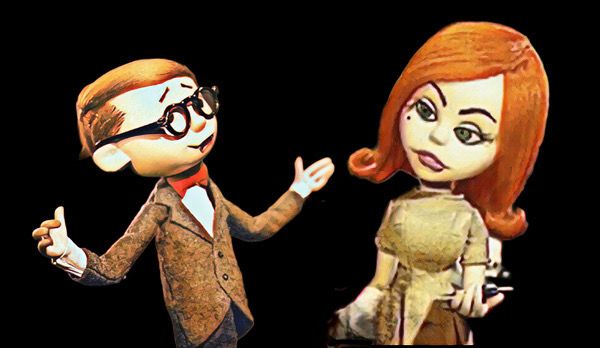
As the monsters squabble and sing, the uninvited “It” — a giant King Kong-like creature — crashes the celebration, rampaging through the island. In a self-sacrificial act, the Baron destroys his own creation and the Isle of Evil along with it. Felix and Francesca escape by boat, where she confesses that she’s not human but an android built by Frankenstein himself. Felix replies gently, “None of us is perfect,” revealing that he, too, is one of his uncle’s mechanical inventions.
A love story among monsters — poetic, absurd, and perfectly Rankin/Bass.
Behind the Scenes: Voices, Style, and Music
The voice cast of Mad Monster Party? is pure history. Boris Karloff, forever the face of Frankenstein’s Monster, lends his gravitas and warmth to the retiring Baron — a meta farewell to the role that defined him. Phyllis Diller, caricatured in puppet form, plays the Monster’s Mate, firing off cheeky one-liners like, “Remember the last time you had a roving eye? I kept it in a jar for a week!”
The unsung hero, however, is Allen Swift, who voiced nearly every other character: Dracula, the Invisible Man, the country Wolfman, Dr. Jekyll and Mr. Hyde, the Mummy, Quasimodo, and even Yetch, the Peter Lorre-inspired butler. His performance included parodies of Jimmy Stewart, Sydney Greenstreet, and Charles Laughton, making him a one-man repertory troupe.

Composer Maury Laws provided a delightfully groovy score, sung by Ethel Ennis, Gale Garnett, and Phyllis Diller, with highlights such as “Mad Monster Party,” “One Step Ahead,” and “Never Was a Love Like Mine.” Though the credits promised an RCA Victor soundtrack, it wasn’t released until 1998 (Percepto Records) and later on vinyl in 2016 (Waxworks Records) — now a collector’s gem.
Humor, Camp, and the Art of Laughing at Fear
What makes Mad Monster Party? so irresistible is its self-awareness. Rankin and Bass didn’t want to frighten — they wanted to wink. They turned gothic icons into party guests, crafting a psychedelic monster mash bursting with innuendo and dad jokes. Dracula flirts by saying, “You’ve always been my type — O negative!”, while Frankenstein quips that “It” wasn’t invited because “it was a crushing bore—crushing boars right in its hands!”
This blend of Borscht Belt humor, pop-art visuals, and gleeful absurdity anticipates modern meta-comedies like What We Do in the Shadows. It’s both a parody and a love letter — the first true shared monster universe, long before Marvel’s misfired Dark Universe tried the same trick.
Reception, Restoration, and Cult Legacy
Upon release in 1967, the film earned modest reviews but lasting affection. The New York Times noted, “This party should make everybody chuckle.”
For decades, Mad Monster Party? survived in faded 16 mm prints, resurfacing only on late-night TV marathons each Halloween — a hidden gem for those lucky enough to catch it.
Years later, when a pristine 35 mm negative was rediscovered, the film underwent digital restoration, leading to the 2003 Anchor Bay DVD, the 2012 Blu-ray, and finally the 2023 Umbrella Entertainment edition — the first in its original 1.85:1 widescreen. For collectors and nostalgics alike, it was like reviving a long-lost childhood dream.
Today, Mad Monster Party? stands as a cult masterpiece: strange, tender, and endlessly rewatchable. Its scarcity only deepened its mystique — a Halloween ritual whispered between generations.

The Party That Never Ends
Mad Monster Party? is more than a film; it’s a time capsule of imagination — the missing link between the glittering innocence of Rudolph and the bittersweet poetry of The Nightmare Before Christmas. It reminds us that monsters, too, sing and dance, fall in love, and dream of belonging.
Revisiting it today, in restored high definition, feels like opening a childhood portal. Every frame breathes the same wonder as stop-motion itself: hands moving invisibly, one frame at a time, to create eternity.
The world has changed, but that monster bash still happens every time we press play.
Descubra mais sobre
Assine para receber nossas notícias mais recentes por e-mail.
 miscelana.com