
Few characters belong so deeply to popular culture that they become mirrors of their time — and Robin Hood is one of them. Since medieval ballads turned him into a symbol of popular resistance — the outlaw who defied kings and tax collectors — each generation has felt the urge to retell his story in its own way. The result is a gallery of portrayals that range from romantic to political, naïve to brutal, fairy tale to tragedy. None, however, has ever truly revealed who the “real” Robin Hood was.
The figure of Robin Hood oscillates between myth and history, with no concrete proof of his existence. The first references appear in medieval ballads from the 13th and 14th centuries, recounting the adventures of an outlaw archer living in Sherwood Forest, near Nottingham. Even then, he was described as someone who “stole from the rich to give to the poor,” a symbol of social resistance in an age dominated by feudal oppression. Historians have suggested real-life inspirations — Robert Hod (mentioned in 1225 records) or Robert of Loxley, a Sheffield archer — but others note that “Robehod” and “Robyn Hode” became generic nicknames for rebels, suggesting that Robin Hood emerged less as a man than as an idea of rebellion. When legends began including real figures such as King Richard the Lionheart and Prince John, the myth merged with history — turning Robin into the people’s champion against tyranny.
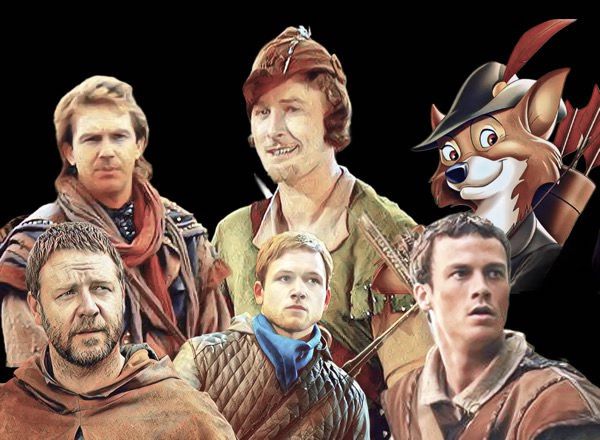
Over the centuries, writers and filmmakers reimagined him endlessly — from Sir Walter Scott’s romantic patriot in Ivanhoe to the silver-screen hero whose charisma and moral clarity defined generations. The Adventures of Robin Hood (1938) set the template: Errol Flynn, in green tights and with a defiant grin, embodied the hero as gallant, daring, and larger than life. Decades later, Kevin Costner’s 1991 version (Prince of Thieves) turned him into a Hollywood action star, complete with Bryan Adams’ immortal ballad. Ridley Scott’s 2010 film, with Russell Crowe, stripped away the gloss to show a pre-legend Robin forged by war and injustice. And when Taron Egerton tried to modernize him in 2018, the result may have stumbled under its own style — but proved the myth remains alive, reshaped for every age.

Even animation left its mark: for many who grew up in the 1970s, the most beloved Robin Hood is the fox from Disney’s 1973 classic — charming, mischievous, and tender. That version, gentle and melodic, captured the moral heart of the tale: that generosity and justice endure, even in the simplest forms. Each Robin reflects his era — Flynn’s idealism of the interwar years, Costner’s global heroism of the ’90s, Crowe’s moral fatigue of the new millennium, Egerton’s restless modernity, and Disney’s nostalgic innocence.
Now, the MGM+ series (2025) renews the cycle. Created by John Glenn and Jonathan English, it draws on Batman Begins and Peaky Blinders but aims for something deeper: to restore the hero’s humanity and explore the wounds of a post-Norman England where resistance means survival. Jack Patten plays Rob as a wounded man rather than an untouchable legend. Around him, women like Eleanor of Aquitaine (Connie Nielsen), Maid Marian (Lauren McQueen), and Priscilla (Lydia Peckham) emerge as political voices, finally granted agency.

Fittingly, this new version continues a curious tradition: Australians behind the bow. The first was Errol Flynn, followed decades later by Russell Crowe, and now Jack Patten — a lineage that suggests that, somehow, Robin Hood has always had an Australian spirit.
If Errol Flynn created the myth, Russell Crowe deconstructed it, and Taron Egerton stylized it, Jack Patten seeks to redefine it — not as legend, but as reflection. A human, radical Robin Hood, one who understands that stealing from the rich was never about gold, but about dignity.
And that’s where the circle closes: from bow and arrow to the politics of survival, from Sherwood to Westminster, Robin Hood endures because he’s still needed.
Descubra mais sobre
Assine para receber nossas notícias mais recentes por e-mail.
 miscelana.com