
Many Disney classics are celebrating anniversaries in 2025 — from Cinderella to Fantasia — but one of the most beloved, effortlessly spanning generations, is Lady and the Tramp (1955). The film is a canine romance that speaks of class, freedom, and belonging with a tenderness the collective memory condenses into a single image: two dogs sharing a plate of spaghetti. Behind that sweetness, though, lie the artistic and industrial ambitions that shaped a true classic. As the film turns 70 in 2025, it’s worth revisiting not only its magic but the machinery that made it possible.
The Spark: A Dog Named Lady, a Magazine Story, and Walt’s “Something Extra”
It all began intimately. Joe Grant, a veteran Disney artist, brought in sketches inspired by his cocker spaniel Lady and her jealousy after a new baby arrived in the family. The dog’s point of view as the emotional center of a home was the perfect seed — but Walt Disney wanted a counterpoint. He found it in Ward Greene’s 1945 Cosmopolitan story “Happy Dan, the Cynical Dog”: a streetwise mutt, the aristocratic Lady’s opposite. Thus was born the film’s central equation — the comfort of home versus the promise of the open road.
Over the years of story development, this duality evolved. Names changed, roles shifted (the Siamese cats were once called “Nip and Tuck,” Lady’s suitor was “Hubert”) until the final form emerged: Lady guarding her perfect life, and Tramp — the footloose wanderer — teaching her that homes can also be chosen. A charming production note: Trusty, the old bloodhound, originally died in an early draft, but was spared when Walt decided the audience, especially children, needed emotional repair after the rat sequence.
The Genius Moment That Almost Didn’t Happen
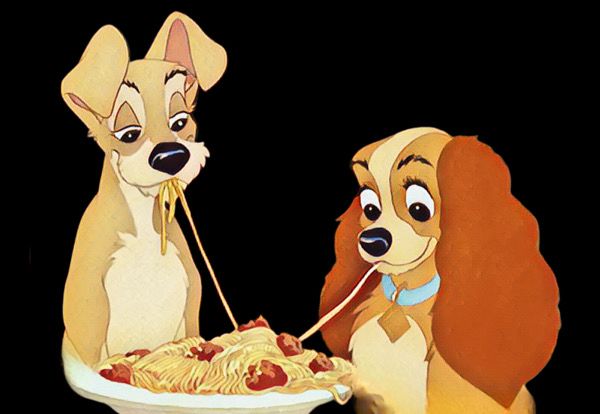
The spaghetti scene — now synonymous with cinematic love — almost didn’t exist. Walt thought dogs eating pasta would look “silly.” Animator Frank Thomas went ahead and animated it anyway. The result convinced even Walt himself. That small act of rebellion produced one of the most romantic sequences ever drawn, a perfect marriage of comedy, choreography, and tenderness.
CinemaScope: When Disney “Opened the Screen” and Changed Animation
Lady and the Tramp was the first animated feature filmed entirely in CinemaScope — not just a technical footnote, but a creative revolution. The wide frame forced animators to rethink scale and movement: characters now crossed spaces, towns breathed, and Victorian houses gained architectural weight. Costs rose, deadlines stretched, but the result was an elegant, cinematic sheen that redefined the Disney aesthetic.
Because few theaters could project CinemaScope in 1955, the studio released two versions — widescreen and Academy ratio — re-framing scenes for each. It was part logistics, part curatorial precision.
Visually, Claude Coats grounded the “turn-of-the-century” Americana aesthetic (porches, lacework, curving fences), while Eyvind Earle — who would later define Sleeping Beauty — added atmospheric miniatures for “Bella Notte.” To capture a dog’s-eye view, Coats built miniature interior models and filmed them from floor level. That obsession with detail became Disney’s trademark.
Giving Voice to the Heart
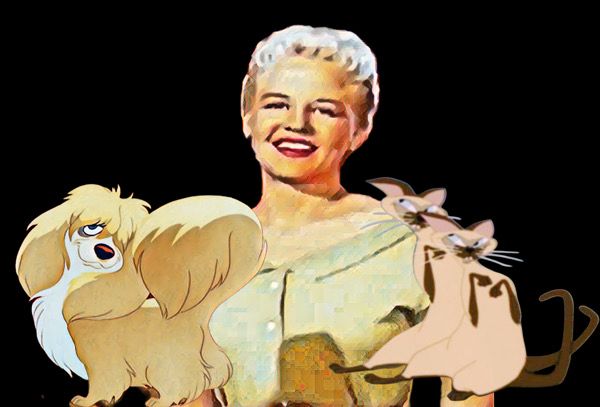
The voice cast is a miniature history of golden-age animation. Barbara Luddy’s Lady radiates crystalline sweetness; Larry Roberts gives Tramp his streetwise charm. Bill Thompson shifts between voices (Jock, Joe, Bull, Dachsie…), Verna Felton plays the impatient Aunt Sarah, Bill Baucom the tender Trusty, and Stan Freberg the whistling Beaver. And then there’s Peggy Lee — who sang (“La La Lu,” “He’s a Tramp,” “The Siamese Cat Song”), co-wrote the songs with Sonny Burke, and voiced Darling, Peg, and the Siamese cats. Decades later, Lee would famously sue Disney for unpaid home-video royalties — and win — setting a precedent for artists’ rights in the VHS era.
Music That Becomes a City
Oliver Wallace’s score stitches together the neighborhoods Lady and Tramp wander through. The music flows between waltz, march, and lullaby, while Peggy Lee and Sonny Burke’s songs mark emotional crossroads: the gentle “La La Lu,” Peg’s sultry “He’s a Tramp,” and the now-controversial “Siamese Cat Song” (later reimagined in the 2019 live-action remake). “Bella Notte” remains the film’s emotional summit — an alley transformed into an open-air opera of affection.
Behind the Scenes: Labor and Little Legends
To achieve realism, animators studied live dogs’ paw anatomy, weight, and how ears move with emotion. Milt Kahl handled most of the canines (especially Tramp), John Lounsbery brought humor to Tony and Joe, and Wolfgang Reitherman animated the action scenes (the rat fight was modeled on real rodents in a studio cage). Les Clark captured the delicate playfulness of Lady as a puppy. The film’s rhythm — serene but fluid — came from CinemaScope’s demand for longer, more deliberate shots.
New Lives: Sequels, Remakes, Comics, Parks
The world of Lady and the Tramp kept expanding. The 2001 direct-to-video sequel Scamp’s Adventure follows the couple’s restless son in his bid for freedom. The 2019 live-action/CGI remake debuted as one of Disney+’s launch titles, with Tessa Thompson and Justin Theroux voicing the leads — a warm homage built with real dogs and digital enhancements.
Beyond the screen, Lady and the Tramp lived on in comic strips (1950s–70s), collectibles, and the parks: Tony’s Town Square Restaurant on Main Street, U.S.A., at Walt Disney World, and Pizzeria Bella Notte at Disneyland Paris.
Why It Still Works (and Why 70 Years Matter)
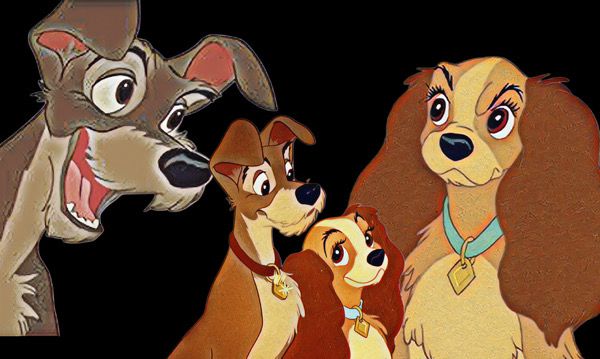
Because behind its “simple” story lies a complex truth. Lady embodies safety and tradition; Tramp represents risk and reinvention. Together they learn that freedom without love is noise, and love without choice is a cage. The supporting cast — the Beaver charging for his services, Trusty losing and regaining his sense of smell, Tony and Joe serenading the alley — turn small gestures into poetry.
And there’s that turn-of-the-century America Walt adored: snow-globed Christmases, wrought-iron fences, horse-drawn carriages, cursive shop signs. A nostalgia rendered tactile and timeless — cinema as the memory of what home could feel like.
To End (With Tomato Sauce)
Seventy years later, Lady and the Tramp still proves that a classic doesn’t need grandeur — only perspective. Lady’s, in recognizing that care is a choice. Tramp’s, in understanding that commitment isn’t a leash. And ours, every time that single strand of spaghetti draws two worlds together — because happiness, in the end, is simply meeting halfway.
Descubra mais sobre
Assine para receber nossas notícias mais recentes por e-mail.
 miscelana.com