
Sometimes I feel like an alien: I’ve never watched a single episode of The Kardashians, and I’m not into anything related to them. But I like Ryan Murphy — maybe not everything he does, but most of it.
Because Murphy is a genius — and an extravagant one. He has an unmistakable signature: tackiness, grandeur, saturated colors, a certain disdain for reality, and a deep passion for performance. Whether it’s musical, true crime, horror, or fantasy, you can always tell when his hand is behind it. His quality level is so far above average that he moves between major platforms — from FX to Netflix to Hulu — as easily as changing outfits. That’s rare. And maybe for that reason, he enjoys what few in television do: complete freedom. He can create whatever he wants. Grotesquerie was one example. All’s Fair is another.

Another trademark: Murphy’s loyalty to his muses. Sarah Paulson, Jessica Lange, Niecy Nash-Betts, Glenn Close — intense, chameleonic, unpredictable women. And now, in a move that feels equal parts madness and brilliance, he decided to create an entire show tailored for Kim Kardashian.
Yes, All’s Fair was her idea. Kim wanted something inspired by Laura Wasser, Hollywood’s ultimate divorce lawyer (and her own). Murphy ran with it and built a universe to match: Los Angeles seen through the eyes of the legal elite who feed on other people’s drama. The result is a blend of The First Wives Club and the Coen Brothers’ Intolerable Cruelty — where luxury meets satire.
And the result… is pure Ryan Murphy: a spectacle of glamour, irony, and carefully orchestrated chaos.
The World of All’s Fair
Set in an all-female law firm, the series follows Allura Grant (Kim Kardashian), a divorce attorney who is both the best and the most dangerous in the city — and who, ironically, is going through her own separation.
Around her revolves an impressive cast: Dina Standish (Glenn Close), the ruthless senior partner; Liberty Ronson (Naomi Watts), her best friend and business ally; and Emerald Greene (Niecy Nash-Betts), the firm’s pragmatic and unshakable private investigator. Against them stands Carrington Lane (Sarah Paulson), a jealous, gifted, and vengeful former colleague determined to take them down — plus a long list of ex-husbands who refuse to let their wives walk away with dignity or money.
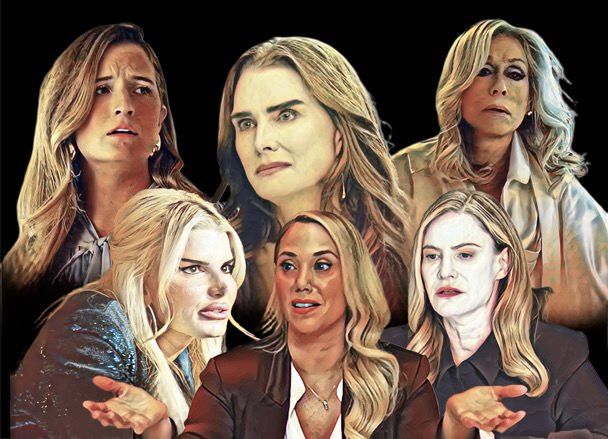
Each episode features celebrity guest appearances — Jennifer Jason Leigh, Brooke Shields, Jessica Simpson, Judith Light, Ed O’Neill, and others — all playing variations of themselves. Every divorce case mirrors some famous Hollywood split we’ve heard about, as if All’s Fair were a warped reflection of the industry itself: a world where every outfit is a strategy and every tear comes with waterproof makeup.
Behind the Scenes: Between Glamour and Mockery
The production cost nearly $70 million, aided by California’s film tax incentives. Filming began in October 2024 and wrapped in March 2025. Even before the cameras rolled, Murphy hosted an “introductory dinner” for the cast — and the set quickly became a sorority of stars.
Kim gifted the cast Skims pajamas. Sarah Paulson accidentally threw a French fry into Kim’s eye during an emotional scene. Naomi Watts handed out lubricant as a joke among colleagues. In other words, the off-screen energy mirrored the show’s tone: absurd, glamorous, and delightfully performative.
Laura Wasser herself served as a consultant, grounding the legal aspects in reality — though Murphy’s lens turned it all into theater: billion-dollar divorces, lawyers strutting through courtrooms like runways, and clients turning heartbreak into public spectacle.
The Critics — and the Backlash
Since its premiere, All’s Fair has been torn apart by critics. The Guardian called it “fascinatingly, existentially terrible.” News.com.au declared it “the worst TV drama of the modern era.” One review even said that “Kim Kardashian’s acting is the emotional equivalent of a face filter.”
But, as with almost everything Murphy touches, excess is part of the contract. He knows his projects divide audiences. All’s Fair doesn’t want to be The Good Wife; it wants to be Dynasty with irony, Big Little Lies with Botox. The mistake may lie with those who expect prestige from a man who has always offered performance.

The Verdict
All’s Fair exists somewhere between delirium and critique, between mockery and opulence. The series doesn’t seek realism — it thrives on the artificial. It’s gaudy, chic, absurd — and, like all of Murphy’s best work, deliberately provocative.
The critics may be right to call it unbalanced and excessive. But perhaps they’re wrong to demand “believability” from an artist who has always made theatricality his brand. What Murphy offers here is a mirror of the industry that made him: dazzling, cruel, shallow, and irresistible.
I said this was a show to love or hate — and I’m realizing that, thanks to Murphy, I might just end up entering the Kardashian universe myself. Is that a good thing? Probably not. But if we’re diving into this chaos of vanity, glamour, and irony, let’s do it with the right soundtrack, wardrobe, and poison. Because in Ryan Murphy’s courtroom, even excess has style — and spectacle comes guilt-free.
Descubra mais sobre
Assine para receber nossas notícias mais recentes por e-mail.
 miscelana.com