
At a time when pop music often obeys formulas, Rosalía is the exception. From her first steps as a flamenco student, she already seemed to exist on another frequency. She never chose between the popular and the sophisticated — she fused them. And out of that fusion comes Lux, her most daring and mature album yet: a sensory, intellectual, and spiritual experience that restores mystery to pop.
Roots and Reinvention
Rosalía Vila Tobella was born in 1992, in the small Catalan town of Sant Esteve Sesrovires — a world away from the global stages she now commands. But the artistic DNA was there from the start. Fascinated by the emotional power of flamenco, she spent nearly a decade studying its complex rhythms, its primal vocal language, its confessional depth.
Those roots remain the gravitational center of everything she creates. What she learned from flamenco is not just technique but an ethos — total surrender. Singing is confession, emotion is performance. When she applies that same intensity to pop, the result is alchemy: music that’s both raw and architecturally precise, emotional and cerebral, ancestral and futuristic.
Between the Whisper and the Cry: The Billie Eilish Connection
At times in Lux, it’s impossible not to think of Billie Eilish. Both artists master the power of silence — they use it as part of their composition. Rosalía whispers, Billie sighs; both build tension from absence, from what remains unsaid. But while Billie works in emotional minimalism and psychological intimacy, Rosalía transforms silence into prayer. It’s the same control, the same vulnerability, directed toward the sacred rather than the domestic.
The link between them extends beyond sound. They are part of a generation of artists who refuse to be “manufactured pop.” Like Billie and Finneas, Rosalía writes, produces, edits, and directs — reclaiming total creative authorship. Both make music as an act of autonomy.
If Billie Eilish turned melancholy into a manifesto, Rosalía turns devotion into revolution. Two polar forces of the same current: the will to bring authenticity back to art.
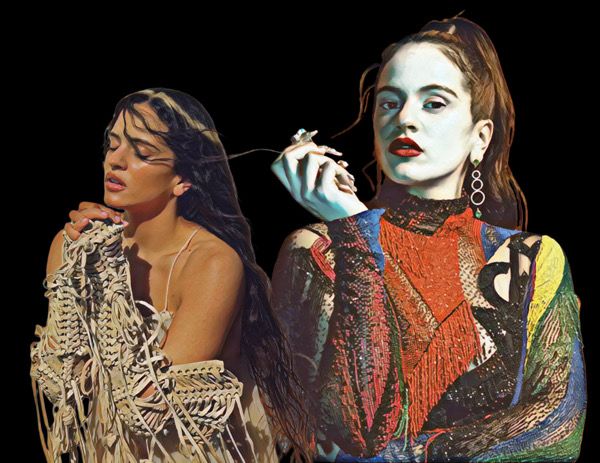
The Influences That Shaped a Language
Rosalía is the child of many traditions. From flamenco, she inherited duende — the spiritual force that transforms pain into art. From urban music, she took rhythm and body. From visionaries like Björk, Laurie Anderson, Kate Bush, and FKA twigs, she learned that sound can be image, gesture, and performance all at once.
There are echoes of Kanye West in her boldness, of Frank Ocean in her emotional futurism, and of Madonna in her constant reinvention. Visually, she’s in dialogue with Spanish surrealism, Almodóvar’s emotional excess, and the baroque intensity of Catalan architecture.
Her work is also deeply literary and cinematic. She reads Duras and Lispector, collaborates with Loewe and Balenciaga, and draws inspiration from artists like Marina Abramović and Matthew Barney. Nothing about her aesthetic is superficial — it’s all part of an integrated language of body, sound, and image.
Echoes of Mecano: The Emotional Legacy of Spanish Pop
Among her many influences, one stands quietly but unmistakably — Mecano.
The trio that defined 1980s Spanish pop combined sophistication, theatricality, and emotion in ways that prefigured Rosalía’s artistry. She carries their DNA: the longing for intelligent pop, one that unites melodic clarity and emotional depth.
Like Ana Torroja, Rosalía sings with crystalline restraint — pure, delicate, yet devastating. In songs like Porcelana and Luz sobre Luz, she evokes the same luminous melancholy that Mecano mastered: the mix of faith, fragility, and transcendence. Where Mecano sought the human inside the synthetic, Rosalía finds the divine inside the digital. It’s a lineage — reimagined for a new century.
Lux: Between the Sacred and the Chaotic
Structured in four movements, Lux feels like a postmodern mass. There are orchestras, synthesizers, and choirs; thirteen languages; moments of stillness followed by sonic storms. Collaborations with Björk and Yves Tumor reinforce the sense of duality — the divine and the flesh, the chaos and the calm.
Each track is its own ritual. The production by Daníel Bjarnason with the London Symphony Orchestra is monumental yet intimate. Rosalía sings as if in a trance: sometimes a priestess, sometimes a ghost, a woman simply trying to breathe. In an age of sonic perfection, Lux finds beauty in tension — in imperfection, in humanity.
Originality as a Political Gesture
Rosalía’s rebellion is quiet but seismic. By refusing to conform to expectations — musical, cultural, or gendered — she redefines what pop can be.
In Lux, she writes, produces, and directs her own vision. That alone, in a male-dominated industry, is radical. But beyond authorship, her originality is rooted in risk — in the courage to make something that can’t be replicated or predicted.
While the industry optimizes for virality, Rosalía opts for transcendence. She’s not creating content — she’s creating cosmos.
Highlights from Lux
1. “Porcelana”
A breathtaking opener. Choirs and electronic minimalism intertwine, establishing the album’s thesis: fragility as strength.
2. “Mio Cristo (Piange Diamanti)”
Sung in Italian, it’s practically an aria — devotion turned into drama, faith turned into flesh. Rosalía’s voice is operatic, almost unearthly.
3. “Divinize”
A sonic bridge between heaven and earth. Stark beats meet lush orchestration; Bjarnason’s production elevates the song into a sacred space.
4. “La Perla”
The album’s most human moment — tender, grounded, regional. A love song that smells of sea salt and confession.
5. “Berghain” (feat. Björk & Yves Tumor)
A collision of three worlds: industrial, spiritual, experimental. It’s the album’s dark heart, where sound becomes a form of transcendence.
6. “Luz sobre Luz”
The finale — intimate, liturgical, breathtaking. A closing prayer where the pop star dissolves into pure sound.

An Artist Out of Time
Rosalía doesn’t belong to one era. She belongs to all of them — medieval Spain, digital modernity, and a future yet to arrive. Lux could echo through a cathedral or orbit a satellite. It’s ancient and futuristic, bodily and celestial.
While others chase the algorithm, she chases the eternal. In a world made of plastic, Rosalía remains flesh, blood, and light.
Descubra mais sobre
Assine para receber nossas notícias mais recentes por e-mail.
 miscelana.com