
As published on CLAUDIA
I’ve been a longtime admirer of Emma Thompson. To me, she stands on the same level of perfection as Meryl Streep, effortlessly navigating drama, comedy, suspense, adventure, classics, and contemporary stories alike. She’s an actress who no longer needs to prove anything, yet continues to choose roles that challenge her — roles that demand presence, irony, and emotional density. Over four decades, Emma has become one of the most powerful voices in British cinema and one of its sharpest minds. Her talent goes far beyond acting: she’s also a screenwriter, producer, activist, and, above all, a woman who understands human complexity like few others do.
A two-time Oscar winner — Best Actress for Howards End (1992) and Best Adapted Screenplay for Sense and Sensibility (1995) — Emma Thompson remains one of the rare artists to have mastered both writing and performance with equal brilliance. That duality explains much about her trajectory: each character she plays seems to come with its own reflection, a moral subtext, a social analysis. That’s why, in any genre, Emma is never predictable.

And when she chooses to be a villain, she’s irresistible. Her Baroness von Hellman in Cruella (2021) is a feast of stylized wickedness — vain, ruthless, and as entertaining as she is dangerous. It’s the kind of antagonist she transforms into social commentary, satirizing fashion worship and the narcissism of power. Before that, in the Harry Potter universe, her Professor Trelawney had already been a delightfully exaggerated portrait of the mystical and the misfit. Thompson commands absurdity with the same elegance with which she commands drama.
But it’s in Down Cemetery Road, an Apple TV+ production, that Emma finds a new point of balance: wit and experience merging into a restrained, precise, magnetic performance. Based on the novel by Mick Herron — the same author behind Slow Horses — the story begins with an explosion in a quiet Oxford suburb and the mysterious disappearance of a child. The protagonist, Sarah Trafford (played by Ruth Wilson), refuses to accept the official version and turns to private investigator Zoë Boehm — Thompson’s character for answers.
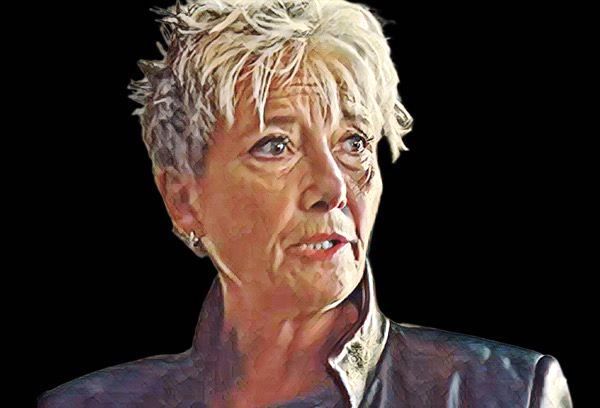
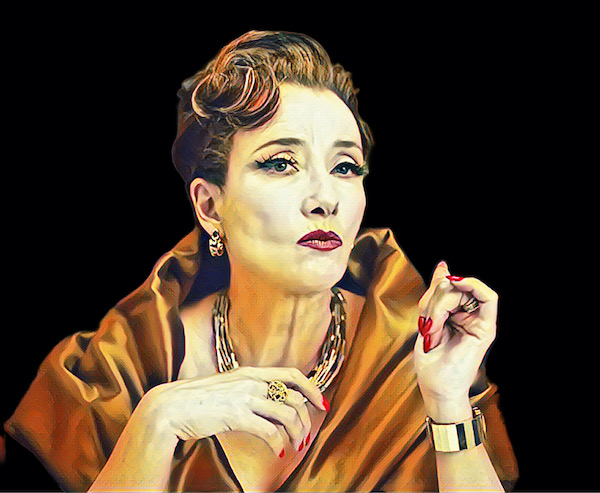
Zoë is the kind of woman who doesn’t need to raise her voice to dominate a scene. A private investigator who carries the weight of her past between the lines, she observes before acting, doubts before trusting. In Emma’s gaze lies what words cannot express: trauma, guilt, empathy, fatigue. It’s a character built against stereotype — mature, discreet, and almost cruelly intelligent.
For fans of Slow Horses — a critical and popular phenomenon also adapted by Apple TV+ — it’s easy to see how both universes share the same DNA: the mind of Mick Herron. While Jackson Lamb moves through the British espionage world with irony and melancholy, confronting the moral decay of institutions with sharp, dark humor, Down Cemetery Road is, in a way, the seed of that style. It came first, testing Herron’s fascination with the tension between individual conscience and systemic power, between human error and political control. What Slow Horses conveys through fallen spies appears here in the form of a private investigator forced to confront the consequences of telling the truth.
The series was met with enthusiasm from critics. After years of period dramas and modern-day emotional roles, Emma is masterful in a performance that’s sexy, clever, and deeply emotional. Audiences agreed: Down Cemetery Road became one of Apple TV+’s most-watched thrillers of 2025, driven largely by the actress’s presence. This name continues to embody credibility and depth in any production, even after a period of relative distance from the screen.
Watching Thompson as Zoë Boehm is to witness the complete command of an actress at the height of her maturity. She doesn’t simply act — she inhabits. Every silence is a confession; every pause, a strategy. There’s vulnerability and authority, sweetness and steel. And unlike most mystery series, Down Cemetery Road doesn’t turn its protagonist into a heroine. Thompson gives Zoë something far rarer: humanity.

By choosing this character, Emma reaffirms the kind of artist she has always been — a woman who prefers risk over repetition, complexity over comfort. That’s what makes her so necessary. Down Cemetery Road may be a slow-burning thriller, but its emotional impact runs deep. And at its center, Emma Thompson delivers one of the richest performances of the year: mature, skeptical, empathetic, and absolutely mesmerizing.
In a world still obsessed with measuring women’s worth by their youth, Emma once again proves that time doesn’t diminish talent — it only refines it.
Descubra mais sobre
Assine para receber nossas notícias mais recentes por e-mail.
 miscelana.com