
In the third episode of Pluribus, Carol comes home. Not to ruins, chaos, or burning cities, but to something far more unsettling: an apocalypse where she still sleeps in her own bed, drinks the vodka she likes, eats what she wants — and, crucially, still watches TV. The world has ended, and she’s sitting in front of a DVD of The Golden Girls. That detail alone tells us everything about who she is and what this show wants to examine.
It’s not random that she’s watching a DVD instead of cable or streaming. The medium matters. That box set is almost as old-fashioned as her idea of individuality. While nearly everyone on Earth has merged into one shared “we,” Carol is hanging on to a little plastic disc and a remote control, insisting that there must still be space for one person to exist apart from the collective.
By the end of the episode, it’s pretty clear there may not even be TV stations anymore. No shared live broadcast, no sense of millions watching the same thing together. There’s just the hive mind on one side and Carol on the other, clinging to a sitcom as if it were proof that “being human” still means something.
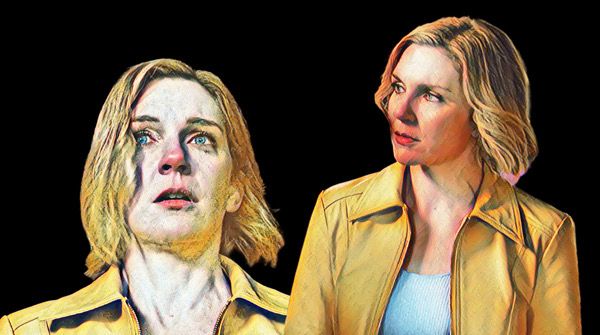
A joke about a grenade that stops being a joke
The episode’s title, “Grenade,” is literal. Smothered by the Joined’s relentless attempts to “make her happy,” Carol vents and says there’s nothing wrong with her that a grenade wouldn’t fix. In her head, it’s just bitter humor. To the collective, it’s a request.
So, later that night, Zosia appears at Carol’s door holding an actual grenade. They suspected she might have been joking — but they weren’t willing to risk ignoring her. That small decision captures the paradox of the hive: a terrifying level of efficiency combined with a compulsive need to satisfy her every demand.
Visually, it’s funny: ordinary people bending over backwards for one woman, all smiles, all service. Emotionally, it’s chilling. The hive is busy rebuilding the world, but it always finds time to deliver whatever Carol says out loud, no matter how extreme.
The non-apocalypse of Carol Sturka
Instead of digging into the mechanics of the alien signal or interrogating the big mysteries, Carol spends most of the episode doing something deeply recognizable: she drinks, broods, complains, and refuses to engage. She doesn’t trust the Joined to tell her the truth, so she simply doesn’t ask.
On the way back from Spain, she tries a different route — asking Zosia about other non-English-speaking survivors, hoping someone out there sees the world with her level of bitterness. The hive connects her to a self-storage manager in Paraguay, another immune human who has been ignoring their calls. The conversations go nowhere. He hangs up. He swears at her. She calls back and, in halting Spanish, swears back.
It’s darkly funny, and also sad: even among the last few “unconnected” humans, there’s no sense of alliance, only exhaustion and anger.
So Carol returns to Albuquerque. To vodka. To The Golden Girls. To isolation.

The fantasy of having “your” supermarket back
One of the episode’s rare large-scale moments comes at the grocery store. Carol tries to do something simple — shop — and finds shelves stripped bare. Food has been centralized and redistributed. No more individual stockpiles. No more overstuffed aisles promising choice.
She complains. The hive responds.
Within hours, trucks arrive. Workers file in. The store is restocked. Not for society’s sake, not because the system “needs” it, but because Carol wanted her familiar Sprouts back. It’s a surreal fantasy of absolute privilege: one woman gets the world to rearrange itself so she can pick up oat milk and listen to Sade over the PA system.
The scene is delightful and deeply critical at the same time. What kind of “better world” mobilizes global resources so one person doesn’t have to live with an empty aisle?
When the lights go out, the real horror shows up
If Carol still has small private pleasures — a drink, a sitcom, a perfectly timed complaint — the hive has moved on to a different logic. We find out that at night, the entire city shuts down. Power off. Lights out. No nightlife. No late shifts. No glow in the distance.
There’s no crime, no need for night workers, so why waste electricity? When Carol protests, Zosia reminds her that she once donated to the Sierra Club. In the hive’s eyes, the blackout is just a coherent, eco-conscious policy. It doesn’t occur to them that something essential might be lost in the process.
For Carol — and for us watching — that’s horrifying. A life without those tiny, useless, deeply personal moments: a walk under streetlights, board games after dinner, a movie at 1 a.m., staying up just because you feel like it. You can call it “sustainable” or “optimized,” but it stops looking like a life.

Saving Carol, with or without her consent
The Joined are still planning to convert Carol as soon as they figure out how. At first, they call it a “biological imperative.” When that fails to move her, they try a different framing: if you saw someone drowning, wouldn’t you throw them a life preserver?
In their minds, refusing to absorb Carol would be cruelty.
The episode smartly connects this to the flashback in the Norwegian ice hotel. Years before the alien signal ever hit, Carol was already struggling to experience joy. Surrounded by beauty, with Helen glowing beside her under the Northern Lights, she fixated on the cold, the discomfort, the book sales. Helen teases her: This is the perfect vacation because Carol likes feeling bad.
Pluribus is careful not to reduce everything to trauma or lack, but it does suggest that the hive didn’t create Carol’s misery. It only collided with it.
What makes a life a life?
By stripping away the big set pieces and leaning into atmosphere, “Grenade” delivers one of the show’s most quietly disturbing hours so far. Not because of any new rules or twists, but because of the mundane details: a DVD menu looping on a TV. A woman drinking alone. A grocery store is fully stocked for one customer. A city swallowed by darkness while a single window glows blue.
This is the apocalypse Pluribus is really interested in: a world that claims to have eliminated suffering but, in the process, seems dangerously willing to erase the odd, fragile, deeply personal joys that make us who we are — including the right to be grumpy, to complain, to stay up too late watching a comfort show we’ve already seen a hundred times.
The real question the episode leaves hanging in the air is simple:
If we give all that up in the name of “happiness,” who exactly is left?
And in that quiet, Pluribus becomes genuinely chilling again.
Descubra mais sobre
Assine para receber nossas notícias mais recentes por e-mail.
 miscelana.com