
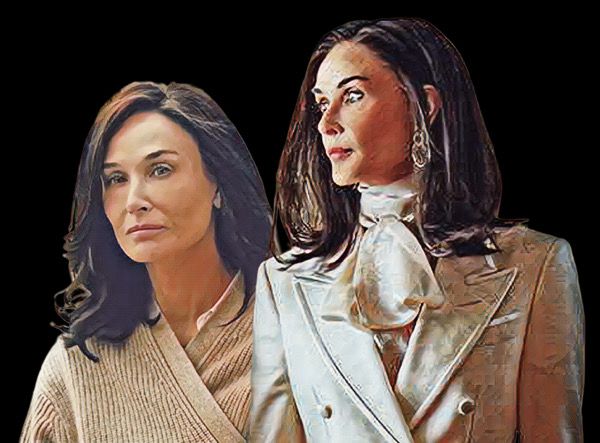
We return to Tommy Norris, still shaken by Monty’s death and the arrival of his new boss, Cami Miller. The men around her distrust her immediately, which only fuels the already infernal routine of the landman. In a way, the series seems to be correcting one of its biggest missteps: Demi Moore being relegated to a few scenes and treated like a side character.
Right away, Cami delivers the episode’s strongest moment. In the bathroom, she’s mocked by two young women who see her as a “disposable old lady,” completely unaware of who they’re insulting. Her response is lethal and precise. She calls herself a hunter, fearless, and warns: underestimate her and die regretting it.
Cami is crueler than Monty. And she’s ready to prove it.
The speech that flips the table
At the Fort Worth luncheon, surrounded by oversized cowboy hats and oil executives who expect nothing from her, Cami delivers her best scene in the entire series so far. Instead of giving a bland industry speech, she eviscerates the room, warning that she’s coming after contracts, equipment, and any man who thought she’d be easy to sideline.
“Enjoy your lunch — I paid for it with your fuckin’ money.”
It’s the moment Demi Moore finally gets what she deserved since season one: space.
But not even this sequence escapes Taylor Sheridan’s obsession with traditional gender dynamics. Cami only lights her fuse after being humiliated by younger women — as if feminine motivation must always come from aesthetic offense. And Tommy, trying to be helpful, suggests she delegate all negotiations to him. In practice? He drains her of the power Monty left her.
He praises, he protects — and still reproduces the same structure he claims to fight. Structural misogyny rarely recognizes itself.
Cooper wants to be a billionaire — and takes his first big step
Meanwhile, Cooper Norris is determined to become the billionaire his father never managed to be. Living with Ariana, he launches his own operation and is instantly rewarded: his first well hits a deposit expected to produce 10 million dollars a year.
His storyline is simple but effective — Cooper is ambitious, volatile, and clearly struggling to break free from his father’s shadow while still repeating many of his behaviors.
Ainsley — between stereotype and absurdity
Angela and Ainsley dedicate themselves to Ainsley’s college application — a daunting task given the girl’s lack of preparation. Whenever she speaks, Ainsley reinforces stereotypes so exaggerated they border on offensive, though Michelle Randolph plays her with such charm that she remains oddly irresistible.
Even with outrageous answers (and an increasingly furious admissions officer), she gets accepted into TCU.
But the point is clear: Sheridan insists on turning young women into caricatures, sacrificing nuance for easy laughs.
Angela explodes — again — and Tommy tries to keep the pieces together
Now president of an oil company, Tommy faces an Angela increasingly materialistic and unhinged. She wants to leave Midland to live “accordingly” to his new status.
When Cooper asks his father to talk business, it means sitting through dinner with Angela and Ainsley — a ticking bomb.
Angela detonates, smashing the house in a fury of frustration. And, as always, the couple slips back into its toxic pattern that ends in sex.
Ali Larter is terrific even when Angela is written in just one note: hysterical, demanding, volatile.

Thomas Norris — the sunset before the storm
We meet Thomas “T.L.” Norris, played by Sam Elliott, a lonely elderly man who only wants to watch the sunset before dinner at the assisted-living facility.
His scenes bring melancholy — and a dose of sexism — since his first line is snapping at a nurse for not understanding why the sun sets later than the day before. Sheridan doesn’t spare anyone.
Later, T.L. receives the news that his wife has died. And Tommy gets the same devastating call just as he and Angela are settling into yet another brief reconciliation.
A heavy, quiet ending — unexpectedly emotional.
Conclusion — A strong premiere weighed down by Sheridan’s old vices
The episode delivers what Landman does best: sharp performances, compelling oil-industry politics, striking landscapes, and finally a chance for Demi Moore to ignite the screen.
But it also keeps what Sheridan refuses to abandon:
– women reduced to tropes;
– crude humor;
– structural misogyny disguised as “realism”;
– scenes that undercut themselves for shallow commentary.
Even so, “Death and a Sunset” opens season two with tension, family fractures, and a sense that everything is about to unravel — the perfect recipe for drama.
Descubra mais sobre
Assine para receber nossas notícias mais recentes por e-mail.
 miscelana.com