
Hollywood has always needed to reinvent its action men, but one thing never changes: the urge to soften muscles with humor. Since the late 1980s and early 1990s, there has been a nearly automatic instinct to humanize the buff hero, turning him into the “gentle giant” who stumbles, jokes, struggles emotionally, and, by the end, hugs children. That’s how Arnold Schwarzenegger, the ultimate hyper-masculine icon, ended up teaching kindergarten or becoming pregnant. Later, Vin Diesel stepped away from the nitrous fumes of Fast & Furious to become a nanny. The tradition continued with Dwayne Johnson, who essentially built an entire career on the contrast between his colossal physique and a surprising tenderness. And John Cena, with his self-deprecating humor, quickly found his niche as the sweet, loyal bruiser who tries to understand feelings while accidentally breaking furniture.

Now, the streaming era has embraced this tradition and placed its new giants in the same mold. Mark Wahlberg, a veteran in this hybrid category, fits in comfortably. And Alan Ritchson, coming off the enormous success of Reacher, steps firmly into this territory where muscles collide with family comedy. This is where The Family Plan (1 and 2) and Playdate intersect. Not in plot or tone — they couldn’t be more different — but as vehicles designed to build and reinforce the modern persona of the muscle-dad: loyal, devoted, emotionally available, and always ready to save his family and, time permitting, the world.
Mark Wahlberg is the lethal dad trying to live a normal life
In The Family Plan and now in its sequel, Wahlberg plays the contemporary version of the classic dangerous man who desperately wants peace. His character carries the weight of a deadly past — assassin, secret agent, or any Hollywood profession that requires silent kills — and tries to perform domestic normalcy with all the earnestness in the world. The charm lies in this attempt to fit in. Wahlberg is physically capable of everything — fighting, running, confronting any threat — but emotionally he stumbles through his sincere desire to be a present father, a loving husband, and a tourist fully committed to creating the perfect vacation.
When the shadow of his past, now embodied by Kit Harington, returns during the most festive time of year, everything unravels in a deliciously predictable way. Suddenly, Christmas markets become battlegrounds, historic avenues turn into escape routes, and the family that only wanted to relax is dragged into a whirlwind of chaos wrapped in holiday cheer. Wahlberg remains the “emotional super-dad,” the man who tries to avoid violence but inevitably returns to it to protect the people he loves.


Alan Ritchson and the official beginning of the “domesticated Reacher”
Alan Ritchson arrives in Playdate carrying the near-mythic aura that Reacher gave him. His physical presence alone communicates extreme competence, sheer strength, and a sort of calm lethality. He is the kind of actor who doesn’t need to do much to look like he could defeat ten men with a shoulder shrug. And it is precisely this narrative body that the film uses — and subverts.
Unlike Wahlberg in The Family Plan, Ritchson is not the protagonist. He is the too-perfect father, the one who is quietly efficient, always ready for anything, with impeccable reflexes. Next to Kevin James, who plays the “ordinary man” in its purest form, Ritchson becomes a living parody of the ideal “perfect dad,” as if he were a suburban Reacher undercover at a children’s playdate.
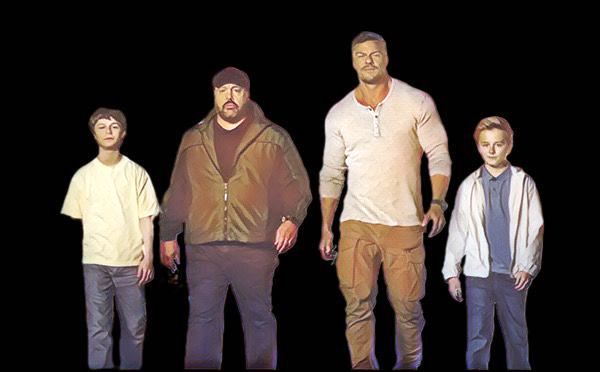

The contrast between the two men drives the film. While Brian stumbles, falls, panics, and struggles to survive a situation wildly outside his skillset, Jeff moves with an almost professional precision, as if he were always two steps ahead. The comedy emerges from the growing suspicion that this gentle, muscular dad is simply too good to be true. Under Luke Greenfield’s direction, Playdate transforms suburban normalcy into a stage for exaggerated, absurd action, where minivans, white picket fences, and juice boxes become improvised weapons in a carefully orchestrated spectacle of chaos.
The persona of the domesticated action hero
Although The Family Plan 2 and Playdate exist in entirely different universes — one embracing holiday sentimentality, the other leaning into suburban satire — they share the same cultural DNA. Both function as showcases for a persona Hollywood has adored for decades: the domesticated bruiser, the loyal giant, the man who looks capable of destroying the world but who really just wants a quiet afternoon with his family. Wahlberg and Ritchson, each in their own way, embody this contemporary archetype. One does so through emotion; the other through contrast. One runs from a past that keeps returning; the other becomes the embodiment of the “perfect dad” who unsettles more than he reassures.
In the end, Playdate and The Family Plan 2 have nothing in common narratively or aesthetically, yet they serve an identical function within the industry: they help shape and project the public personas of their stars. Comedy becomes a shortcut to humanize muscles. Fatherhood becomes a metaphor for responsibility, vulnerability, and heroism. Hollywood has been telling this story for decades, merely swapping faces and settings. Once it was Schwarzenegger holding a baby; now it’s Wahlberg trying to enjoy a family vacation and Ritchson taking the kids to a park while outrunning mercenaries. The fantasy is the same — only the packaging has changed.
Descubra mais sobre
Assine para receber nossas notícias mais recentes por e-mail.
 miscelana.com