
Watching the new documentary about P. Diddy on Netflix is deeply uncomfortable, and that is perhaps precisely why it is necessary. We live in a moment when part of the public debate tries to downplay the gravity of the accusations by resorting to old rhetorical shortcuts, almost always crossed by sexist and outdated arguments, such as the idea that everything was “consensual” or that this would merely be another case of domestic violence, as if monstrosity could be measured on a scale, as if there were abuses that were more or less acceptable. What the documentary does, above all, is refuse to allow this moral cushioning. It insists. It does not let the case die. And that, in an environment of accelerated forgetting, is in itself a political gesture.
If until now projects about Diddy mostly operated through archival footage, photographs, later interviews, and reconstructions, this new one advances a few degrees in exposing the real mechanics of the collapse. Some images function almost like a reality show of the downfall: the hours preceding his arrest, the backstage of damage control, the assembly of legal and communication strategies, the permanent sensation that everything might still be contained, as it always had been. For the first time, we are not merely looking at a glorious past that crumbled, but at a present still in combustion, at the moment when the empire tries to stand while already being structurally broken.

For those who follow the case closely, the script does not exactly bring new accusations. And far from being a weakness, this is part of its strength. What changes here is the materiality of the evidence. The previously unseen images, the records brought by victims or by people who were very close to Diddy, do not merely expand the catalogue of allegations: they confirm, one by one, the words that had already been circulating. What had been described in documents and testimonies now acquires body, time, reaction, silence, and expression. Coercion ceases to be a legal term and becomes a visible experience. Abuse ceases to be an abstract narrative and gains texture. Trauma ceases to be a concept and settles into gestures, pauses, gazes. Everything he was accused of finds, here, an imagistic grounding that makes the comfortable defense of eternal doubt impossible.
It is also impossible to watch this material without realizing how it only exists because a criminal culture was normalized for decades behind the music industry, a culture that protected, shielded, negotiated, and reconfigured the power of figures like him whenever necessary. Lawyers, settlements, silence contracts, extrajudicial payments, implicit threats, institutional complicity — none of this arises by chance. Diddy was not an anomaly within a healthy system, but a product perfectly adapted to it. The documentary exposes not only an individual, but an entire machine that continues to function even after one of its most visible pieces finally falls.
Still, some absences weigh heavily, and they do not go unnoticed. Central names in the symbolic machinery of power remain outside the frame: Jay-Z, Kanye West, Beyoncé, Jennifer Lopez. A single image keeps returning to the collective imagination, that of Leonardo DiCaprio at the famous white party, as if it alone could symbolize a much broader network of complicity. Victims such as Justin Bieber are also absent, which is certainly related to legal restrictions, but the symbolic effect remains the same: there are silences that the documentary cannot break. And those silences also tell a story, one in which certain names are still protected by the same forces that protected Diddy for so long.
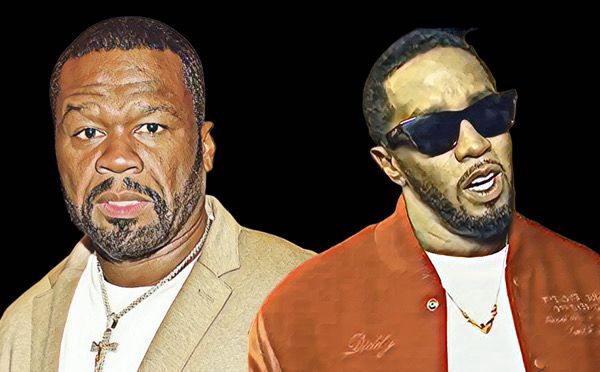
None of this is neutral, nor is the documentary’s existence as an audiovisual product. The rivalry between Diddy and 50 Cent spans decades, cuts across disputes over power, control, narrative, and money within rap itself. Here, however, it spills into another territory. The fact that 50 Cent signs the production is inseparable from his long-standing clash with Diddy, but reducing the documentary to a mere personal vendetta would be an all-too-convenient escape — almost as comfortable as attempts to relativize the accusations. There is interest. There is symbolic revenge. There is, yes, spectacle. But there is also a clear act of insistence: the refusal to allow the machinery of forgetting to absolve yet another powerful man simply through the erosion of time.
In the end, the documentary itself states something that is almost unbearable to admit: even in prison, Diddy has won. He has won because he built a financial empire that continues to operate independently of his physical presence. He has won because his contracts, assets, and brands keep circulating. He has won because the structures that sustained him remain essentially intact. And if he has won, that victory unfolds over a collective defeat — ours — the defeat of a society that allowed success and money to function as moral shields, that tolerated abusive practices while they were profitable, that preferred to separate talent from character until the limit of what is sustainable was long surpassed.
That is why, despite accusations of sensationalism, despite its gaps, despite its strategic silences, this documentary matters. Because it irritates, disturbs, contradicts, and exposes. Because it refuses the idea of comfort. Because it insists on reminding us that idolatry also kills, even if in ways less visible than direct violence. And because, at its core, there is an uncomfortable truth in 50 Cent’s motivation that transcends his personal rivalry: monsters cannot be deified. They never could. They never should have been.
Descubra mais sobre
Assine para receber nossas notícias mais recentes por e-mail.
 miscelana.com