
I found it curious that the sugar-coated The Gilded Age opened its season by showing the Russell family investing precisely in silver mines in the American West — and later returned to the subject as a symbol of prosperity, expansion, and future. By then, I was already aware that by the end of the year, Netflix would finally release The Abandons, a series willing to expose the decidedly unromantic side of that same historical chapter. Yes, I love a good western. And this one would be led by two strong female characters. How could I resist?
The genre traditionally presents itself as a foundational myth: the place where everything begins, where a nation organizes itself out of chaos. The Abandons chooses the opposite path. Set in 1854, in the still-unstable Washington Territory, the series is not interested in founding anything. Its gaze settles on a dangerous interval — the moment when law has not yet truly arrived, and violence begins to organize itself as a method. Be patient: the connection between the two series lies precisely there.
Here, the dispute is not ideological. It is material. Land, silver, ownership, inheritance. Jasper Hollow does not function as a romantic symbol but as an asset — a piece of ground too valuable to remain neutral. What American history has often framed as “Manifest Destiny” appears in the series stripped of idealism: expansion means expulsion; prosperity means taking.
The very title helps define this world. The Abandons is not poetic. It refers to an actual term from the period used to describe those pushed outside the social contract: orphans, displaced people, disposable bodies. These are not misunderstood heroes living on the margins of society; they are people born outside it, forced to negotiate every inch of existence. Family here is not inheritance — it is a survival arrangement.
The series originates from an old idea by Kurt Sutter, creator of Sons of Anarchy and an author obsessed with communities that turn into parallel authorities when the law fails. But The Abandons reaches Netflix, shaped by a turbulent production process and by other creative forces. Sutter exited the project before filming ended, and the series was reshaped by a broader group of producers, directors, and post-production decisions. That journey leaves visible marks. The Abandons bears a disputed authorship — perceptible both in its ambitions and in its inconsistencies — constantly pulled between a hard political western and a more traditional clan drama. That friction is what makes it interesting. It also explains why critical reception proved so divided.
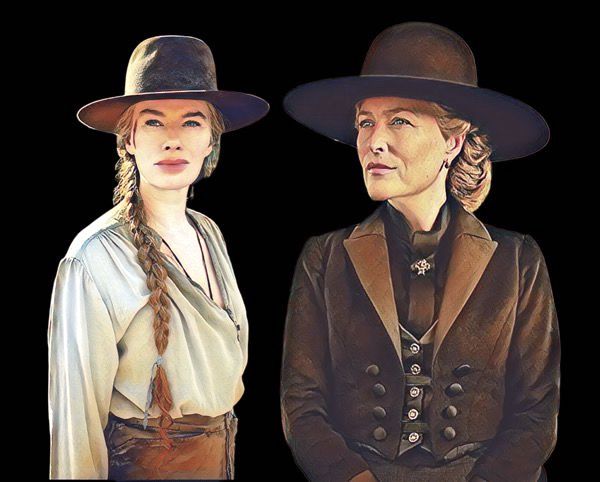
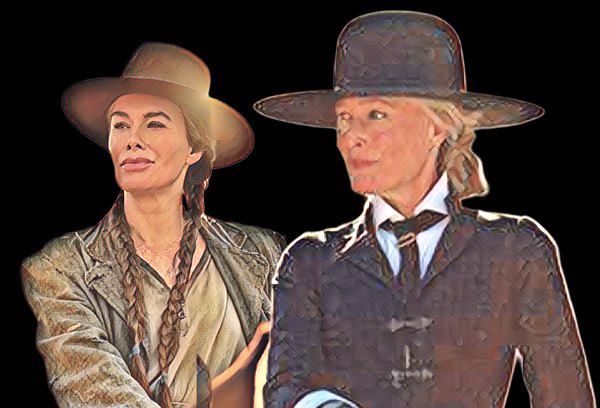
At the center of the story are two widowed women, two forms of power, two ways of justifying violence.
Fiona Nolan, played by Lena Headey, builds a family where there was nothing before: orphans, people without surnames, lives without legal protection. Her faith is not decorative — it structures decisions, defines limits, and gradually hardens her choices. Fiona loves, protects, and controls. The greater the threat, the more absolute her convictions become. In The Abandons, maternal love is not comfort; it is command.
Opposite her stands Constance Van Ness, portrayed by Gillian Anderson. Also widowed, also a leader, also convinced that yielding is equivalent to disappearance. Where Fiona speaks of protection, Constance speaks of progress. Where one claims a moral right to the land, the other claims the collective future. Both employ legitimate arguments — and increasingly indefensible tools. The series establishes this clash early on, when Constance fears losing the support of her main investor, Cornelius Vanderbilt (yes — here lies the direct bridge to The Gilded Age), should she fail to uncover new mineral wealth. And the most promising land happens to be occupied by the Abandons themselves.
It is impossible to ignore that Westerns have rarely offered meaningful space for women beyond three recurring roles: resigned widows, imperiled young women, or prostitutes. The Abandons aligns with the contemporary push toward female protagonism, but it justifies that choice perfectly by casting performers of the caliber of Lena Headey and Gillian Anderson. Even when the script falters — when dialogue becomes heavy-handed or narrative decisions stumble — they are the ones holding the conflict together. Their performances lend density, threat, and humanity to characters that might otherwise collapse into archetypes.
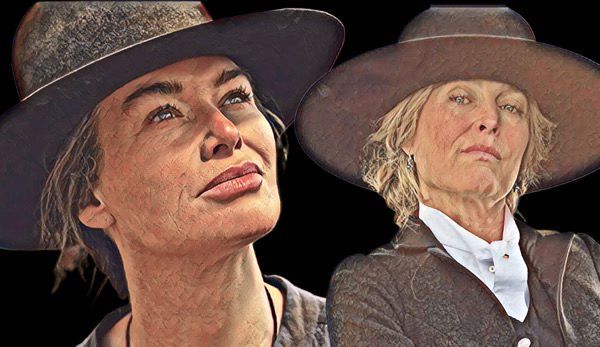
The series wisely avoids turning this confrontation into a simple fable. The Abandons understands that comfortable villains do not survive when the conflict is structural. The question is never who is right, but how much each character is willing to lose — or destroy — to keep existing.
The younger characters orbiting this clash — Elias, Dahlia, Albert, and Lilla Belle — do not function as emotional relief. They are both victims and perpetrators, the true ethical battleground of the story. Violence accumulates in them, is learned through them, normalized through them. The forbidden romance between Elias and Trish is not an exercise in hope; it is a line crossed in a world that punishes those who insist on blurring boundaries of blood, class, and loyalty.
Yes, The Abandons visibly carries narrative flaws. There are uneven episodes, unstable pacing, thematic repetition, and decisions that feel like the result of late-stage rearrangements. But rather than invalidating the series, these imperfections draw it closer to the western tradition itself: stories that never fully close because they reflect the chaotic occupation of the territory they depict.
This is not a romantic West. There is no glorious foundation, no clear promise of future order. What we see instead is the birth of inequality, the institutionalization of force, the transformation of ordinary people into something harder than they ever intended to be.
In the end, even while speaking about origins, The Abandons does not ask how a nation was born.
It asks who was left behind — and what those people had to become in order not to vanish.
It is from this unstable ground that the recaps begin. Next on Miscelana.
Descubra mais sobre
Assine para receber nossas notícias mais recentes por e-mail.
 miscelana.com