
The world of Avatar has always been more than a visual spectacle; it is a meditation on belonging, pain, and survival. Since 2009, when James Cameron first took us to Pandora, we have followed the journey of Jake Sully (Sam Worthington) and Neytiri (Zoe Saldaña) across worlds, bodies, and belief systems. The second chapter, The Way of Water (2022), expanded this mythology into the oceans, deepening the Sully family dynamics and cementing the franchise as the most ambitious cinematic saga of the century.
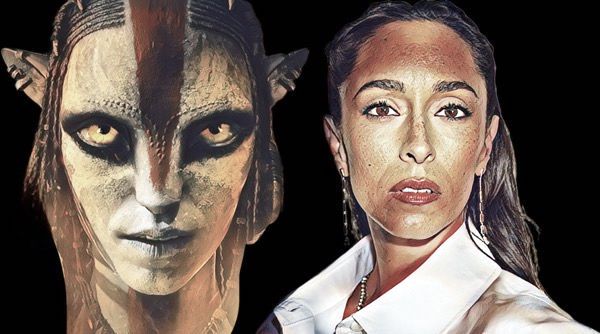
Now, with a release date set for December 19, 2025, Avatar: Fire and Ash promises a new turn, both narrative and emotional. The third film introduces an unexplored territory of Pandora: volcanic regions inhabited by the Mangkwan, or Ash People, a clan that lives in harmony with fire and bears the scars of ancestral trauma. At the heart of this people is Varang, portrayed by Oona Chaplin, an intense, multifaceted leader whose story brings unprecedented moral complexity to the Na’vi universe.

Varang is not a traditional villain. She was born from pain, loss, and the feeling of having been abandoned by Eywa — the deity that guides all Na’vi. After a natural catastrophe devastated their homeland, the Ash People severed their spiritual connection and learned to survive by instinct rather than faith. “She’s a survivor who turned grief into fuel,” Oona explains. “She used pain and despair as her driving force — almost like a revenge story.”
It is within this emotional borderland that James Cameron finds the heart of Fire and Ash. The film dives into the gray zones between empathy and fury, exploring what happens when love for one’s people merges with the desire for power and revenge. “Hurt people hurt people,” Oona summarizes, reflecting on how unresolved pain turns into violence — on Pandora and beyond.
In our exclusive conversation with Revista Bravo!, Oona Chaplin spoke about the process of bringing Varang to life, the liberating experience of performance capture (“It’s like going back to the school playground, where only imagination matters”), and working with a director she describes as “a generous genius, curious and passionate.” James Cameron, she says, continues to expand the planet and its stories “with a loving eye toward humanity and the contradictions of the Na’vi.”
Between lighthearted memories from set — such as improvised singing and dancing rituals she used to bond the Ash People cast — and deep reflections on grief and resilience, Oona Chaplin reveals herself as an artist carrying the legacy of a legendary lineage: granddaughter of Charlie Chaplin, great-granddaughter of Eugene O’Neill, and daughter of Geraldine Chaplin. She has built a career marked by intensity and authenticity. From Game of Thrones — where she became part of television history with the shocking Red Wedding — to Taboo and now Avatar, Oona transforms every role into a reinvention.
Below, our exclusive conversation, in which she speaks about fire, faith, wounds, and the strength of Varang — Pandora’s newest indomitable soul.
Revista Bravo!
What can you tell us — without too many spoilers (though I don’t mind spoilers) — about your character and what we can expect from her in the film?
Oona Yes! So, Varang. Varang is the name of my character. She is the leader of the Ash People, the Mangkwan. And she’s a very intense woman. A fierce warrior, and very different. The Ash People are also very different from the other Na’vi we’ve come to know on Pandora. She has a confrontational relationship with Eywa. They cut their connection with Eywa because there was a natural disaster in their homeland. They felt abandoned. They went through great trauma. And out of that trauma, Varang rose from the ashes and decided to reorient her life, to turn this pain and grief — that she and her people felt — into fuel for the fire. So it’s almost like a revenge story. They are survivors. She did what had to be done. Eywa abandoned her, and she thought, “Well, that’s it then.” They found a different, stronger power. And she really comes in to add complexity and shades of gray to our beloved blue world.
Revista Bravo!
The so-called “antagonist,” but with empathy.
Oona: Yes, you know, I understand her. I feel her heart.
Revista Bravo!
Because in such a binary world, with people coming from wounds and trauma, deciding what’s right and wrong, how does she navigate that? How do you see that challenge in building character?
Oona: Well, you know, grief is a very powerful energy. Grief, despair, and abandonment are incredibly strong energies. They move people forcefully. And when that’s your fuel, when grief is your fuel, you gain a lot of power. You can see this in the world today. Many of the conflicts we see around us come from a place of pain. It’s the classic “hurt people hurt people.” It was easy for me to connect to that. I act differently; I like to heal what hurts me. I think forgiveness is the highest form of protection. But at the same time, I understand how grief can turn into hatred. So it was a very beautiful and empowering journey for me to connect with this character. I have deep compassion for her, even though I don’t agree with her choices.
Revista Bravo!
But we wouldn’t have a story to tell if there weren’t people we disagreed with, right?
Oona Exactly, right? Try building a story without drama. [laughs] I don’t know. We’ll see if that’s possible someday.
Revista Bravo!
James Cameron has been building the world of Pandora layer by layer. How do the Ash People fit into this, and Varang as well, without spoilers, if possible?
Oona: Well, they come in because we saw the first film, we met the Omaticaya clan, then we went to the reef and met the clan that lives there. And we keep expanding the world of Pandora, because this moon is incredibly rich in culture, diversity, and biodiversity. What Jim is doing is expanding, diving deeper into this planet, and also telling a story that becomes more relatable to us. I think the main theme of the third film is grief — grief and despair — and all of us can connect to that. He’s widening our lens so we can better understand what it means to live in our own hearts.
Revista Bravo!
And what was it like working with him, of course, and with all the stars as well?
Oona: He’s incredible. He’s a genius, first of all. He has a deep understanding of so many things. He’s very curious, attentive, passionate, and extremely generous. It was a breathtaking experience. I have so much affection for him. I admire him deeply — everything he wants to do in this world, all the good thoughts he has — for himself, for his family, for humanity — and for the Na’vi as well.
Revista Bravo!
And what was it like? I know you’ve probably answered this a thousand times, but it’s always fascinating: how is it to work with live action, all this technology, and still keep everything physically and emotionally real? What were the biggest challenges for you?
Oona: Actually, all the challenges of filming disappeared for me, because it was the most liberating form of acting I’ve ever experienced. Everything — costume, hair, makeup, lighting, extras, snacks — all the things that normally limit you or put boundaries around your performance (even healthy ones) — all of that disappears. You have the equipment, the cameras, but everything is there only to feed your imagination. It’s like going back to the playground at school — you imagine everything. What exists is your conviction and your imagination to create the moment, and everything else is just there to support and amplify it. It’s incredible, inspiring — a true luxury for actors. I wish everyone could experience it, because people have the wrong idea about performance capture. I did too. But it is an incredibly liberating experience as an artist — to commit to the moment in such a pure form of imagination. It’s magnificent.

Revista Bravo!
I can’t wait. Is there a favorite behind-the-scenes moment you can share?
Oona: Behind the scenes? Wow, so many! We were there for a year and a half, so I have lots of great stories and memories. The feeling of family, support, learning, and acquiring so many new skills… There’s one funny moment worth telling: the character is so different from me that every day I had to “arrive” at her energy. I had to hype myself up, start shouting, and stomping my feet. And I forced all the Ash People actors to do it with me — singing, shouting, stomping before scenes. It was so much fun, and they were very game. Now, when I think about it, I crack up laughing, because it must have looked very strange.
Revista Bravo!
But those are the good memories.
Oona: Exactly.
Revista Bravo!
I can’t leave without asking — a personal curiosity: decades later, how often are you still asked about the Red Wedding?
Oona: [laughing] Oh, it’s such a landmark moment in television history, so yes, I get asked. But it’s fine. I mean… I’m grateful for that horrible moment. [laughs]
Descubra mais sobre
Assine para receber nossas notícias mais recentes por e-mail.
 miscelana.com