
I have a certain fatigue when it comes to Hollywood films about Hollywood. The industry is so self-absorbed that these stories usually arrive with an instruction manual already built in: the star’s crisis, nostalgia for a golden age, fame staring back at itself in a cracked mirror. Even when the director is Noah Baumbach and the cast includes names like George Clooney and Adam Sandler, both already circulating prominently in Oscar 2026 conversations, skepticism feels almost automatic. I expected an elegant, competent, predictable film. I was wrong.
Jay Kelly is, above all else, a film of rare sensitivity. Perhaps it’s Nicholas Britell’s score, which follows the protagonist like an emotional afterimage, never intrusive, always quietly melancholic. Maybe it’s the screenplay by Baumbach and Emily Mortimer, which avoids easy cynicism and instead chooses a more humane, almost restrained approach to discussing fame, memory, and identity. Or perhaps it’s simply the whole: a film that trusts time, silence, and actors. Either way, Jay Kelly is a beautiful film.

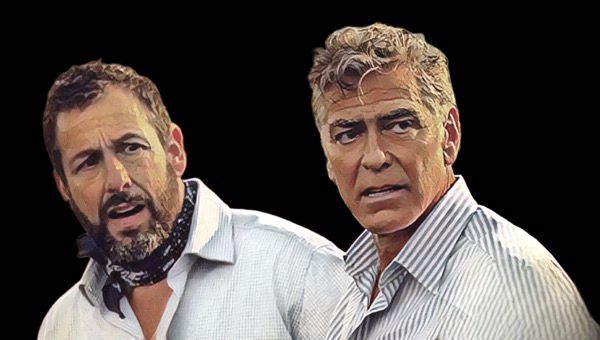
Clooney plays a movie star who seems to be reaching the invisible end of a model that no longer exists. Jay Kelly is not in free fall — he remains famous, desired, revered — but he is beginning to realize that his entire sense of self has been built around being seen. The problem is what remains when that external gaze no longer suffices. Jay doesn’t quite know who he is outside of his public image; his memories, his relationships, even his regrets appear organized like scenes from a film. Unsurprisingly, he experiences the present as if he were constantly performing.
The story follows a handful of decisive days in Jay’s life: the death of a defining mentor, unexpected encounters from his past, an unresolved desire to reconnect with his daughters — especially the youngest, on the verge of leaving home — and a trip to Europe that feels less like travel than like an interior passage. Baumbach structures the film as a mosaic: memories, movements, and conversations that initially seem disconnected, but gradually assemble into a precise portrait of the emotional emptiness of someone who has spent a lifetime being loved by millions, while consistently failing in the relationships that mattered most.

Adam Sandler is the film’s quiet emotional center. His Ron, Jay’s longtime manager and closest companion, escapes the usual caricature of the predatory Hollywood fixer. He genuinely loves Jay, truly believes in the joy Jay’s films bring to audiences, and at the same time maintains a life of his own, a wife, children, and a stability Jay has never managed to sustain. It’s an extraordinarily delicate performance, and possibly one of the best of Sandler’s career, because it reveals something quietly unsettling: in the end, Ron is the more complete human being. Jay is the star, but Ron is the one who feels whole.
Behind the scenes, the film carries Noah Baumbach’s reflections on the very ecosystem he has always inhabited. Yet the tone is neither caustic satire nor loud self-critique. Jay Kelly plays more like a gentle lament for an era that is slipping away: the age of the movie star who could open a film on charisma alone. The opening tracking shot across a working film set already signals this, a respectful, melancholy farewell to the classical machinery of cinema.
Critical reception has largely embraced the film on those terms. Reviewers note its refusal to indulge in Hollywood narcissism, favoring a meditation on the emotional cost of a life lived on constant demand. Many point to the fragmented structure, which doesn’t always resolve in conventional ways but mirrors the protagonist’s inner dislocation with clarity. Others highlight how Clooney deploys his public persona — charm, elegance, the aura of the “last classical star” — to create something exposed and even painful. The recurring impression is that the role feels like a career summation without ever tipping into self-celebration.
As awards season approaches, Jay Kelly is positioning itself with quiet confidence. Clooney has emerged as a strong Best Actor contender, Sandler remains present in supporting-actor conversations, Nicholas Britell’s score is already widely cited, and Baumbach returns to the awards radar for both writing and direction. This is not a campaign built on noise, but the kind of film that gathers momentum through critical consensus, an emotional favorite rather than a strategic one.
Before a single image appears, Jay Kelly opens with a line from Sylvia Plath’s journals — not a poem, but an intimate, unsparing thought: “It’s a hell of a responsibility to be yourself. It’s much easier to be somebody else or nobody at all.” The choice is no accident. It serves as the key to everything that follows.
Jay has spent his entire life being someone for others. A face, a name, a collection of gestures that belong as much to the audience as to himself. His memories arrange themselves as scenes, his relationships as poorly rehearsed roles, and the present as a continuous performance. As the film draws toward its conclusion, what’s at stake is no longer redemption or collapse, but the late recognition that sustaining an identity built for public consumption comes at an unbearable cost.
Jay Kelly neither condemns its protagonist nor casts Hollywood as an absolute villain. Instead, it observes — with melancholy and compassion — the specific emptiness of a life lived under constant scrutiny. In the end, Baumbach seems to suggest something quietly devastating: when all your memories become performance, being yourself becomes the hardest role of all.
Descubra mais sobre
Assine para receber nossas notícias mais recentes por e-mail.
 miscelana.com