
It seems I was paying attention, wasn’t I? I included Peaky Blinders: The Immortal Man among my most anticipated films of 2026, and now Netflix has officially confirmed — via Tudum, alongside a handful of new images — what had already been in the air ever since Steven Knight began describing the project as something “necessary.” The Immortal Man is not a nostalgic epilogue, but a repositioning. A film that advances Tommy Shelby’s story to 1940, during the midst of World War II, and reframes the Peaky Blinders universe within a new historical, political, and generational context.

After a four-year hiatus — the series ended in 2022, the film was officially announced in 2024, and filming took place between 2024 and 2025 — the mystery finally comes to a close in March 2026, when we return to the harsh, violent streets of Birmingham, England.
It is telling that this return is happening now. Peaky Blinders has always been a story about broken men trying to adapt to a world in flux: from the aftermath of World War I to the rise of fascism in Europe. Taking the narrative into World War II is not only coherent — it feels inevitable. And, in many ways, it fulfills a promise the series has been making since the beginning.
As I have written on Miscelana since the film was first announced, this project never sounded like fan service. It felt far more like something Steven Knight needed to tell. There was understandable concern that Cillian Murphy — after a decade in the role (and never hiding how much he hated the Shelby haircut that became the show’s signature), now an Oscar winner — might be done with the saga. Instead, he confirms that the ending was still unresolved when he says that “Tommy Shelby wasn’t finished with me.” It’s not just the character who returns, but the central question of the series itself: what remains when power, violence, and trauma spill across generations?

Directed by Tom Harper — a filmmaker deeply tied to the show’s visual and emotional identity — the film follows Tommy after a self-imposed exile. The world is at war. The country is at war. And, as Knight puts it with almost cruel precision, “the Peaky Blinders are at war too.”
But something is different now. The Tommy who returns is not the rising figure of the 1920s, nor the conflicted politician of the 1930s. He is a survivor. A weary myth. A man forced to confront not only his family’s legacy, but the impact he himself has left on the world. Without his wife — one dead, the other having left him at the end of the series — estranged from his surviving son, and grappling with another child he only discovered in adolescence, Tommy carries a life full of unresolved drama.
The casting choices reinforce this transition. Alongside familiar faces, actors like Rebecca Ferguson and Barry Keoghan join the film — performers who bring a contemporary, restless, less reverent energy. That matters. The Immortal Man seems far less interested in closing doors than in repositioning the Shelby universe for new perspectives.
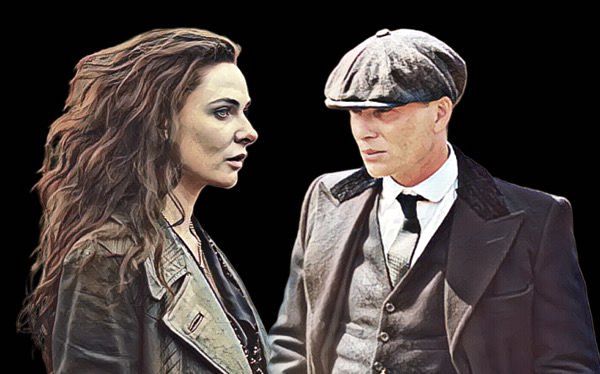

Their roles, like Tim Roth’s, have not been officially revealed, but the images suggest that my suspicion was right: Ferguson appears connected to the gypsy side of the story, while Keoghan is firmly among the Peaky Blinders themselves, wearing the signature cap.
This is where the film becomes something larger than a conclusion and begins to function as a bridge. For those who have followed the series since 2013, it is a return heavy with memory. For newcomers who have never stepped into Small Heath, it may be a first encounter with this world — now filtered through a broader cinematic, historical, and emotional scale.
Peaky Blinders has always been a story about time. The time that passes, the time that destroys, the time that turns ordinary men into historical figures. Turning the “ending” into a film set during World War II is an acknowledgment that this story belongs not only to its characters, but to the eras they move through.
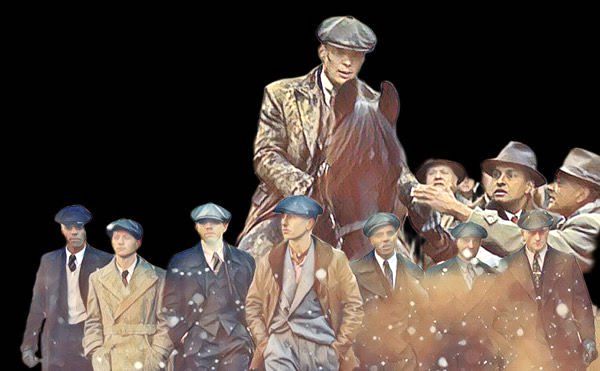
Perhaps The Immortal Man will truly be Tommy Shelby’s final chapter. Or perhaps it will be the opening chapter of something else entirely. A new generation. A new point of entry. A universe that refuses to be archived.
Either way, one thing is clear: Peaky Blinders did not return to repeat itself. It returned to remind us that some stories — like certain ghosts — don’t disappear. They simply change shape.
And by order of the Peaky Blinders, we comply.
Descubra mais sobre
Assine para receber nossas notícias mais recentes por e-mail.
 miscelana.com