
As published on Bravo Magazine!
Jane Austen wrote a few books: six complete novels in total, only five of them published during her lifetime. She was recognized in her own time, especially among attentive readers and informed literary circles, but she was not a celebrated or widely famous author in the way we understand success today. Like many women of her era, she published anonymously (“By a Lady”), which already imposed clear limits on her public visibility. Even so, her books sold well by the standards of the time, received positive reviews, and circulated steadily among England’s middle class and reading elite.
Jane lived in relative comfort, but without full financial independence. Her definitive consecration came 53 years after her death, in 1870, when her nephew Edward, Lord Brabourne, published A Memoir of Jane Austen, the author’s first biography. The book introduced the public to a figure who had until then remained almost invisible: a woman who had written brilliant novels away from the spotlight, in domestic silence, without full recognition. From that moment on, Austen ceased to be merely “an author of good novels” and became a cultural figure, finally acknowledged as one of the great novelists of the English language.

For someone who gave us some of literature’s most enduring love stories, there is a curious mystery surrounding who Jane Austen really was: whether she loved anyone, what her personality was like, and what caused her early death. These gaps continue to fuel books, series, and films that attempt — almost always in vain — to reimagine her. What many contemporary writers and screenwriters lack is precisely what Austen mastered: emotional precision, irony, and economy of language.
On December 16, 2025, Jane Austen would have turned 250. Round-number anniversaries often provoke predictable tributes, but Austen’s case resists ceremonial treatment. She did not survive time as a literary relic; she remains alive because she continues to be read, reread, adapted, reinterpreted, and — above all — discussed. Few classical authors maintain such vitality without relying on academic reverence. Austen crosses generations because she writes about things that do not age: social expectations, inequality, female desire, money, choices, and the inevitable consequences of each of them.
For those who still insist on reducing her legacy to “romantic novels for women,” it is worth remembering that it was inspired by Persuasion — my favorite of her books — that Virginia Woolf wrote Mrs. Dalloway in 1924. Both novels are structured around regret and memory: protagonists who silently revisit fundamental choices made in the past. In both, female subjectivity is built from what is left unsaid. Woolf acknowledged this explicitly in her beautiful essay on Persuasion, in which she praises Austen’s ability to show “not merely what people say, but what they leave unsaid.”

It is therefore shallow to think of Austen’s books as mere “period romances,” associated with Empire-waist dresses, elegant drawing rooms, and successful marriages. Such a superficial reading ignores what matters most. Jane Austen wrote about limits: limits imposed on women, on social classes, on the possibilities of mobility, and even on ways of loving. Her books do not romanticize the world they depict; they expose its rules with irony, precision, and often cruelty. Curiously, her antagonists are frequently the characters for whom she shows the greatest empathy.
It is also important to remember that Austen wrote during a time of profound transformation. She lived in the shadow of the Napoleonic Wars, the consolidation of the English bourgeoisie, and a rigidly hierarchical social system. Indeed, she rarely addresses issues such as slavery directly — and her characters deal with problems that today could, not entirely unfairly, be summarized as “champagne problems.” Still, she never ignores the structures that produce these tensions. Her revolution takes place in the realm of perception. By narrowing the field of action — small villages, balls, visits, letters — she expands the psychological reach. Every social gesture is a power play. Every silence carries calculation. Every romantic choice is also an economic one.
This awareness runs through her entire body of work. In Pride and Prejudice, the love between Elizabeth Bennet and Darcy can only be fulfilled after both have revised their social and moral positions. In Sense and Sensibility, the conflict between emotion and prudence is also a commentary on female survival. In Mansfield Park — another personal favorite, and perhaps her most unsettling novel — Austen directly questions the morality of the English elite, including, albeit obliquely, its relationship to slavery. I like to think she would have gone even further in these larger questions had she not died suddenly at the age of 42. In Persuasion, her most melancholic novel, published after her death, time is not a romantic ally but an implacable force that exacts its price. It is a work of rare maturity.

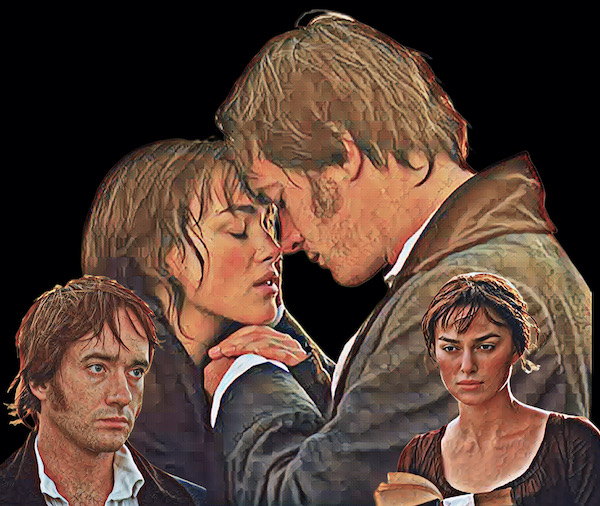
What distinguishes Austen from so many of her contemporaries is her refusal of easy sentimentalism. Her happy endings are not illusions; they are possible agreements within an unequal system. Marriage, in Austen, is never merely a romantic resolution — it is a social contract, and she insists that the reader understand this.
Perhaps that is why her work speaks so clearly to the 21st century. At a moment when we debate the emotional cost of choices, the precariousness of relationships, and the impact of social structures on intimate life, Austen sounds surprisingly modern. She does not offer simple answers. Her books demand careful reading, discomfort, and reflection. There are no easy villains. Entire systems are operating silently.
The contemporary fascination with Jane Austen can also be explained by the way her work resists adaptation. Each generation tries to translate her into its own language — from classical cinema to pop reinterpretations — but the core remains intact. The irony does not fade. The social critique does not disappear. Austen survives because her writing is structurally solid: it works on the page, on the screen, and in cultural debate.
Celebrating the 250th anniversary of Jane Austen is not about looking backward with nostalgia, but about recognizing an author who understood, like few others, the social machinery that shapes affections, ambitions, and failures. She wrote about women who think, observe, and choose, even when the world insists on limiting those choices. And perhaps that is precisely why we keep returning to her.
Jane Austen does not teach us how to love better. She teaches us how to see better.
And that, two and a half centuries later, remains one of literature’s most powerful achievements.
Descubra mais sobre
Assine para receber nossas notícias mais recentes por e-mail.
 miscelana.com