
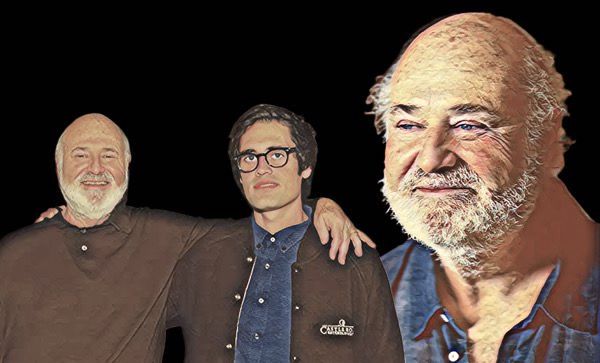
There is something profoundly unfair about the way Rob Reiner’s tragedy has been discussed. Not only because of the violence of its outcome, but because of the immediate shift in focus: from real life to the work, from grief to interpretation, from family to symbol. Suddenly, everyone is talking again about a film made ten years ago, as if it held the explanatory key, the hidden moral, the answer that was missing.
But perhaps what hurts most is precisely the opposite: even Rob Reiner — a filmmaker who spent his life trying to understand human relationships — could not answer the question everyone is now asking. How do you act when love is not enough? Where does care end and a boundary begin? How long do you insist, and when does insisting stop protecting?
Reiner built an entire career around dialogue, listening, and the possibility of repair. His films were never cynical; they were human. They spoke of conflict, but also of affection. Of imperfect families that, despite everything, found some form of reconciliation. The tragedy that crossed his personal life dismantles that narrative architecture. Because life does not offer a dramatic arc. It does not offer guaranteed redemption. It does not offer a final scene that makes chaos intelligible.
Friends claim that the Reiners tried everything, and this is not a defensive phrase. It is a fact. Treatments, early rehabilitation, specialists, resources, persistence. Nick’s addiction was already severe by the age of sixteen. And “nothing worked for him,” as he said. Perhaps, at that moment, nothing really did. Addiction and psychological suffering do not obey proportional logic: loving more does not guarantee saving better.
Society, however, hates this answer. It is unbearable. We prefer to believe there is always a correct course of action that prevents catastrophe — because that belief gives us the illusion of control. When the illusion collapses, judgment follows. The family. The parents. Hollywood. The past. The film.
It is tempting to explain everything through a Hollywood equation: fame, pressure, public image, fear of scandal. There may indeed have been noise. Celebrity amplifies everything. But reducing an intimate collapse to that external framework is far too comfortable. Sometimes Hollywood is not the cause; it is merely the stage where pain gains echo. And an echo is not an explanation.
It is also tempting — and even crueler — to judge the Reiners as parents. Judgment creates distance: if I can identify their mistake, I can convince myself that it would be different with me. But what emerges from the accounts is not negligence, but exhaustion. “He was always troubled” is not a diagnosis; it is an attempt, worn down by years, to name something that refuses to be contained. The obsession with diagnosis is another trap. As if naming were solving. As if a label were a guarantee. Even when there are possible comorbidities — mood disorders, impulsivity, substance-induced psychosis, personality traits — none of this ensures treatment adherence, stability, or safety.
Perhaps the most painful point is the conflict that runs through both the film Being Charlie and the interviews: Reiner admits he listened more to specialists than to his own son, and feels remorse. Michele, in turn, speaks of doctors who convinced her that Nick lied, manipulated, and staged his suffering. And here we enter the most dangerous territory of all: when medical language becomes moral sentencing.
People struggling with addiction can lie, manipulate, promise, and break promises. Not out of villainy, but because substances reorganize priorities and sustain denial. The problem begins when the system reduces a person to this — “manipulative,” “irredeemable” — and pushes the family into an impossible role: policing instead of caring, punishing instead of treating. At the same time, families who have already heard everything also have the right not to romanticize every relapse. Listening to one’s child is not the same as obeying them. Love is not following the script of someone unwell.
And this is where the most avoided — and most urgent — question emerges: how do you set a boundary without becoming the villain? How do you say “you can no longer live here” without putting your own life at risk? There is no clean way. There is only one responsible one.
Setting a boundary is not a moral speech or an abrupt act of expulsion. The greatest danger lies precisely in improvisation, in solitary confrontation, in decisions made at the height of crisis. When addiction is combined with agitation, paranoia, recent humiliation, or a sense of being cornered, the risk escalates. It escalates dramatically when there is access to lethal means, a history of aggression, or threats, even those disguised as jokes.
The safest boundary is one that is not announced in the heat of a crisis; is not negotiated face-to-face during intoxication or loss of control; and does not turn the home into an emotional battlefield. Easier said than done once you are living it.
In practical terms — and this is hard to say — a boundary must be structured, not heroic. It involves preparing the ground: restricting access to dangerous objects, not confronting alone, involving outside support, coordinating with professionals, and, if necessary, emergency services. It involves communicating the decision clearly, without humiliation, without theatrical ultimatums, and with a concrete alternative: another place, another adult, another service, another step. “You cannot stay here” cannot mean “figure it out or die.” But it also cannot mean “do whatever you want to me.”
This does not make anyone a villain. It makes someone who recognizes their limit and the real risk involved.
And here lies the cruelest truth: even doing all of this offers no guarantee. There is no perfect conduct that eliminates the possibility of tragedy. There are only choices that reduce risk. Accepting that means abandoning the fantasy that there exists a final gesture capable of restoring order to chaos.
Perhaps that is why the film from ten years ago has resurfaced with such force. Not because it explains the tragedy, but because it exposes the collapse of a narrative we all like to believe: that love, when absolute, saves. Sometimes love reaches the door. And the door does not open.
The mistake lies in demanding that someone should have answered a question that, in truth, has no definitive answer. Rob Reiner knew how to film love. Life, however, demanded from him something no script can teach: accepting the limit, and surviving it.
And perhaps the most honest thing we can do now is resist the temptation to turn pain into verdict. There is no guaranteed redemptive lesson. No clear moral. Sometimes there is only silence. And the painful realization that even those who spent a lifetime believing in love eventually encountered its limit.
Descubra mais sobre
Assine para receber nossas notícias mais recentes por e-mail.
 miscelana.com