
As published in CLAUDIA (republished as an homage to Jane Austen’s 250th Anniversary)
If Jane Austen had met Emma Thompson, their conversation would have been extraordinary. I’ll go further: if Jane had known Emma’s personal story, she would have imagined tears, misunderstandings, and, of course, a happy ending. Spoiler alert: that’s exactly what the spirit of the writer delivered in Sense and Sensibility.
Before telling that story, it’s worth noting how 2025 is a year filled with major milestones for Jane Austen admirers. In December, we celebrate the 250th anniversary of the author’s birth; in April, the 25th anniversary of the premiere of Pride & Prejudice, starring Keira Knightley, which charmed a new generation; and, also in December, the 30th anniversary of one of the most acclaimed film adaptations of her work: Sense and Sensibility (1995). A favorite among “Janeites” — or “Austenites,” as devoted fans of Austen’s universe call themselves — the film brought to life one of Jane Austen’s earliest published stories, long considered “unfilmable.” Until Emma Thompson came along.

First, the book
Published in 1811, Sense and Sensibility follows the Dashwood sisters, Elinor and Marianne, who represent opposing temperaments: reason (Elinor) and emotion or sensibility (Marianne). After their father’s death, they and their mother are forced to leave their family estate and live modestly in a cottage in the English countryside.
Elinor, a sensible and reserved woman, falls in love with the kind Edward Ferrars, but must conceal her feelings due to familial and financial complications. Marianne, by contrast, is passionate and impulsive, and throws herself into a romance with the charming John Willoughby—who ultimately breaks her heart.
Throughout the story, the two sisters endure romantic disappointments and social trials, maturing and ultimately finding a balance between sense and sensibility. The novel delicately critiques the limitations imposed on women in 19th-century English society, particularly in relation to marriage, wealth, and social status.

It took an “Emma” to choose Elinor
Curiously, one of Jane Austen’s most emotionally rich stories took 184 years to be adapted into a major film, while Emma and Pride & Prejudice have had numerous versions. It took the acclaimed actress Emma Thompson to take a risk on writing her first screenplay to change that history forever.
By 1992, she was one of the most in-demand actresses in Hollywood, having won the Academy Award for Best Actress for Howards End and easily moving between Shakespeare, thrillers, and comedies with unmatched grace. At the time, still married to Kenneth Branagh, she began drafting the script for Sense and Sensibility while accompanying him to Tuscany for the filming of Much Ado About Nothing.
During conversations with producer Lindsay Doran, the two discovered a shared passion for Jane Austen. They noted how Sense and Sensibility was considered the least “cinematic” of Austen’s novels, due to its restraint and subtlety—but Emma saw emotional richness in it. The screenplay, which initially ran 500 pages, was deemed “too sunny,” but through years of dedication, the project would change her life—and cinema.


In 1994, she went through a painful personal crisis: her marriage to Branagh ended when he fell in love with her friend Helena Bonham Carter (who had played her sister in Howards End) while filming Frankenstein. Heartbroken, Emma returned to Sense and Sensibility, identifying deeply with Elinor Dashwood, the reserved elder sister who suppresses her emotions in the name of family duty and decorum. Through writing, Emma Thompson found a way to rebuild herself amid profound grief.
One advantage of adapting a book without a major film precedent was the freedom it offered—but Emma was determined to preserve Austen’s ironic, delicate spirit while making it accessible to a modern audience. Her adaptation brought swift dialogue, cinematic pacing, and emotional sincerity. Deservedly, Emma Thompson won the Oscar for Best Adapted Screenplay, becoming the only person to have received Academy Awards for both acting and screenwriting. But we’ll get to that.

Why the film still matters, 30 years later
Sense and Sensibility remains powerful because it subtly but clearly reveals the fragility of women’s social standing in the early 19th century. The Dashwood sisters, disinherited and reliant on distant relatives, face prejudice, instability, and pressure to marry as the only path to security. Emma understood that, in adapting the novel for film, she could highlight not just its romanticism and literary beauty, but also its embedded social critique. Her adaptation is not only faithful — it’s engaged, lucid, and modern.
An unexpected director and a young actress who would make history
Beyond the personal upheaval, the writing process had its setbacks. When Emma’s computer crashed before she had printed the final version of the script, it was her friend Stephen Fry who recovered the file after seven hours of work. He appears in the film’s credits in gratitude.
The choice of director was surprising. The job went to Taiwanese filmmaker Ang Lee, known for intimate dramas like The Wedding Banquet and Eat Drink Man Woman, but who had never made a period film—let alone a British one set in the 18th century. Yet the choice was perfect: Lee brought a visually subtle and emotionally precise approach. On the first day of filming, he conducted a Buddhist ritual for good luck—though the set was struck by a hailstorm, perhaps foreshadowing the emotional intensity of the production.
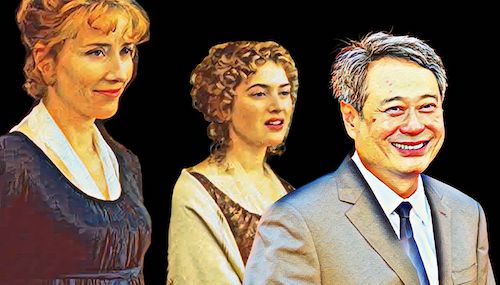
The cast included Emma’s ex Hugh Laurie, and her close friends Hugh Grant and Alan Rickman, but the real revelation was 19-year-old Kate Winslet, who dazzled everyone with her vivacity as Marianne—and Greg Wise, a lesser-known actor who would change Emma’s life forever.
Initially, she wasn’t meant to act in the film herself—even as the most decorated actress of the time. In the novel, Elinor is 19, and Emma is already 35. But Ang Lee insisted that no one understood the character like she did. To strengthen the bond between the Dashwood sisters, Lee suggested Emma and Kate share lodging during filming, resulting in more than just on-screen chemistry: the two remain best friends to this day. And Greg Wise? He and Emma fell in love and now have a family with two children and other collaborations. Jane Austen couldn’t have written a better happy ending.
As a collector and fan, I must mention the soundtrack, composed by Patrick Doyle, a frequent collaborator of Kenneth Branagh and ca lose friend of Emma Thompson. His music lent the film a melancholy elegance, blending classical melodies with restrained emotion—essential to the film’s atmosphere. Doyle also composed original songs sung by Kate Winslet, who revealed her vocal talent at the piano.

With a modest budget of $16 million, the film grossed over $135 million worldwide and received seven Oscar nominations, including Best Picture, Best Actress for Thompson, and Best Supporting Actress for Kate Winslet.
The critical reception was enthusiastic. Reviewers praised the intelligence of the adaptation, the elegance of the direction, and the emotional maturity of the cast. For Austen fans, it was proof that cinema could faithfully translate her novels without sacrificing complexity or subtlety. Three decades later, Sense and Sensibility remains one of the most revered screen adaptations of English literature — and a landmark in the careers of everyone involved, especially Emma Thompson, whose intellect, personal pain, and passion for Austen’s work came together to create something timeless.
Descubra mais sobre
Assine para receber nossas notícias mais recentes por e-mail.
 miscelana.com