
The possible sale of Warner to Netflix raises several sensitive concerns across the industry. Among them, perhaps the most delicate isn’t catalog size, global scale, or algorithmic power, but something harder to quantify: the willingness to back bold, author-driven, deeply uncomfortable projects. This was once a defining characteristic of HBO, and one that has been steadily eroded since the studio came under the far more conservative Discovery umbrella. Raised by Wolves stands as one of the clearest — and most radical — examples of that lost audacity.
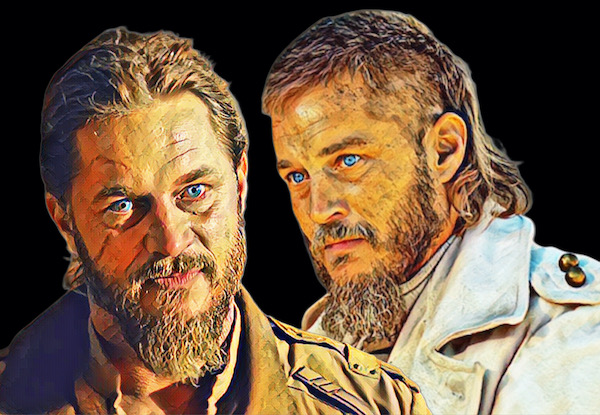
It was never an easy series to pitch, explain, or defend in performance meetings. And yet, it was greenlit. With a high budget, a declared aesthetic ambition, and a premise that refused to make concessions to the average viewer. That fact alone says a great deal about what HBO was once willing to sustain at a different moment in the industry.
Raised by Wolves never asked for permission to exist. And perhaps that was its greatest problem — and its greatest strength — from the very beginning.
It was not an easy series. It was not elegant in the classical sense. It made no effort to be immediately understood or liked. On the contrary, it often seemed to test the viewer’s patience. A flying hybrid serpent? A protagonist killed by being transformed into a tree? A planet that appears to reenact, in endless cycles, the collapse of entire civilizations? Honestly, none of this is easy to take seriously outside the show’s own internal logic. And yet, Raised by Wolves was so radically out of the box that, even three years later, it remains astonishing that it was made, financed, and aired by a major studio.
Created by Aaron Guzikowski and produced by Ridley Scott, the series emerged as a clear bet on philosophical, unsettling, symbolic science fiction. The initial premise sounded almost manageable: two androids, Mother and Father, are sent to Kepler-22b to raise human children after Earth is destroyed by religious wars. But it quickly became clear that this was merely a starting point for something far more disturbing. The conflict between atheists and Mithraics was never meant to function as a simple moral backdrop; it was dismantled episode by episode, until both faith and reason were revealed as equally capable of generating violence, fanaticism, and ruin.

The plot unfolded like a visual essay on historical repetition. Kepler-22b was not presented as a promise of renewal, but as a living archive of civilizational failures. Nothing there was pristine. Everything seemed weighed down by memory, guilt, and inevitability. Technology did not save. Religion did not redeem. Motherhood — biological or artificial — was portrayed as both a creative and destructive force.
Reactions were as extreme as the series itself. Part of the audience abandoned the narrative as it became increasingly abstract, symbolic, and, for many, simply absurd. The flying serpent became a cultural breaking point: for some, the moment Raised by Wolves finally freed itself from any conventional expectations; for others, the precise instant the series “lost control.” Critics oscillated between fascination and perplexity, acknowledging its aesthetic ambition while frequently pointing out the difficulty of emotional and narrative engagement.
In terms of numbers, Raised by Wolves was never a mass phenomenon. It debuted strongly within the HBO Max ecosystem, buoyed by Ridley Scott’s name and the curiosity surrounding the project, but it never evolved into an exponentially growing hit. Its audience was loyal, but limited. It was expensive, dense, poorly suited to casual viewing, and almost impossible to turn into a viral success. In short, it embodied everything that, just a few years later, would be enough to justify cancellation.

That end came in 2022, not because of a sudden ratings collapse, but as part of Warner’s broader restructuring after its merger with Discovery. Under this new model, projects began to be evaluated less by identity and more by efficiency, less by creative risk and more by predictable return. Raised by Wolves was, in essence, the opposite of that logic. Too complex to become a franchise, too strange to satisfy algorithms, too expensive to justify persistence.
According to Guzikowski, the original plan envisioned five seasons. The second was designed as a rupture — the moment when the series would abandon any illusion of linearity, explanation, or classical redemption. The path ahead pointed toward even more unsettling revelations about the planet’s origins, the nature of the entity known as Sol, and the central role androids played in humanity’s cycle of destruction and reconstruction. The literal transformation of characters into creatures, symbols, or even trees was not gratuitous provocation. It was language. It was the series stating, bluntly, that humanity does not evolve — it merely reorganizes itself into new forms of failure.

Today, three years later, Raised by Wolves is missed precisely because almost nothing has attempted to occupy that space. In an ecosystem dominated by series designed for immediate global circulation, with clear conflicts, easily identifiable characters, and arcs calculated for retention, it feels like a system error. A fascinating, imperfect, unsettling error — and therefore a precious one.
Perhaps it was never meant to last long. Perhaps it was never going to deliver a “satisfying” conclusion. But its very existence proved something essential: that HBO once believed large-scale television could still be strange, philosophical, and deeply uncomfortable. If Warner truly moves toward a future increasingly shaped by Netflix-style logic, the real fear isn’t losing shows. It’s losing the courage to back them.
Descubra mais sobre
Assine para receber nossas notícias mais recentes por e-mail.
 miscelana.com