
Closing the year with a production of The Nutcracker is a tradition of classical dance worldwide — one that has marked both endings and beginnings for generations of dancers for over a century. Almost every dance professional had their first encounter with ballet either in the audience or on stage. It is a true rite of passage, one that remains magical even through repetition.
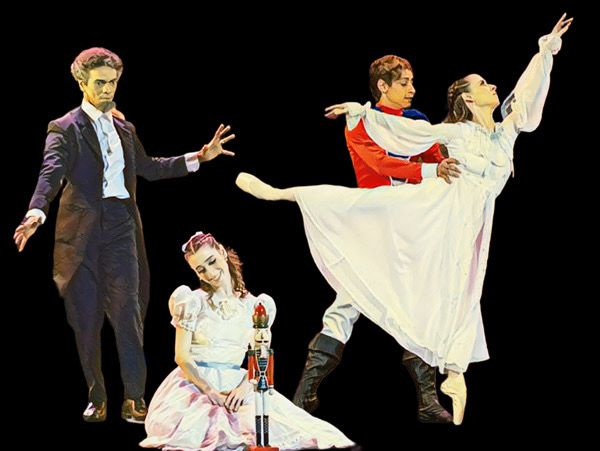
Trying to count how many versions of The Nutcracker have been staged over the years is an impossible task. Since its premiere in 1892, the ballet has become a global phenomenon spanning more than 130 years. Still, the current version by the Ballet of the Theatro Municipal of Rio de Janeiro has all the elements needed to establish itself as a tradition in its own right. Relatively recent, it replaces the long-standing production by Dalal Achcar — beloved and officially associated with the company for decades — but one that clearly called for renewal.
This becomes evident when we consider that while the Bolshoi Ballet continues to perform Grigorovich’s 1960s version and the New York City Ballet preserves Balanchine’s 1954 choreography, most companies reinvent narrative details to engage new audiences. Paradoxically, those two versions have defied time, but for artists who repeat the Christmas ritual year after year, the desire for new challenges is not only understandable — it is necessary. Not all experiments succeed, of course.
At the Municipal, Hélio Bejani and George Teixeira introduced subtle narrative and choreographic adjustments designed to highlight the remarkable development of the male corps de ballet. This focus had already become clear in Swan Lake — traditionally a female-centered ballet, but one whose first and third acts allowed for greater balance — as well as in Le Corsaire and Frida. In The Nutcracker, where solos and moments of prominence are naturally embedded, this investment becomes even more visible.

Importantly, this emphasis does not come at the expense of the female dancers, but in harmony with them. The women remain spectacular, continuing to renew the company’s constellation of stars. Until recently, however, the men often struggled to form a truly cohesive ensemble. Talent existed, but not a group identity. Witnessing the technical strength and cohesion of this new generation is genuinely thrilling.
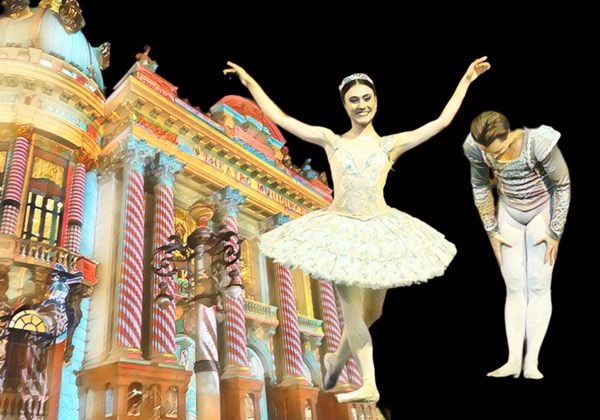
More than a ballet, The Nutcracker has become a true city event at the Theatro Municipal — a Christmas gift to Rio. The season began in early December and runs through the 28th, allowing different casts to shine across performances, enhanced by beautifully designed projections that complete the festive atmosphere.
I attended the final performance before Christmas, on December 23rd, with Manuela Roçado as the Sugar Plum Fairy and Rodrigo Hermesmeyer as the Cavalier. Both captivated the audience, who responded enthusiastically to the production, the sets, and the dazzling costumes.
Since 2024, the BTMRJ version has also introduced a narrative adjustment by adding the character of Klaus, an orphan and nephew of Drosselmeyer, a mysterious clockmaker and toy inventor. After creating a trap that exterminates half of the mice in the kingdom, Drosselmeyer becomes the target of revenge by the Mouse King, who kidnaps his nephew and casts a spell that prevents the uncle from recognizing him, leaving the boy in an orphanage. On Christmas nights, Klaus transforms into the Nutcracker doll. The spell can only be broken if the Nutcracker defeats the Mouse King — a moment made possible by Clara Stahlbaum, Drosselmeyer’s goddaughter. The audience, filled with children, responds warmly to each scene, reminded that the innocence of The Nutcracker remains irresistible.
The technical precision of Manuela and Rodrigo deserves special mention. As my niece jokingly remarked, “they only have ten minutes — but they’re the most physically and technically exhausting ten minutes of the entire ballet.” Their combination of accuracy and delicacy feels truly magical. Seeing Marcela Borges and Alyson Trindade again — here as the Snow Queen and Snow King — after their standout performances in Le Corsaire was another highlight of the evening.
After Christmas, the Ballet of the Theatro Municipal returns for a few final performances, closing the season on December 28th. Tickets are sold out, but there is no need for concern: The Nutcracker is already confirmed for the 2026 calendar. The audience always asks for more. And so, gradually, Rio de Janeiro continues to reclaim — and reaffirm — its tradition.
Descubra mais sobre
Assine para receber nossas notícias mais recentes por e-mail.
 miscelana.com