
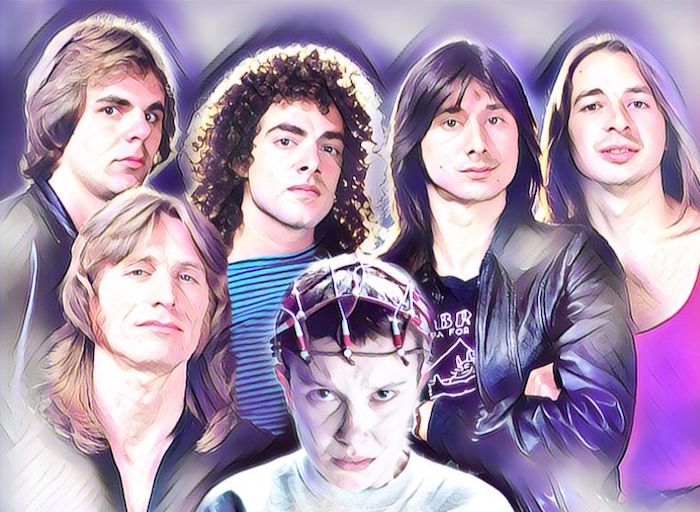
Stranger Things revived Running Up That Hill in an almost mythical way, turning Kate Bush into the soundtrack of a generation that did not live through the 1980s. Over the years, the series also brought back bands like Journey and Deep Purple in its trailers, but it was with Heroes, by David Bowie, over the end credits — visually echoing the epic solemnity of Peter Jackson’s The Lord of the Rings — that the show said goodbye, for now, to its fans. The choice is not merely aesthetic or nostalgic.


“Heroes” is not a song about defeating monsters, vanquishing villains, or saving the world. Paradoxically, it is a song about a minimal, intimate, almost invisible kind of heroism. About two people who, for a moment, dare to be stronger than the reality that surrounds them. In a world saturated with grandiose rhetoric and epic promises, perhaps that is precisely why it resonates so powerfully today.
The song was written in 1977, during the period when Bowie was living in West Berlin, immersed in what would later be known as his “Berlin trilogy” — Low, “Heroes”, and Lodger — alongside Brian Eno and producer Tony Visconti. The city was not merely a backdrop; it was a concept. Divided by a wall and charged with political, ideological, and emotional tension, Berlin offered Bowie something he was seeking at that point in his life: distance from the chaos of Los Angeles, where cocaine addiction and creative isolation had nearly destroyed him, and an urban landscape that mirrored his own inner fragmentation.
The story behind the song is well known, but never banal. Bowie wrote “Heroes” inspired by a real episode: looking out of the window of the Hansa studio, located just a few meters from the Berlin Wall, he saw Tony Visconti kissing a woman by the barrier that separated East from West. The woman was Antonia Maass, a backing vocalist on the album and, at the time, involved with Visconti even though both were in other relationships. The gesture, simple and risky, became the emotional core of the song. It was not merely lovers defying a personal circumstance, but an act of intimacy in one of the most heavily surveilled and symbolically charged spaces on the planet.
Musically, “Heroes” was also born out of experimentation. Brian Eno built the sonic landscape with synthesizers and electronic treatments that expanded rock’s ambition beyond its traditional form. Visconti devised a system of microphones placed at varying distances from Bowie’s voice, which gradually opened as he sang more loudly, capturing not only the performance but the very architecture of the studio. The result is an interpretation that grows in intensity, as if the song were literally gaining physical space as Bowie approaches the climax. It is a technique in the service of emotion, sound engineering transformed into dramaturgy.

The lyrics, in turn, are deliberately simple. “We can be heroes, just for one day.” There is no promise of eternity, glory, or total redemption. There is only an instant. One day. One gesture. Bowie never romanticizes definitive victory; he offers temporary resistance. And it is precisely this refusal of grandiose heroism that makes the song so powerful. In a world of walls — physical, political, emotional — being a hero for a single day is already an act of courage.
When released, “Heroes” was not an immediate chart success. It reached modest positions in the UK and went almost unnoticed in the United States. Critics, however, recognized its singularity early on, and the song began to build its reputation not through rapid consumption but through cultural sedimentation. Over time, it became one of the most emblematic tracks of Bowie’s career, alongside “Space Oddity,” “Life on Mars?,” “Let’s Dance,” and “Changes,” a quintet that today defines, for the general public, the heart of his legacy.
The journey of “Heroes” over the decades is revealing. It has been covered by artists from completely different worlds: U2 turned it into an arena anthem; Peter Gabriel reinterpreted it in a more introspective register; Depeche Mode absorbed it into the electronic imagination; Motörhead carried it into hard rock territory; Oasis used it as an emotional reference in shows and interviews. Each version reveals a different facet of the same idea: the song is elastic, but it never loses its center. It does not belong to a specific genre. It belongs to a feeling.

In film and television, “Heroes” has accumulated appearances that reinforce its status as a classic. It is in Christiane F. (1981), a film that crystallized post-punk Berlin and the lost youth of the era; in The Perks of Being a Wallflower, as the soundtrack to a moment of youthful liberation; in Moulin Rouge!; in Requiem for a Dream; in commercials, ceremonies, state funerals, and sporting events. In 2012, it opened the closing ceremony of the London Olympics as an emotional synthesis of a modern British cultural identity: vulnerable, creative, resilient.
None of this, however, fully explains why “Heroes” resonates so strongly now. Perhaps because we are once again living in a world of walls — not only geopolitical, but symbolic: polarization, culture wars, collective anxiety, technological isolation. Perhaps because, in times of moral exhaustion and disbelief in grand narratives, the idea of a possible heroism, however brief, sounds more honest than any promise of total redemption. “Heroes” does not say that love conquers everything. It says that, for a moment, it can defy the impossible. And that, for those living in 2026, is no small thing.
It is at this point that Stranger Things’ choice gains symbolic density. The series, which has always drawn on the pop mythology of the 1980s, could have closed its arc with a song of triumph. Instead, it opted for a song of active melancholy, of hope without naïveté. By using “Heroes,” at the suggestion of actor Joe Keery (Steve Harrington), the series seems to say: we did not win because we are invincible; we won because, despite everything, we chose to stay.

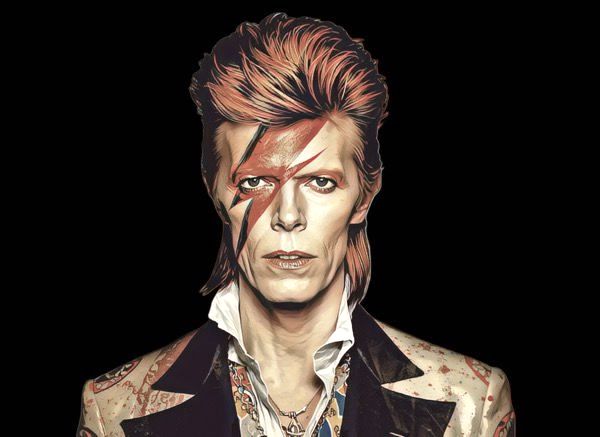
On January 8, 2026, “Heroes” turns 49. Two days later, on January 10, it will be ten years since David Bowie’s death. The coincidence of dates is not merely chronological; it is symbolic. Bowie built an entire career on transformation, on the refusal of fixed identities, on the courage to reinvent himself when the world seemed to demand conformity. “Heroes” condenses that philosophy into four minutes: art as an act of resistance, love as a political gesture, vulnerability as a form of strength.
Today, alongside “Space Oddity,” “Life on Mars?,” “Let’s Dance,” “Changes,” and “Heroes” are among Bowie’s five most famous and emblematic songs. But perhaps it is more than that. Perhaps it is the one that best explains why his work remains alive, covered, reinterpreted, and reappropriated by new generations. Because, in a time when being a hero seems to require impossible feats, Bowie reminds us that sometimes all we have is a day. A gesture. A kiss at the edge of a wall. And still, that is enough to change everything.
Descubra mais sobre
Assine para receber nossas notícias mais recentes por e-mail.
 miscelana.com